
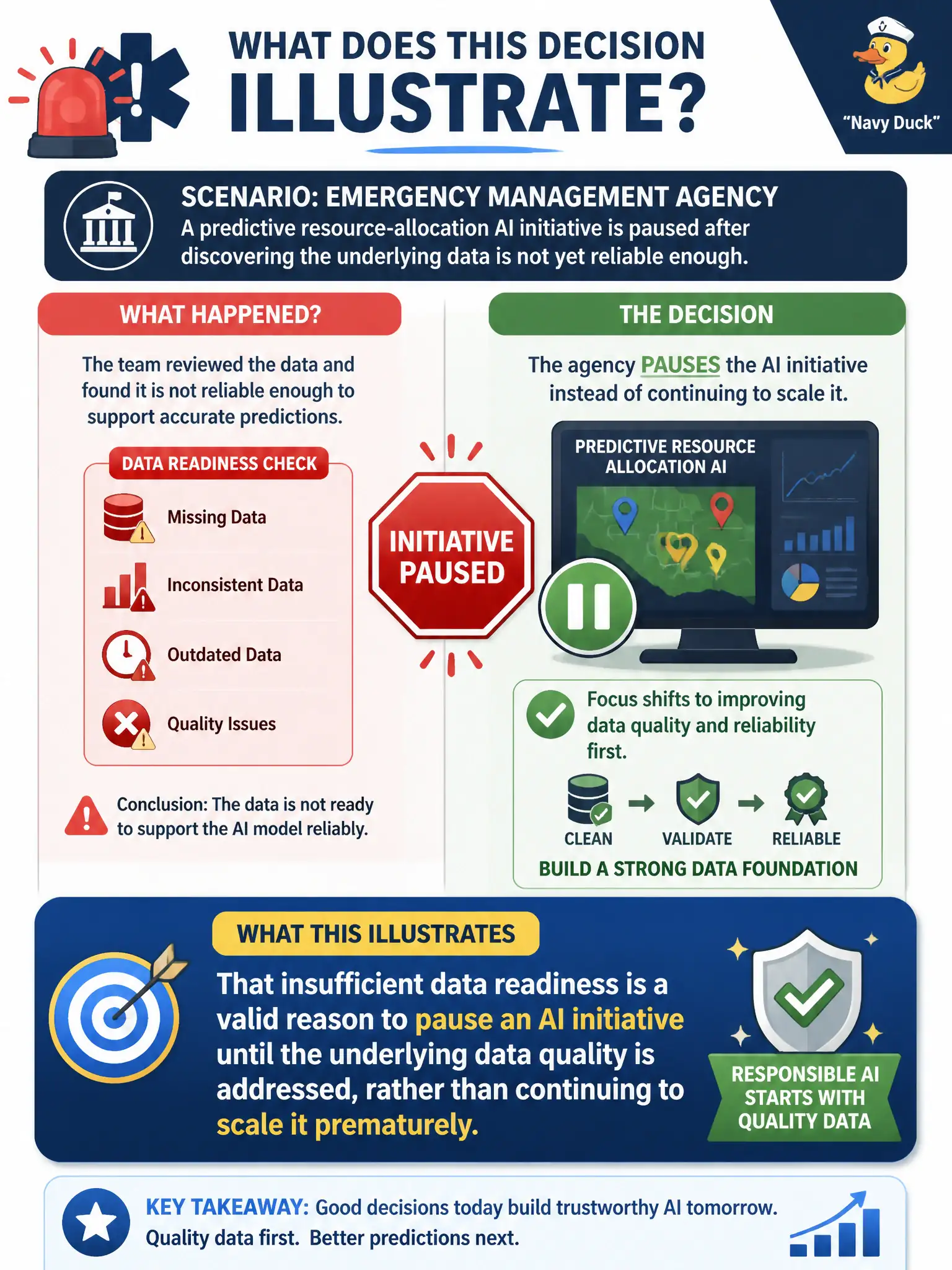
An emergency management agency pauses a predictive resource-allocation AI initiative after discovering its underlying data is not yet reliable enough to support it. What does this decision illustrate?
Select an answer to reveal the explanation.
Short Explanation
Scaling up a resource-allocation tool on shaky data is like handing out sandbags based on a flood map you know is outdated. Pausing to fix the data first isn't giving up, it's making sure the next version actually points crews where they're needed.
Full Explanation
Pausing an initiative when its underlying data isn't yet reliable is a sound response to insufficient data readiness, since a resource-allocation model trained on unreliable data would produce unreliable allocation decisions during an actual emergency, when the cost of a bad call is highest. Pausing buys time to address the data quality issue directly, rather than compounding the problem by scaling a system whose foundation isn't solid yet. Claiming AI initiatives should always continue scaling regardless of data quality ignores that data readiness is a legitimate gating factor precisely because model reliability depends on it; scaling anyway just scales the unreliability along with it. Restricting valid pause reasons to budget exhaustion overlooks that data-quality concerns are just as legitimate a trigger, arguably more urgent for a system meant to guide emergency response. Assuming the initiative must be terminated permanently overstates the severity of a data-quality issue that is, in most cases, fixable through targeted data-improvement work rather than a dead end requiring the whole initiative be scrapped. As a concrete next step, the agency should define specific data-quality criteria, such as completeness and consistency thresholds, that must be met before resuming, since an open-ended pause without clear resumption criteria risks the initiative stalling indefinitely instead of actually being revisited.