
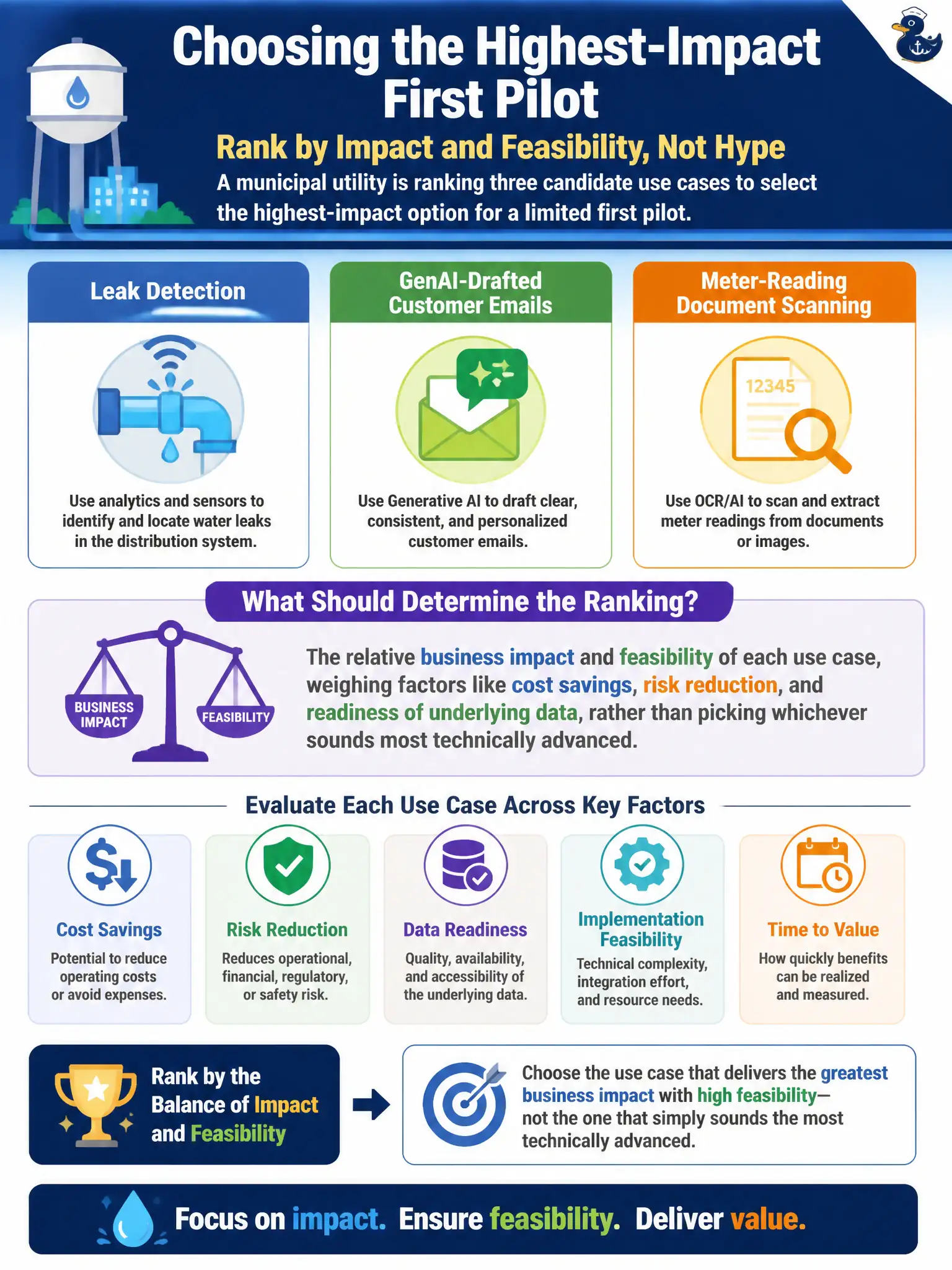
A municipal utility is ranking three candidate use cases, leak detection, GenAI-drafted customer emails, and meter-reading document scanning, to select the highest-impact option for a limited first pilot. What should determine the ranking?
Select an answer to reveal the explanation.
Short Explanation
Three ideas on a whiteboard all sound plausible until you actually weigh what each one saves you, how risky it is, and whether the data behind it is even ready. Rank them on that evidence, not on which one sounds the most cutting-edge.
Full Explanation
Prioritizing candidate use cases requires comparing their relative business impact and feasibility, factors like projected cost savings, risk reduction such as preventing costly water loss from undetected leaks, and whether the underlying data is actually ready to support each use case, rather than defaulting to whichever sounds newest or most exciting. A first pilot with limited resources needs the strongest realistic return, and that's determined by this kind of comparative analysis, not by intuition about which technology seems more advanced. Choosing based on public communication ease substitutes optics for actual value; a use case that's easy to explain isn't necessarily the one that saves the most money or reduces the most risk. Assuming GenAI is inherently higher-impact than other AI types is a category error, since impact depends on the specific business problem being solved, not which technical approach is used; a well-targeted predictive system like leak detection can outperform a generative one on real-world value. Running all three simultaneously ignores the stated resource limitation and dilutes attention rather than concentrating it where evidence points to the strongest return. Before selecting, the utility should build a simple side-by-side comparison of each use case's estimated cost savings, risk reduced, and data readiness, since a ranking made without that comparison is really just a guess.