
A housing authority plans to move its spreadsheet-based, rule-based fraud-flagging process onto an AI platform. What should it evaluate before making that transition?
Select an answer to reveal the explanation.
Short Explanation
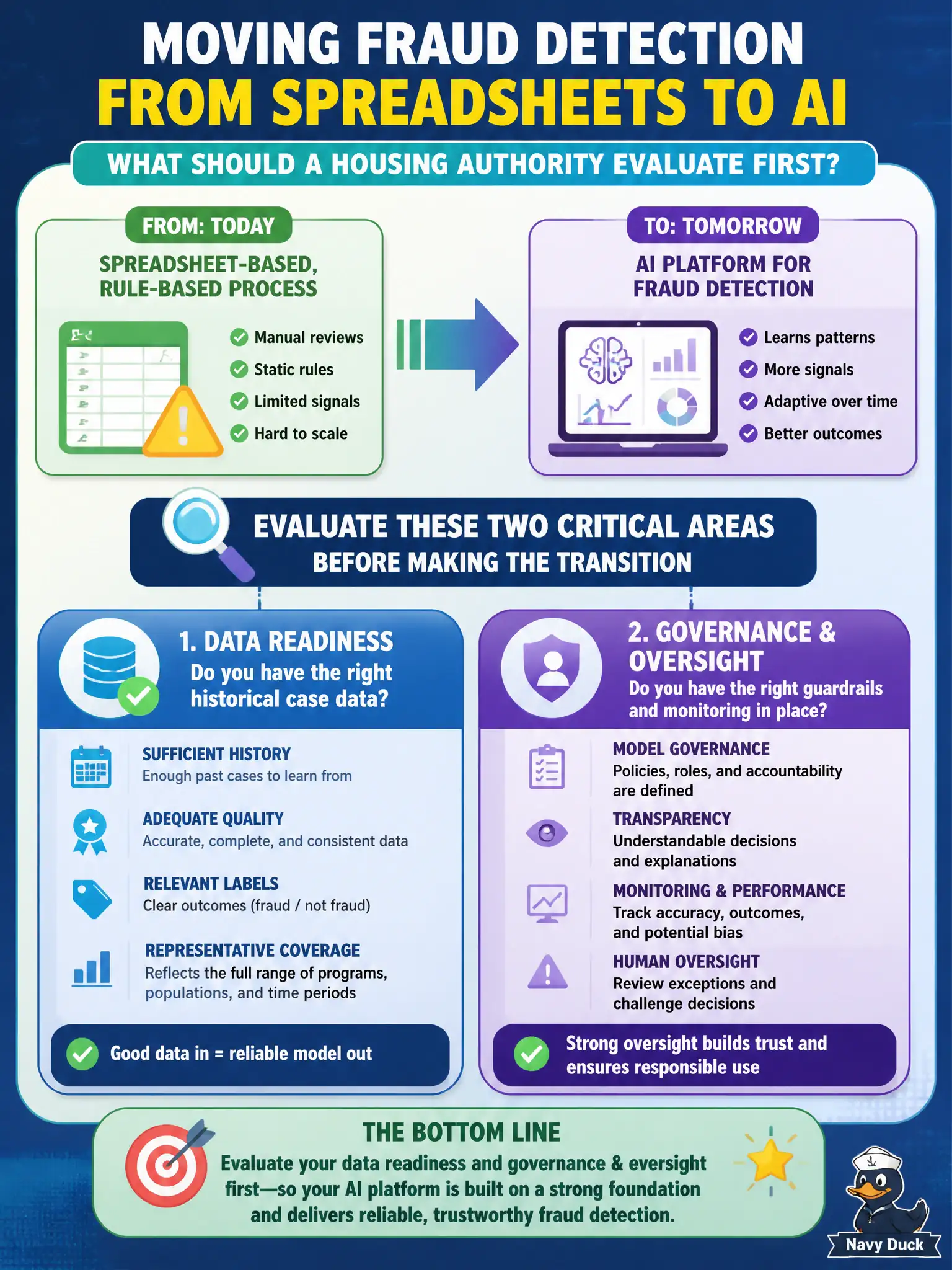
Moving from fixed rules to a learning model isn't a lateral move, it's swapping a system that does exactly what you told it for one that has to be fed good history and then watched. Before you flip the switch, make sure both the data and the oversight are actually ready for that.
Full Explanation
Transitioning from rule-based automation to an AI model changes the fundamental mechanism behind the flagging decisions, from explicit rules a person wrote to patterns learned from historical case data, which means the authority needs enough historical fraud cases of adequate quality to train something reliable, plus governance structures to monitor what the new model actually decides once live. Skipping that evaluation risks deploying a model trained on thin or biased historical data, with no one watching for problems in its output. Focusing only on whether existing spreadsheet rules transfer into the new platform's configuration misunderstands the nature of the change entirely; an AI platform doesn't run copied rules, it learns its own patterns, so that check misses the real readiness question. Reducing the decision to subscription cost versus spreadsheet maintenance ignores the substantive risk and readiness factors at stake in how fraud decisions get made and reviewed. Evaluating only dashboard appearance treats a consequential change in decision-making mechanism as a cosmetic preference, which trivializes what's actually being decided. As a concrete check, the authority should pull a sample of the model's flagged cases once piloted and have staff manually verify a portion against the old rule-based outcomes, since that comparison is the clearest evidence of whether the new system is actually more reliable than what it's replacing.