
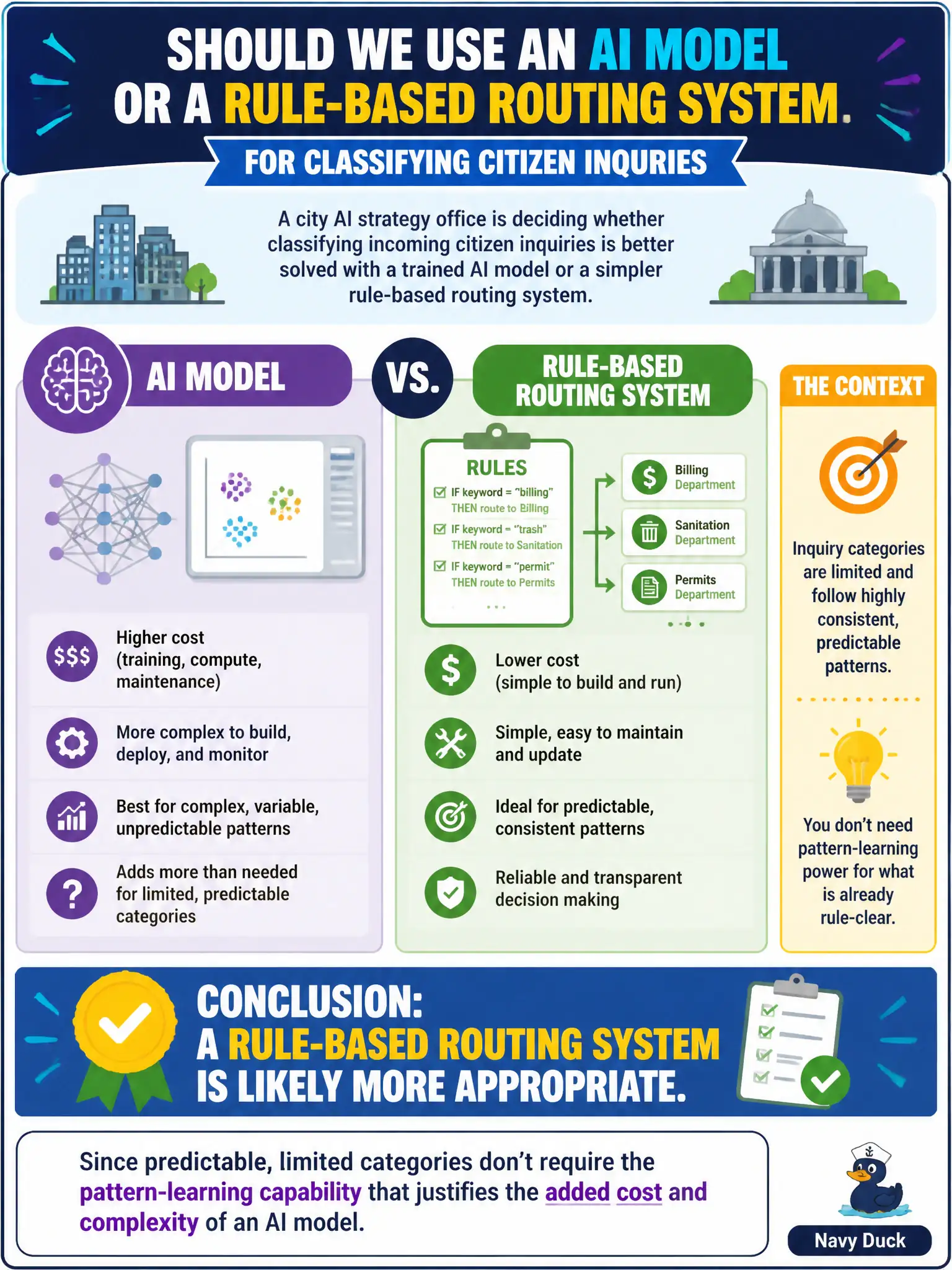
A city AI strategy office is deciding whether classifying incoming citizen inquiries is better solved with a trained AI model or a simpler rule-based routing system, given that the inquiry categories are limited and follow highly consistent, predictable patterns. What should the office conclude?
Select an answer to reveal the explanation.
Short Explanation
If the mail always sorts itself into the same handful of predictable slots, you don't need a whole sorting machine that has to learn as it goes, a set of clear if-this-then-that rules does the job just fine. Save the AI model for the messier problems where the patterns aren't so tidy.
Full Explanation
When inquiry categories are limited and follow consistent, predictable patterns, a rule-based routing system can classify them reliably without the added cost, data requirements, and ongoing maintenance that a trained AI model brings. AI earns its keep when patterns are too complex or variable for explicit rules to capture; a small, stable set of categories doesn't present that complexity, so the simpler tool is the better fit. Insisting an AI model is always superior ignores that appropriateness depends on the problem's actual complexity, not on which tool sounds more advanced; a model here would add cost without adding accuracy. Claiming neither approach works and only manual review is viable overlooks that the described conditions, limited and predictable categories, are exactly where automated rule-based classification performs well. Dismissing rule-based systems as impossible to update is simply inaccurate; rules can be revised whenever category patterns change, which for a small stable set is infrequent anyway. Before building either option, the office should document the actual inquiry categories and confirm how often new, unpredictable ones appear, since a rising rate of unclassifiable inquiries would be the signal that a rule-based system has outgrown its usefulness.