
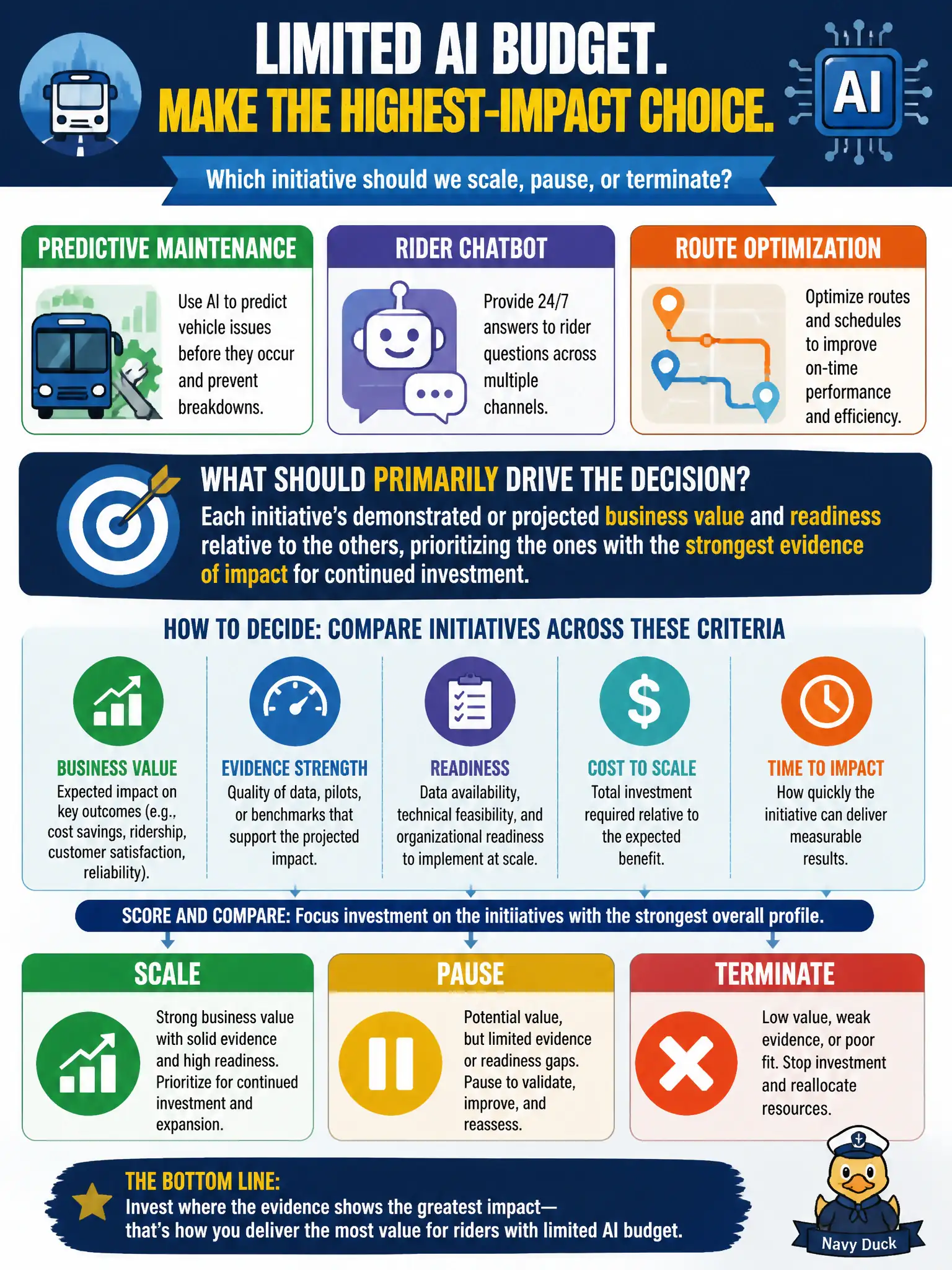
A transit authority with a limited AI budget must decide which of three proposed initiatives, predictive maintenance, a rider chatbot, and route optimization, to scale, pause, or terminate. What should primarily drive this decision?
Select an answer to reveal the explanation.
Short Explanation
With a limited budget, you're not rewarding effort or seniority, you're funding whichever initiative is actually proving its worth. Let the evidence of impact pick the winner, not who got there first.
Full Explanation
Scale, pause, and terminate decisions under budget constraints should rest on each initiative's demonstrated or projected business value and readiness compared against the others, since limited funds mean continued investment has to go where the evidence of impact is strongest. That comparison typically weighs measured outcomes so far, such as maintenance cost savings, chatbot deflection rates, or route-efficiency gains, against how ready each initiative is to scale without major additional investment. Automatically scaling whichever project was proposed first rewards timing rather than performance, and has nothing to do with which initiative is actually delivering value. Scaling all three simultaneously to avoid favoritism ignores the stated budget constraint entirely and spreads limited resources thin instead of concentrating them where they'll do the most good. Choosing based on which uses the newest technology confuses novelty with business impact; a technically impressive system that hasn't demonstrated measurable value is a weaker candidate than a simpler one with proven results. Before finalizing the decision, the authority should pull whatever baseline metrics exist for each initiative, such as cost avoided or rider satisfaction change, since a scale decision made without comparable metrics across all three initiatives is really just a guess dressed up as a prioritization.