
A state agency's contractor explains why unstructured grant-application narrative text needs different preparation than a structured applicant database before either can feed an AI screening tool. What is the core reason?
Select an answer to reveal the explanation.
Short Explanation
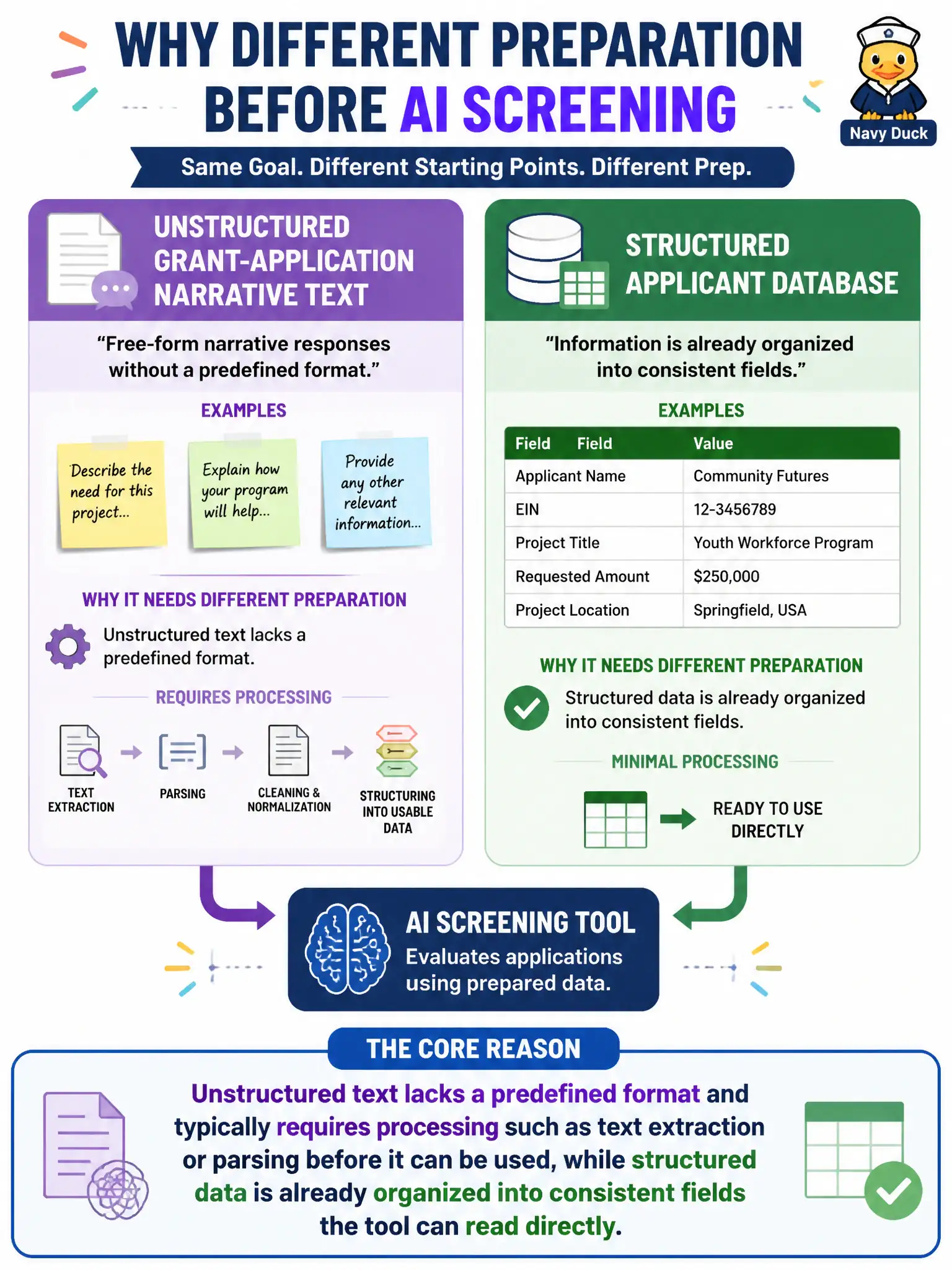
The applicant database already comes pre-sorted into neat labeled boxes, ready to go, but the grant narratives are more like a stack of loose essays someone has to actually sort and tag first. That prep gap is exactly what "structured" versus unstructured is about.
Full Explanation
Structured data, such as a database of applicant names, funding amounts, and dates, is already organized into consistent, predictable fields, so a screening tool can read it directly with little additional work. Unstructured text, like grant-application narratives written in free-form prose, has no such predefined format, so it needs processing, such as extraction or parsing, before a tool can reliably use its content. This gap directly affects project timelines and cost, since incorporating narrative text into a screening tool adds a preparation step that a purely structured dataset doesn't require. Claiming structured data needs more preparation because it must be converted to free text reverses the actual relationship; conversion effort flows the other way, from unstructured toward something more usable, not the reverse. Assuming both types need identical preparation once digitized ignores that being stored in the same system says nothing about whether the content itself follows a consistent schema. Believing unstructured text needs no preparation at all overlooks that raw narrative text, without extraction or parsing, is difficult for most screening tools to use reliably. Before scoping the AI screening effort, the contractor should confirm what specific extraction step, such as identifying key criteria mentioned in each narrative, the tool actually needs performed on the unstructured text first.