
A city manager's office reviewing a permitting-AI vendor pitch needs to correctly sort the vendor's loose use of "algorithm," "model," and "inference" before signing a contract. Which mapping is correct?
Select an answer to reveal the explanation.
Short Explanation
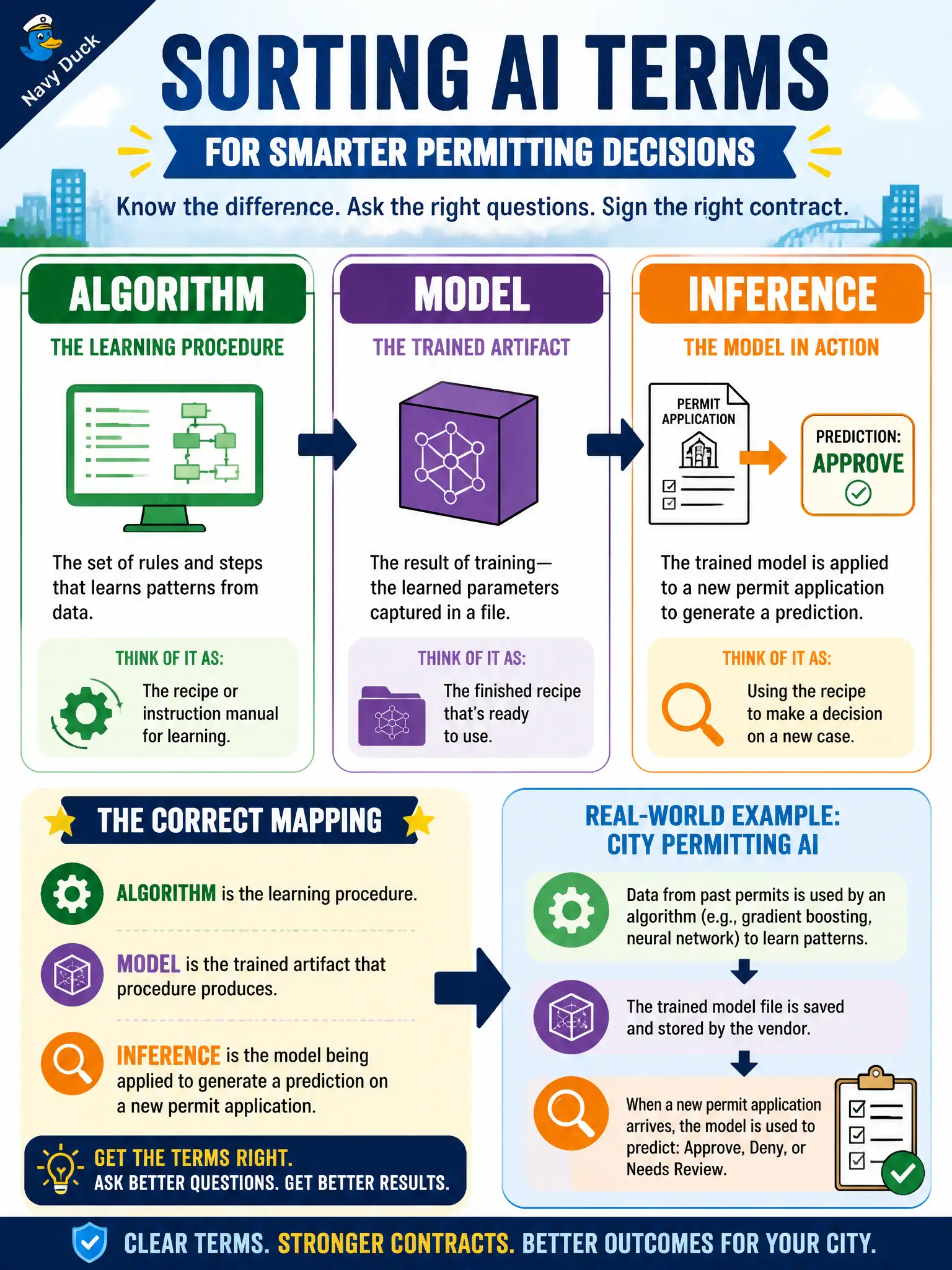
It's a three-step chain: the algorithm is the method, the model is what you get after that method chews through the city's past permit data, and inference is the model finally doing its job on today's new application. Get the order of that chain wrong and you'll misread everything the vendor tells you next.
Full Explanation
The algorithm is the general, reusable procedure for learning patterns from data; the model is the specific, trained result produced once that algorithm has run on the office's own historical permit data; and inference is what happens when that trained model is applied to a brand-new permit application to produce a decision or score. Keeping this chain straight matters directly for the contract, since a vendor claiming strong performance needs to specify whether they mean the algorithm's general track record elsewhere or this office's actual trained model's performance on local data. Reversing algorithm and model swaps the general method for the specific trained outcome, and the reverse. Claiming both terms mean the finished system while inference is just customer support strips all three words of their real technical meaning and hides what's actually being evaluated. Casting inference as the learning procedure and algorithm as a staff report scrambles the entire pipeline, putting the prediction step before the learning step. Before signing, the office should ask the vendor to show inference results specifically from the model trained on this city's own permit history, since a demo running on a different jurisdiction's model doesn't prove how this office's data will perform.