
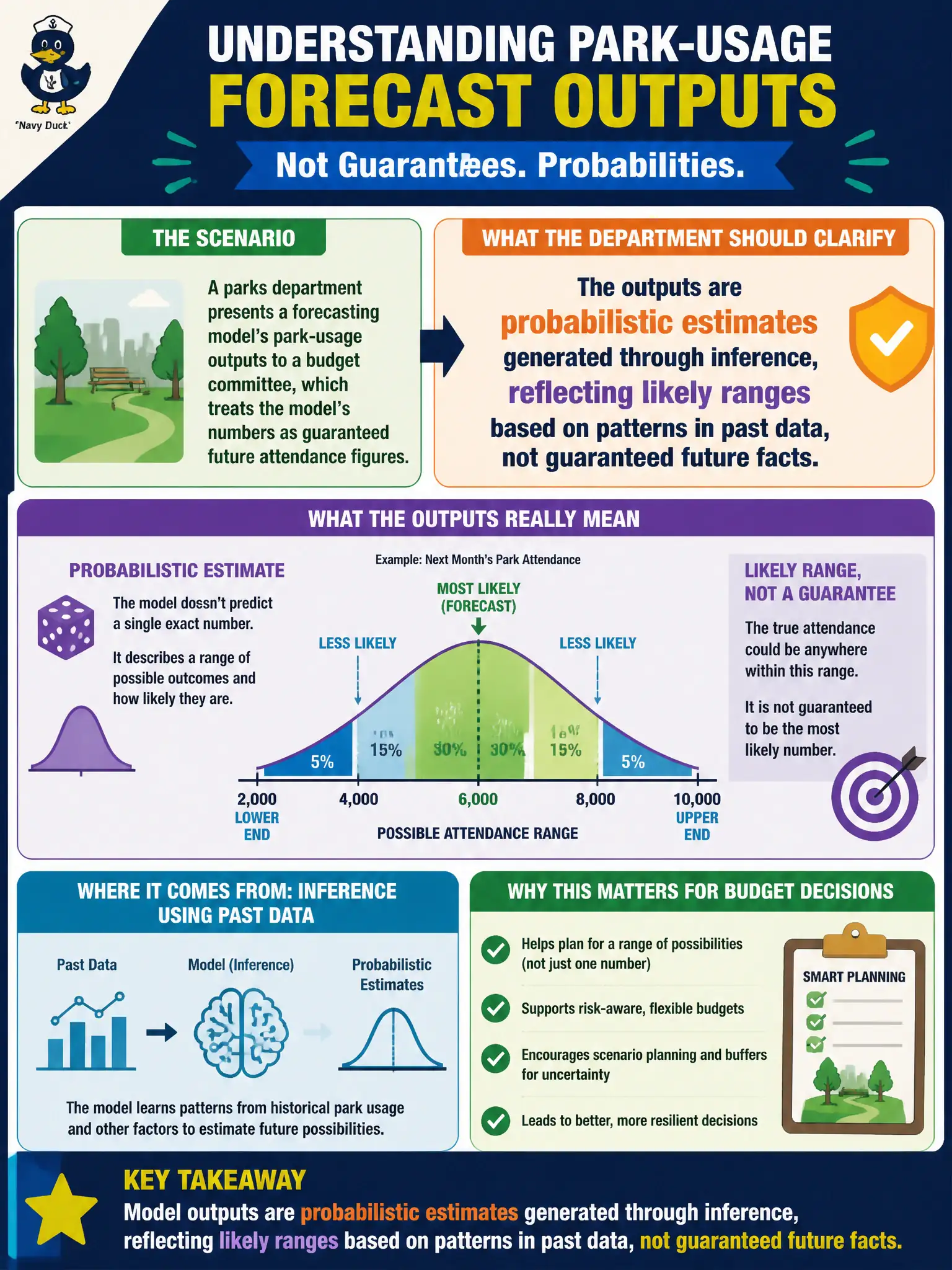
A parks department presents a forecasting model's park-usage outputs to a budget committee, which treats the model's numbers as guaranteed future attendance figures. What should the department clarify about these outputs?
Select an answer to reveal the explanation.
Short Explanation
A weather forecast saying 70 percent chance of rain isn't a promise it will rain, it's the model's best read on the odds. Park-usage predictions work the same way: they're probabilistic estimates from inference, not a guarantee stamped in advance.
Full Explanation
Model outputs generated through inference are probability-based estimates: the model applies patterns learned during training to new inputs and produces a likely range or best guess, not a certainty. A park-usage forecast, like a weather forecast, reflects the balance of historical patterns rather than a locked-in future outcome, and presenting it otherwise sets the budget committee up to over-trust a single number. Tying guaranteed accuracy to a full year of training data confuses having sufficient data with having certainty; more data can improve reliability, but inference remains probabilistic regardless of training-set size. Claiming outputs become guaranteed after six months in production similarly conflates operational maturity with statistical certainty; time in production doesn't convert an estimate into a fact. Attributing guaranteed accuracy simply to the output coming from an AI system rather than a manual estimate is a common but mistaken assumption, since AI-generated numbers carry the same uncertainty any predictive estimate does, and in some cases a manual estimate grounded in local knowledge can be just as reasonable. When presenting these figures, the department should show the model's confidence range or margin alongside the point estimate, since a single number with no stated uncertainty is the easiest way to get mistaken for a guarantee.