
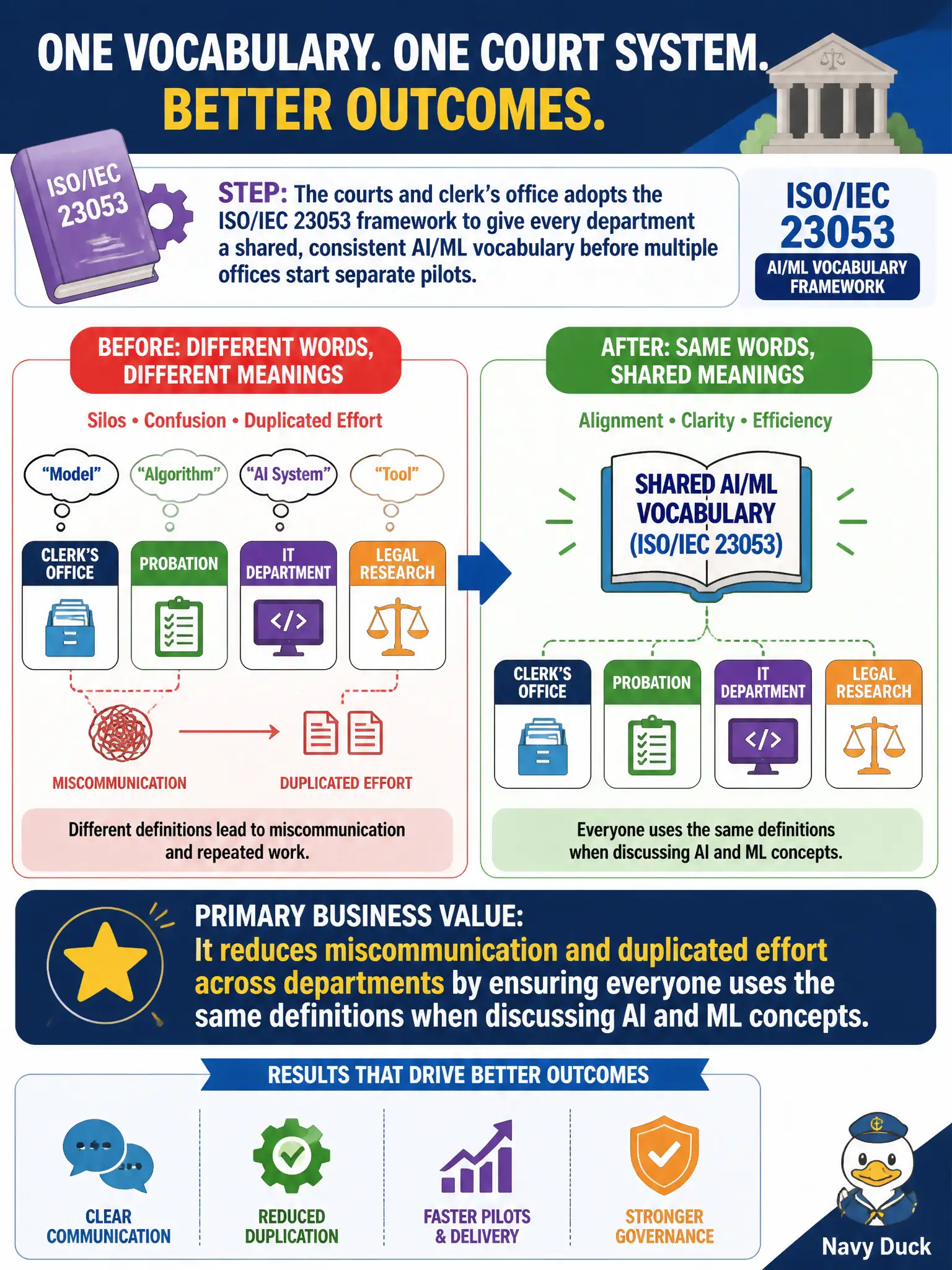
A courts and clerk's office adopts the ISO/IEC 23053 framework to give every department a shared, consistent AI/ML vocabulary before multiple offices start separate pilots. What is the primary business value of this step?
Select an answer to reveal the explanation.
Short Explanation
Imagine three courthouse departments each building an AI pilot, but each one means something slightly different when they say "model." A shared vocabulary like ISO/IEC 23053 is what gets everyone reading from the same glossary, so a clerk's office and a records team actually understand each other before either writes a line of a project plan.
Full Explanation
ISO/IEC 23053 provides a common AI/ML framework and terminology, so when the clerk's office, records team, and case-management staff each start a pilot independently, they describe their systems using the same definitions of terms like model, training, and inference. That shared baseline reduces the miscommunication and duplicated effort that happens when departments unknowingly use the same words to mean different things, which is especially costly once pilots need to be compared, consolidated, or reviewed together. Claiming the framework certifies freedom from bias overstates its scope; a vocabulary standard doesn't audit or guarantee model fairness. Assuming it forces every department onto the same algorithm and vendor misreads a terminology framework as a procurement mandate, which it isn't. Believing it replaces a governance charter confuses vocabulary with authority; a shared glossary helps people talk about AI consistently, but it doesn't grant anyone approval power over new pilots. Before departments proceed, the office should check that each pilot's project documentation actually uses the adopted terminology consistently, since adopting a framework on paper doesn't automatically change how staff describe their own systems in practice.