
A housing authority drafting its first internal AI governance charter cites ISO/IEC 42001 as the reference standard. What does ISO/IEC 42001 actually establish?
Select an answer to reveal the explanation.
Short Explanation
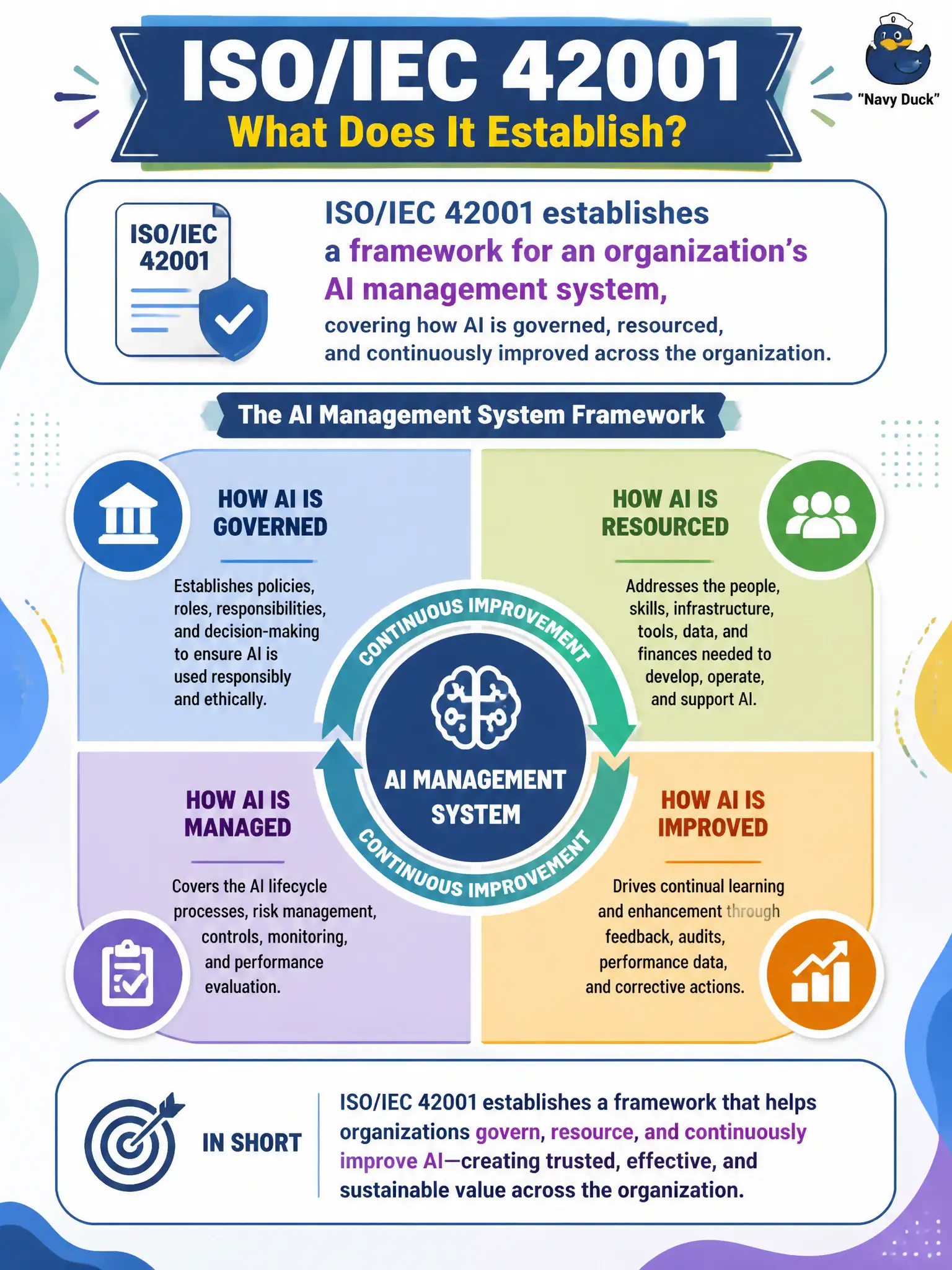
Think of ISO/IEC 42001 less like a rulebook for building a single model and more like the org chart and operating manual for how your whole housing authority manages AI over time. It's a management-system standard, so it's about governance structure, not model math.
Full Explanation
ISO/IEC 42001 defines requirements for an organization-wide AI management system: how leadership assigns accountability, how AI-related risks are assessed and reviewed, how policies get updated, and how the organization continuously improves its AI practices over time. It sits at the governance layer, not the modeling layer, which is exactly why a housing authority cites it in a charter rather than in a technical build document. Framing it as a technical specification for training and validating models confuses a management-system standard with an engineering standard; ISO/IEC 42001 doesn't prescribe algorithms or validation metrics. Treating it as a data-quality standard with accuracy thresholds misplaces it entirely, since data-quality benchmarks are a narrower, technical concern the standard doesn't set numeric requirements for. Calling it a privacy regulation conflates governance guidance with binding law; ISO/IEC 42001 is a voluntary management framework, not a legal data-protection statute, even though responsible data handling can be one element it asks an organization to govern. Before finalizing the charter, the authority should check whether the document actually assigns named accountability for AI decisions and a review cadence, since a charter that only lists principles without governance structure hasn't really implemented what the standard calls for.