
A municipal utility explains to its board why a billing-threshold alert system counts as rule-based automation, while a proposed leak-prediction system is a genuine AI solution. What is the key difference between the two?
Select an answer to reveal the explanation.
Short Explanation
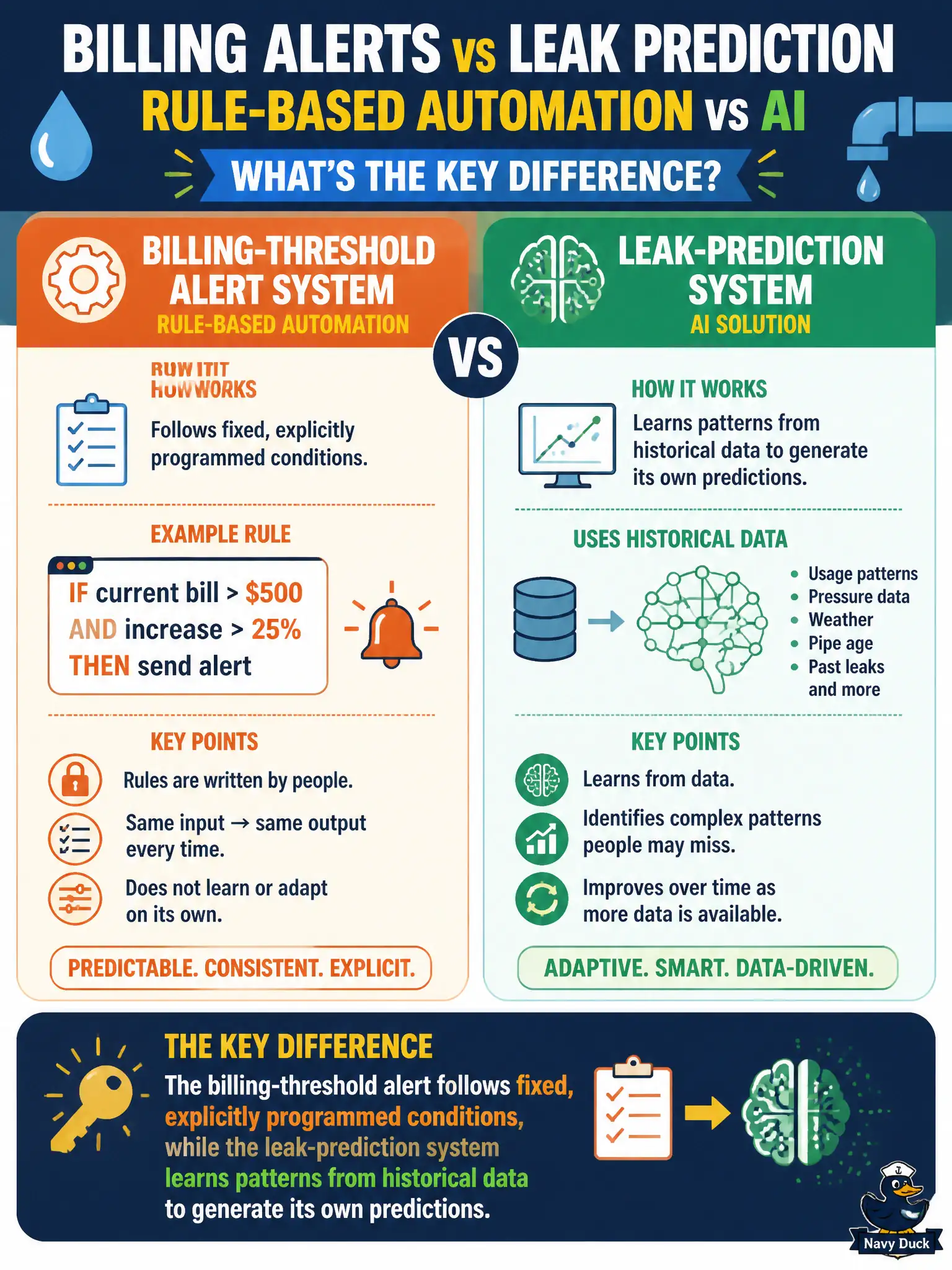
The billing alert is like a thermostat: if the number crosses a line someone set, it fires, every single time, no exceptions. The leak-prediction system is different because it learns its own sense of what "normal" looks like from historical data, which is what actually earns it the AI label.
Full Explanation
Rule-based automation runs on explicitly programmed conditions written by a person, such as "flag any bill 200 percent above the account's average," and it applies that fixed rule identically every time regardless of context. A genuine AI solution, like the leak-prediction system, instead learns patterns from historical data, such as pressure readings and past leak events, and uses those learned patterns to generate its own predictions about future risk rather than following a rule a person wrote. That difference in how the output is produced, not the outcome or the automation itself, is what separates the two categories. Framing the distinction around cost misses the point entirely; a rule-based system can be expensive to build and an AI system can be cheap, so cost doesn't determine the category. Claiming both count as AI because both run automatically without a human collapses the distinction between automation in general and AI specifically; automation is the broader umbrella, and rule-based systems are one form of it that isn't AI. Swapping the labels so sensor reliance makes a system rule-based misreads the criterion; using sensor data doesn't disqualify a system from learning patterns from it. Before presenting to the board, the utility should confirm whether the leak-prediction system was actually trained on historical data or is just applying a fixed pressure threshold under a different name.