
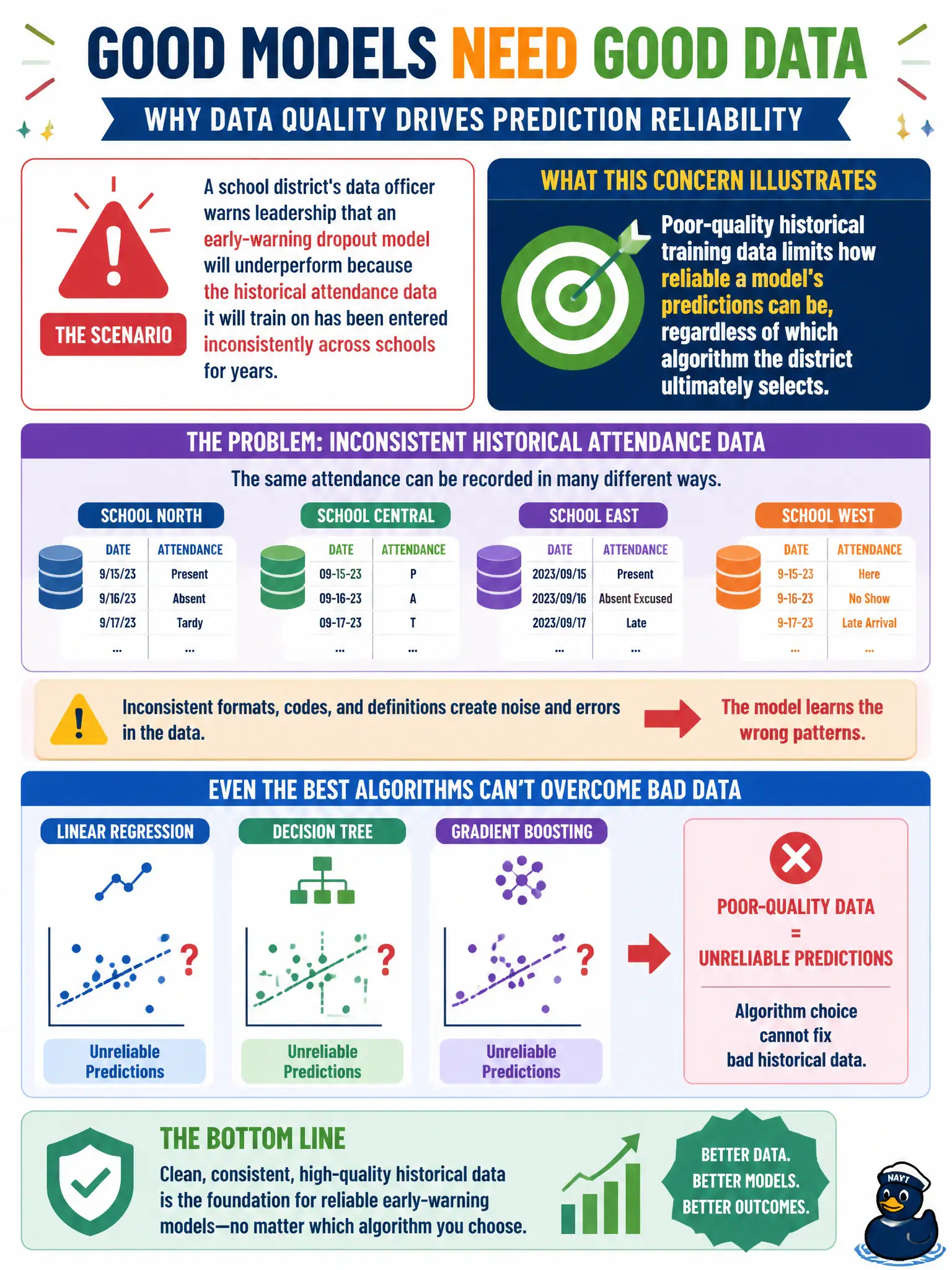
A school district's data officer warns leadership that an early-warning dropout model will underperform because the historical attendance data it will train on has been entered inconsistently across schools for years. What does this concern illustrate?
Select an answer to reveal the explanation.
Short Explanation
You can hand a world-class chef spoiled ingredients and the meal still won't come out right, no matter how good the recipe is. A model is the same way: feed it inconsistent attendance records and even the fanciest algorithm can't cook up reliable predictions from it.
Full Explanation
A model's reliability is capped by the quality of the data it learns from, because training extracts patterns from whatever history it's given, and inconsistent entry practices across schools mean the "pattern" the model learns partly reflects data-entry habits rather than real attendance behavior. That limitation holds no matter which algorithm processes the data, since no algorithm can distinguish a genuine attendance trend from noise introduced by inconsistent recording. Claiming modern algorithms fully correct for this overstates what algorithms do; techniques can reduce some noise but cannot manufacture accuracy the underlying records never had. Restricting the concern to generative AI misses that data-quality dependence applies just as much, if not more, to predictive models trained directly on structured historical records like attendance logs. Believing a more advanced algorithm alone fixes the problem skips the actual fix, which is improving how the data is collected and standardized in the first place. Before greenlighting the model, leadership should ask for a data-quality audit comparing entry practices across schools, since a model trained on data with wildly different recording standards per school will systematically mislearn which students are actually at risk.