
A transit authority planning a route-optimization initiative is sorting its available data sources before scoping the project: ridership counts stored in spreadsheets, and rider complaint narratives submitted as free text. How should the authority classify these two sources?
Select an answer to reveal the explanation.
Short Explanation
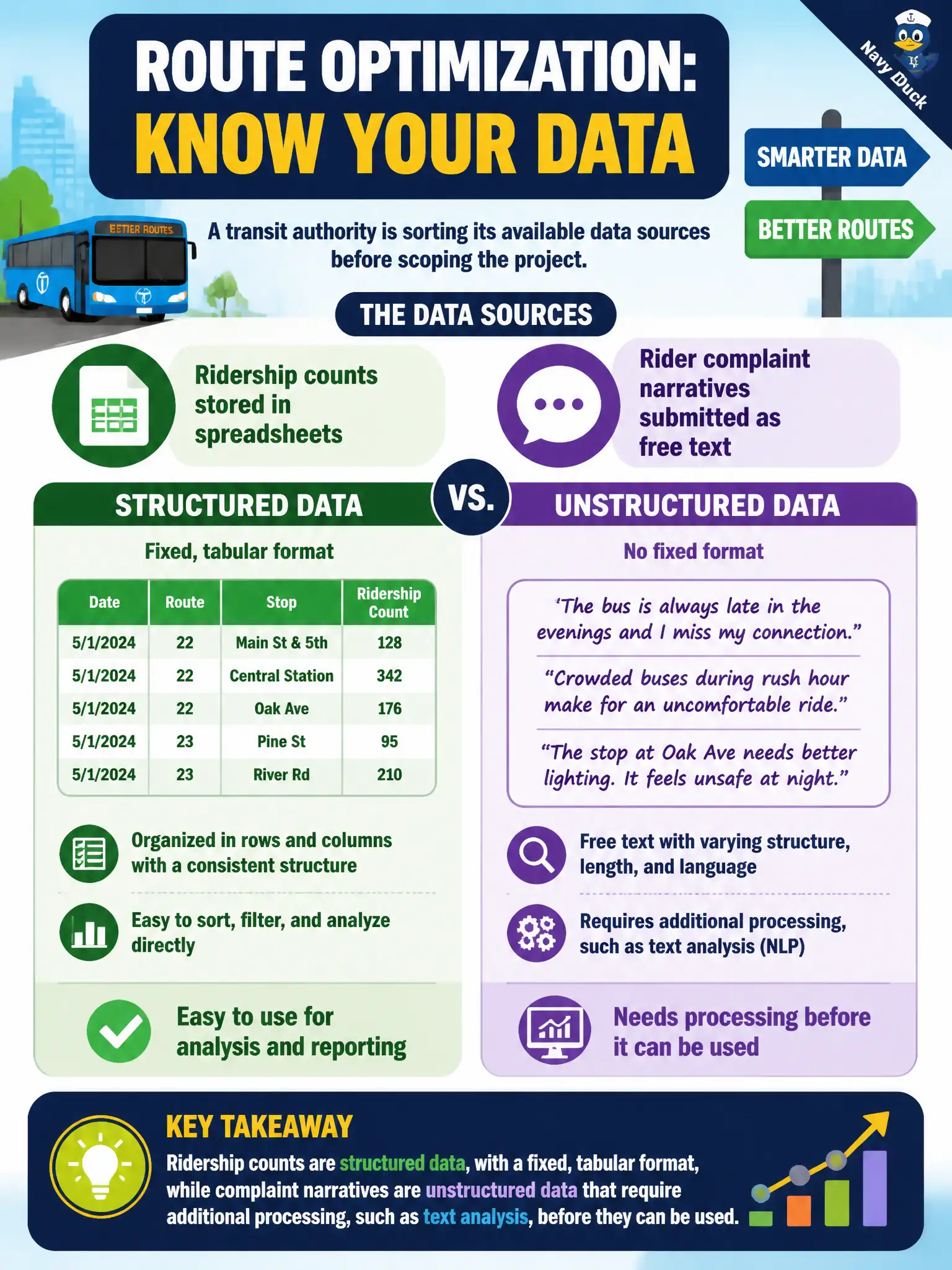
Ridership counts sit in neat rows and columns, so a computer can read them the moment they land, but a rider's complaint narrative is more like a letter someone wrote you; you have to actually read it before you know what it says. That gap in readiness is exactly what structured versus unstructured means.
Full Explanation
Structured data lives in a predictable, fixed format, such as ridership counts in labeled spreadsheet columns, which means a system can consume it directly without extra preparation. Unstructured data, like free-text complaint narratives, carries no predefined fields, so it needs processing such as text parsing or extraction before an AI or analytics tool can make use of it. That gap in readiness directly affects project scoping: a route-optimization effort built only on ridership counts can start sooner, while incorporating complaint narratives adds a text-processing step to the timeline. Calling both sources structured just because they're digital ignores that being stored electronically has nothing to do with whether the data follows a fixed schema; a scanned PDF and a spreadsheet are both digital but not equally structured. Swapping the labels, so ridership counts become unstructured and complaint forms become structured, misreads the actual format of each source rather than its content topic. Claiming the distinction disappears once both are uploaded to one platform ignores that uploading data doesn't change its underlying format; the platform still has to process the unstructured text separately. Before scoping, the authority should check whether the complaint narratives arrive as truly free text or as a templated form with consistent fields, since that determines how much preparation work is actually needed.