
A public-health agency's leadership team is debating when an outbreak-prediction model is ready to "go live," and staff need to clarify what separates the training phase from the inference phase. Which statement correctly distinguishes the two?
Select an answer to reveal the explanation.
Short Explanation
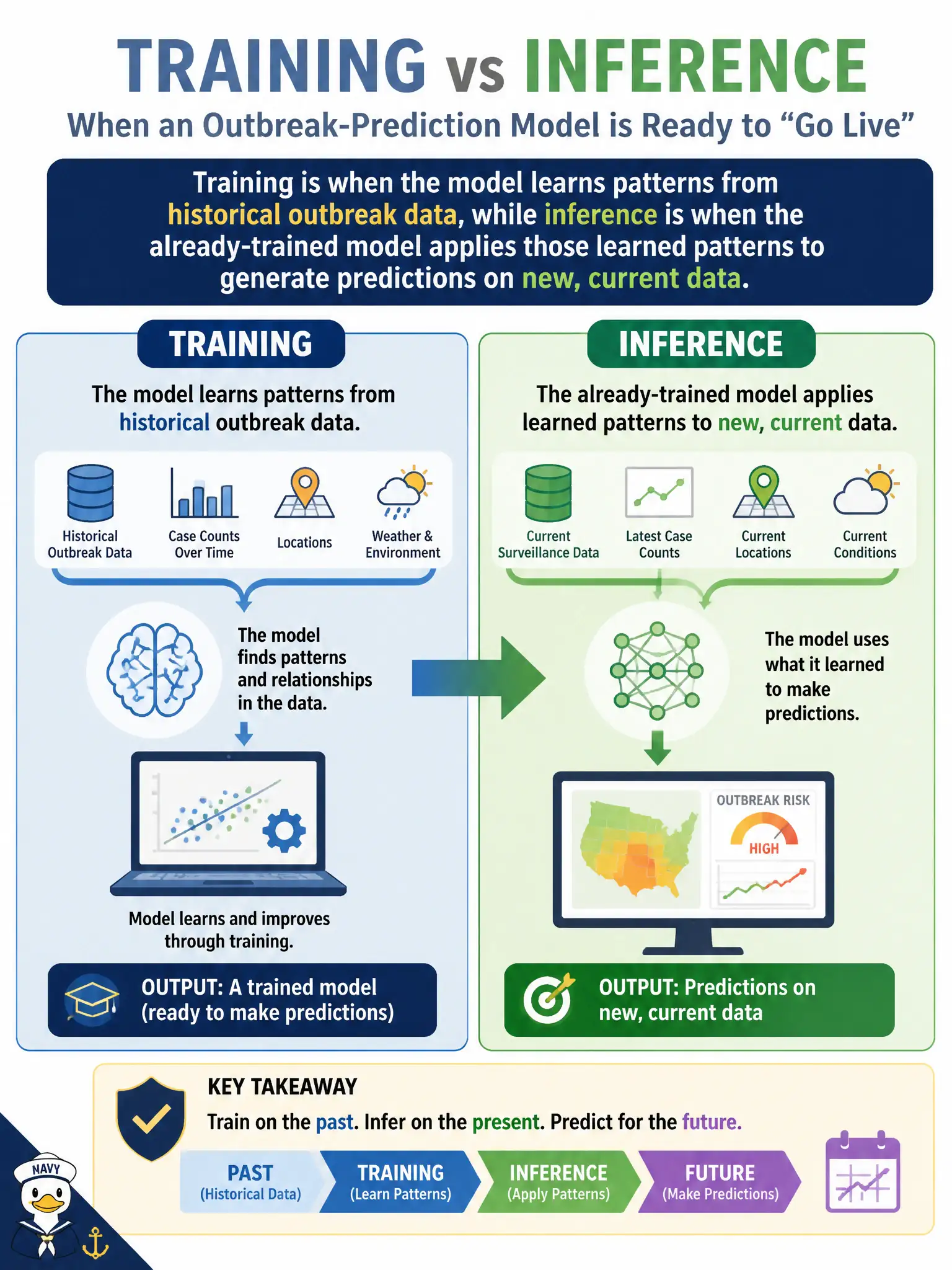
Picture a med student: training is years in the classroom studying past cases, and inference is the moment they're in the exam room applying what they learned to the patient in front of them. The model needs to finish school before anyone trusts it to make live calls.
Full Explanation
Training is the phase where a model is exposed to historical outbreak data and adjusts its internal parameters to capture the patterns in that data, such as how case counts historically preceded a surge. Inference is the separate phase that happens afterward, where the now-trained model is fed new, current data and produces a prediction without further learning from it. This distinction matters for "go live" decisions because a model that hasn't finished training, or was trained on data that no longer reflects current conditions, will produce unreliable inferences even though it appears to be running. Saying training happens only once and never recurs ignores that models are commonly retrained periodically as new outbreak data accumulates; inference is not simply data collection. Reversing the two definitions swaps the learning step and the prediction step entirely. Calling them the same process performed by different staff misses that training and inference are computational phases of the model itself, not organizational roles. Before declaring the model ready, leadership should confirm what date range the training data covers and how recently it was refreshed, since a model trained on outdated case patterns will infer poorly against a live, evolving outbreak.