
A county CIO is briefing elected officials on a benefits-fraud detection proposal, and the vendor's pitch keeps using "algorithm" and "trained model" as if they're the same thing. How should the CIO explain the difference?
Select an answer to reveal the explanation.
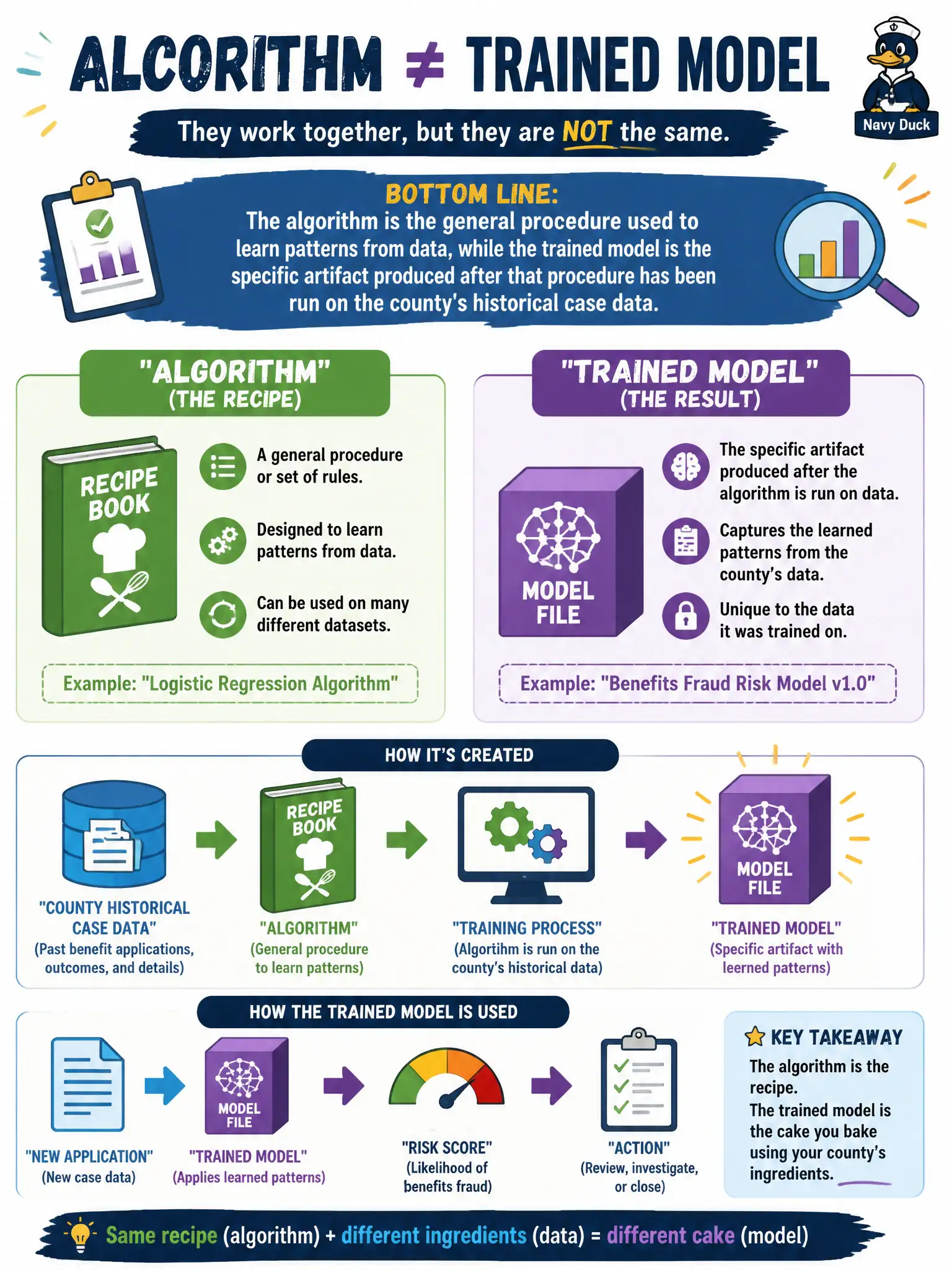
Short Explanation
Think of a recipe versus the cake that comes out of the oven. The algorithm is the recipe, a repeatable set of steps, and the trained model is the actual cake baked from the county's own case data, which is why swapping in a different county's data bakes a different cake.
Full Explanation
An algorithm is a general, reusable procedure for learning patterns from data; the same logistic-regression or gradient-boosting method can be applied to any county's dataset. A trained model is what results once that procedure has actually run on a specific dataset: an artifact with learned weights, tuned to the patterns present in this county's historical fraud cases. That distinction matters for procurement, because a vendor selling "the algorithm" is selling a method, while a vendor selling "the trained model" is selling something shaped by whatever data trained it, including any bias baked into that history. Calling the algorithm a license and the model an open-source component confuses a legal question with a technical one; either piece could be proprietary or open regardless of which is which. Treating them as interchangeable at different sales stages glosses over exactly the risk officials should be probing: has this model actually been retrained on county-specific data, or is it a generic one repurposed without adaptation? Swapping the definitions so the model becomes "raw data" and the algorithm becomes "the report" gets both terms backwards. Before approving the contract, officials should ask the vendor to name which historical dataset trained the model being proposed; a vague answer signals it wasn't adapted to this county at all.