
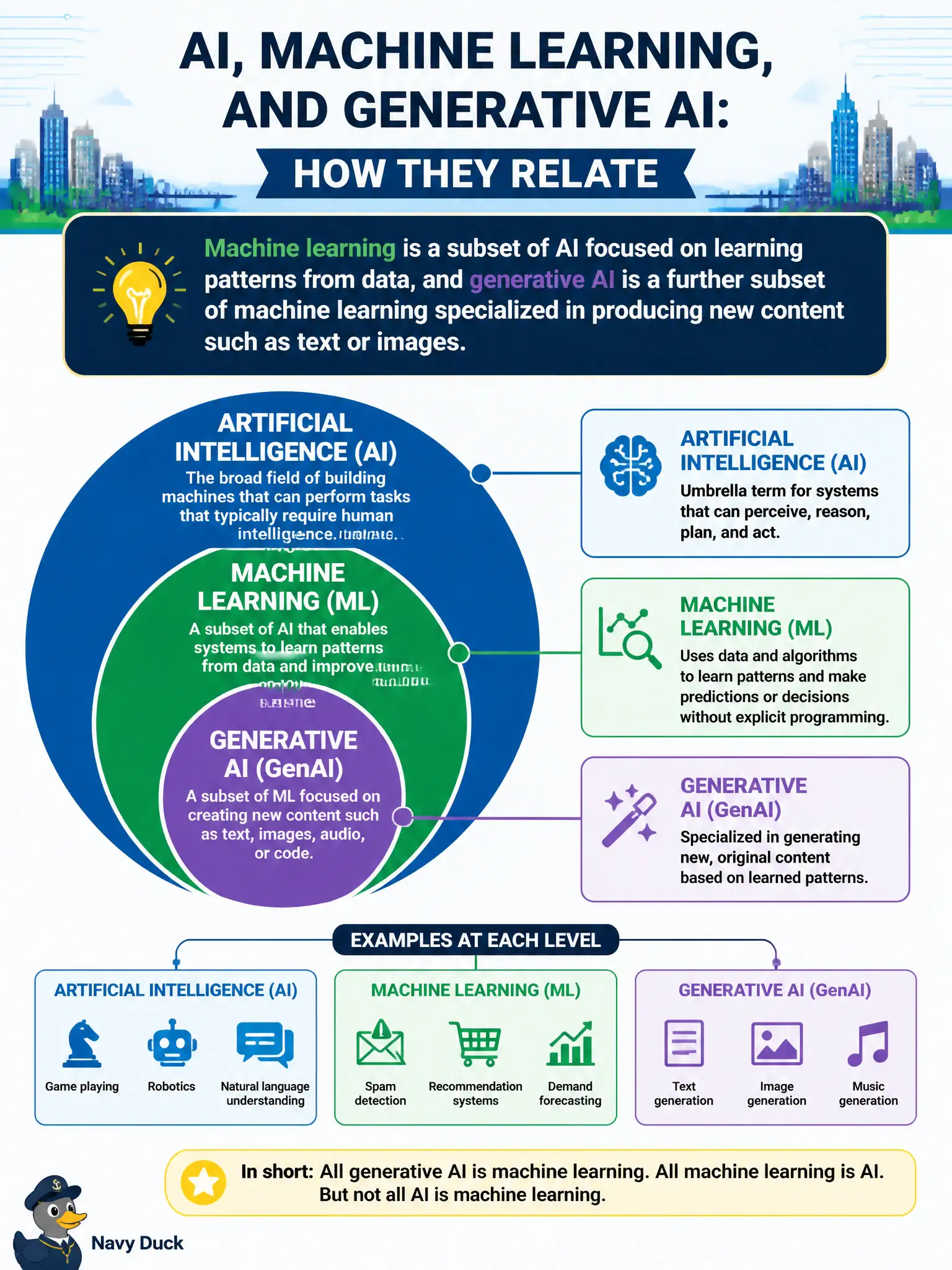
A city AI strategy office is briefing council members ahead of a budget vote, and the councilmembers keep using "AI," "machine learning," and "generative AI" as if they mean the same thing. Which statement correctly captures how the three terms relate to each other?
Select an answer to reveal the explanation.
Short Explanation
Think of it like nesting dolls: AI is the big doll on the outside, machine learning is the next one in, and generative AI is the smallest doll tucked inside that. You don't need three separate vocabularies here, just one hierarchy, and once the council sees it that way, the budget conversation gets a lot less confusing.
Full Explanation
Artificial intelligence is the broad discipline covering any system built to perform tasks that normally require human judgment. Machine learning sits inside that discipline as the specific technique of training a system on data rather than hand-coding every rule, and generative AI narrows further still, describing machine-learning models trained specifically to produce new content rather than just classify or predict. Treating the three as synonyms hides real cost and risk differences that matter directly when a council is voting on funding. The claim that the three are unrelated fields ignores that ML and GenAI are built on top of AI as a foundation, not beside it as competing categories. Flipping the hierarchy so generative AI sits on top gets the nesting backwards; it is a specialized technique within ML, not the umbrella over it. Collapsing ML and GenAI into one identical concept erases a real distinction, since plenty of ML use cases, like fraud scoring or demand forecasting, never generate content at all. Before the briefing, a strategist should have every proposed initiative labeled by which layer it actually sits in, since that single check keeps council members from budgeting for a vague "AI project" without knowing whether it is a simple classifier or a costly generative system.