
When you are solving a machine-learning problem, what is the primary value of using cross-validation during model assessment?
Select an answer to reveal the explanation.
Short Explanation and Infographic
Okay, let's dive in. Cross-validation is your reality check, not a magic accuracy boost. Think of it like this: if you grade a student on one pop quiz, maybe they just got lucky. Five quizzes across different chapters? Now you know what they actually know. Same idea—multiple train/val splits give you a sturdier read on unseen data and help catch overfitting. Exam trap: folks say CV "makes the model more accurate," "more interpretable," or "faster." Nope. It costs more compute and doesn't explain decisions. What it does is answer, "Can I trust this score?" When your boss walks in asking if the holdout number is real, you want folds behind you. That's the takeaway.
Full explanation below image
Full Explanation
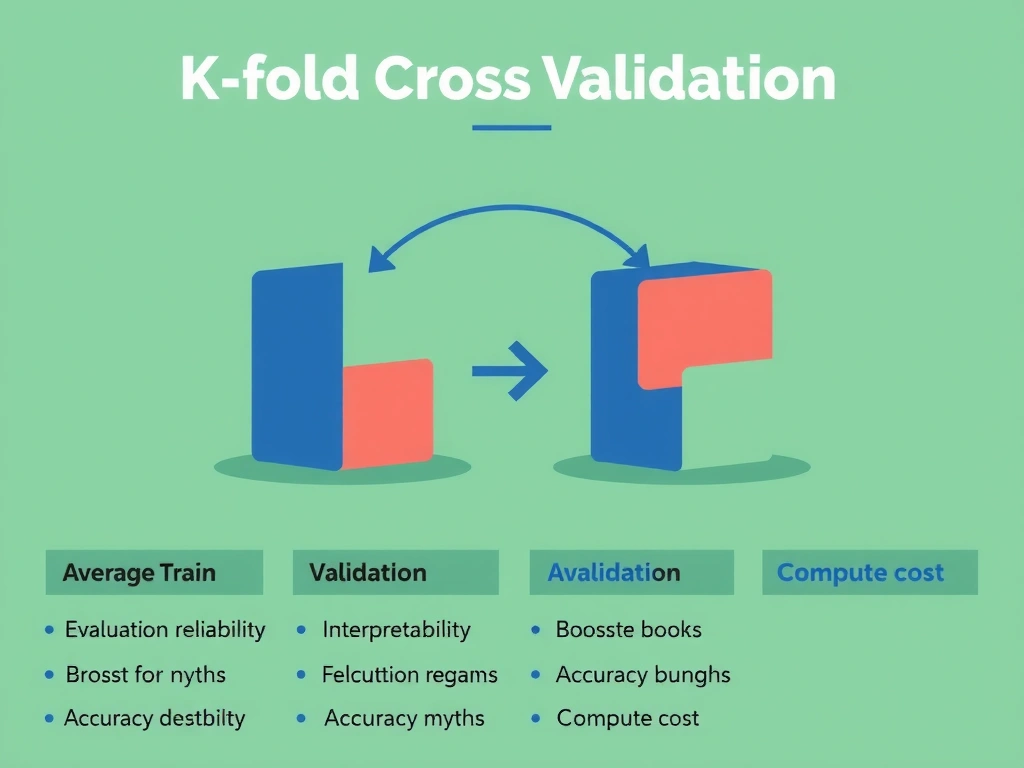
Cross-validation is a resampling strategy for estimating generalization performance more reliably than a single train/validation split. In k-fold cross-validation, the dataset is partitioned into k subsets; each subset serves once as validation while the remaining folds train the model. Reported metrics are aggregated (mean and often variance) across folds. Because each example participates in validation exactly once (in standard k-fold), the estimate is less sensitive to an unusually easy or hard random split.
That robustness matters when comparing algorithms, tuning hyperparameters, or detecting overfitting. A model that scores high on one lucky validation set but collapses on other folds is exposed by CV. Nested or careful CV setups also reduce optimistic bias when selection and evaluation are separated. Related techniques include stratified k-fold for imbalanced labels, group k-fold when samples are correlated, and time-series splits that respect temporal order.
Interpretability is unrelated: transparent models, feature attributions, and documentation address why predictions happen, not how data is split. Claiming CV "makes predictions more accurate" confuses evaluation with training; CV may guide you toward better hyperparameter choices, but the procedure itself is not a production accuracy upgrade. Training time usually increases because multiple models are fit; any claim that CV mainly exists to speed training is inverted.
Practical guidance: use CV when data is limited and variance of a single split is high; still hold out a final test set for an untouched estimate after all selection is complete. Document fold metrics and their spread so stakeholders see stability, not only the average score. Memory aid: cross-validation stabilizes the performance story and guards against overfitting illusions—it does not magically interpret the model or cut training cost. Treat CV as your measurement instrument; treat final training and deployment choices as separate steps informed by those measurements.