
Which engineering practice best supports making production AI decisions understandable to humans who must trust or audit the system?
Select an answer to reveal the explanation.
Short Explanation and Infographic
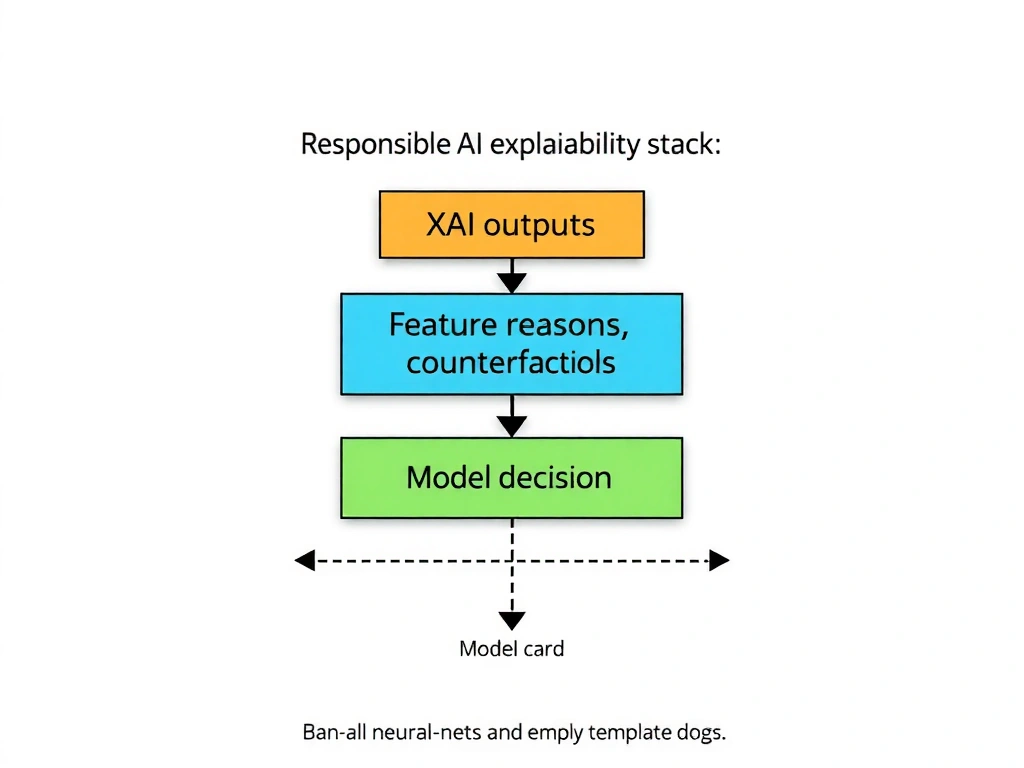
Check this out—explainability isn't "never use a neural net." Your boss walks in and says compliance needs to know why the model denied this case. You need XAI: clear, human-readable reasons for the decision. Think of it like a change ticket with a comment—not just "deployed," but why. Exam trap: the test waves "simple linear model only" or "ban deep learning" as if that's the only path. Sometimes you need capacity; what you still need is transparency. Another trap is empty paperwork that doesn't match the system. Best practice: use XAI techniques—and documentation that actually explains the model. Pay attention here; this one shows up in ethics and governance questions a lot.
Full explanation below image
Full Explanation
Explainability and transparency are core goals in responsible AI engineering, especially in regulated or high-stakes domains. A key best practice is to employ explainable-AI (XAI) techniques—and supporting processes—that provide stakeholders with understandable rationales for model outputs. Depending on the system, that may include inherently interpretable models, post-hoc local explanations (feature attributions, counterfactuals), global summaries, example-based explanations, or structured documentation such as model cards that describe intended use, limitations, and known failure modes.
The correct answer emphasizes XAI methods that deliver transparent reasons for decisions. That aligns with auditability, user trust, debugging, and ethical accountability: people need to know not only what the model predicted but why that prediction is plausible under the training data and features used.
Forbidding neural networks entirely is not a sound general rule. Deep models are often necessary for vision, language, and other complex tasks. The engineering response is to pair capable models with explanation tools, human review, and governance—not to ban entire model families. Mandating only simple linear models similarly oversimplifies: linear models can be interpretable baselines, but they may underfit complex relationships; best practice is to choose model complexity appropriate to the problem and then apply explanation and monitoring. Deploying an unrelated template fails because documentation must reflect the actual model, data, and decision logic; cosmetic compliance artifacts do not create real understandability.
In practice, teams define who needs explanations (operators, customers, auditors), what fidelity is required, and how explanations are validated so they are faithful to the model. Memory aid: explainability best practice equals real transparency for decisions—via XAI and honest documentation—not blanket bans or empty paperwork.