
A warehouse vision system correctly names the items it sees on a conveyor belt, yet every predicted bounding box is shifted away from the true object. Which part of the detector is most likely failing?
Select an answer to reveal the explanation.
Short Explanation and Infographic
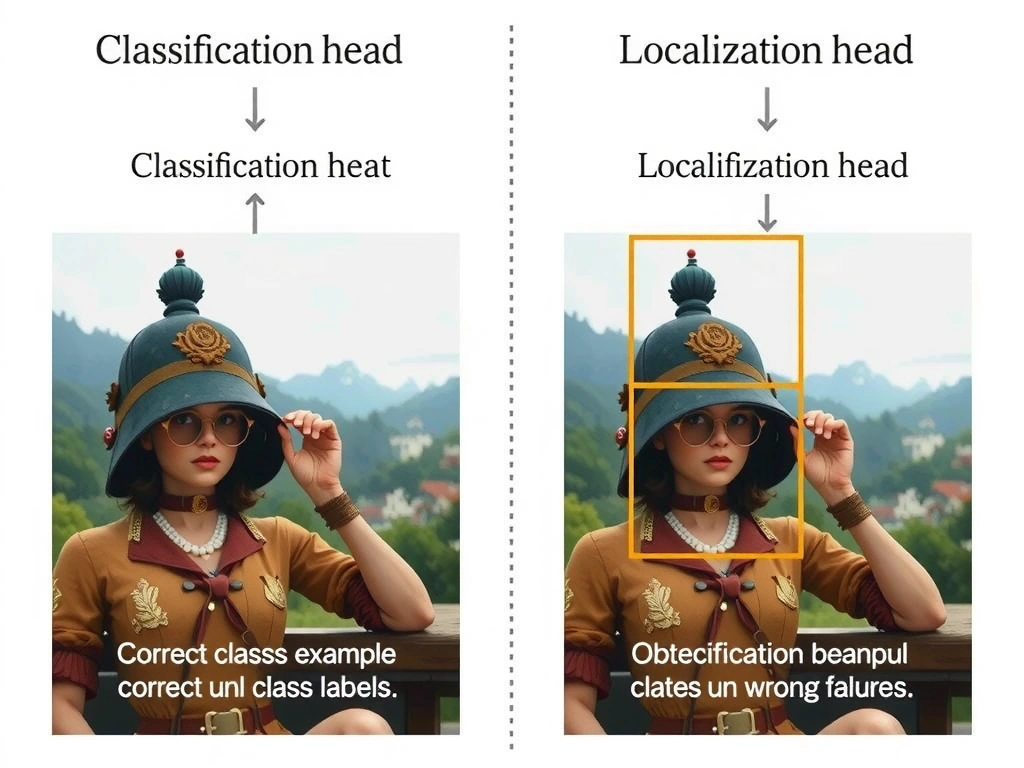
Here's the deal: object detectors do two jobs—say what something is, and say where it is. Your model is nailing the labels but painting the boxes in the wrong spot. That's localization, not classification. Think of it like a GPS that knows you're at "the coffee shop" but drops the pin three blocks over—the place name is right, the coordinates aren't. Exam trap: people see "detection problem" and jump to recall, bias, or the class head. Wrong. If names are good and boxes are bad, the regression head (or box refinement path) is the smoking gun. Remember: wrong place = localization; wrong name = classification. Got it? Sweet—lock that in for the test.
Full explanation below image
Full Explanation
Modern object detectors typically decompose the problem into classification and localization. Classification predicts the category of each candidate region or anchor. Localization (often implemented as a bounding-box regression head) predicts spatial parameters such as center coordinates, width, and height, or refinements to proposal boxes. When a system assigns the correct class labels but systematically places boxes away from the true object extents, evidence points to failure in the localization pathway rather than the class head.
This failure mode can arise from several training or architecture issues that still leave classification relatively intact: poorly calibrated box regression losses, inadequate localization-aware sampling, mismatched image and annotation coordinate systems, or insufficient capacity devoted to spatial refinement. Metrics that focus only on whether an object was "found" (for example, loose recall definitions) may still look acceptable while Intersection-over-Union (IoU) scores and localization error remain poor. Therefore diagnostic evaluation should separate classification accuracy from box quality (mean IoU, localization error curves, mAP at strict IoU thresholds).
The classification-head distractor is incorrect because wrong labels would be the symptom, not correct names with wrong geometry. High recall is not a diagnosis of precise localization; recall can be high with coarse or shifted boxes if a weak match criterion is used. Low bias is a general statistical idea about under-flexibility of a hypothesis class; it is not the standard engineering explanation for offset bounding boxes on an otherwise correctly labeled detector.
Best practice: when debugging detectors, inspect qualitative overlays, stratify errors into misclassification versus localization, and train with losses and data augmentations that specifically improve spatial alignment. Memory aid: correct class + wrong box equals localization problem; wrong class + reasonable box equals classification problem.