
A generative text system starts producing offensive or harmful responses for end users. Which ethical issue does this primarily illustrate?
Select an answer to reveal the explanation.
Short Explanation and Infographic
Here's the deal. Your chatbot starts spewing nasty or dangerous text. That's not "the algorithm's big-O is too high," and it's not primarily a confidentiality leak of someone's SSN. Transparency is about whether you can explain decisions—not whether the model is yelling toxic junk. What you're looking at is model bias or toxicity: the system generates content that can insult, exclude, or harm people. Think of it like a junior agent on chat support who learned bad habits from messy training data and no guardrails. Exam trap: pick the ethical-sounding word closest to "AI" and hope—don't. Pay close attention: harmful generations map to safety, toxicity, and bias controls—filters, red-teaming, policy alignment, human review. Land it, then go practice spotting these distinctions. Nice and clean.
Full explanation below image
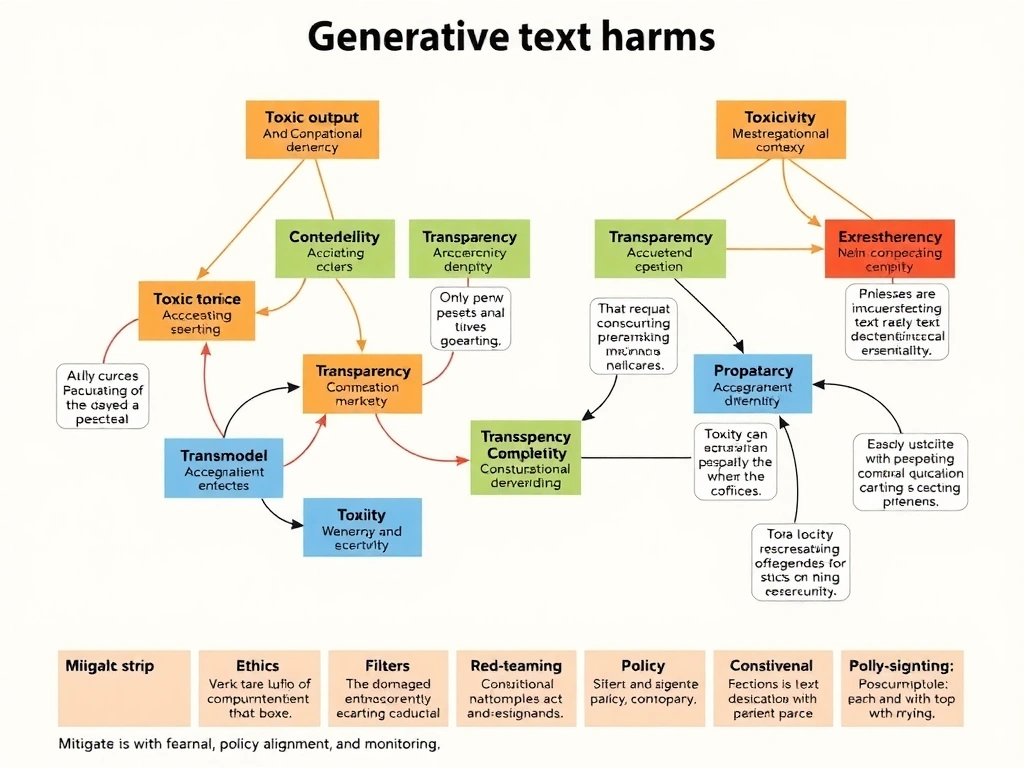
Full Explanation
Generative models can produce fluent language that still violates safety and ethics expectations. When outputs are offensive, harassing, discriminatory, or otherwise harmful, practitioners typically discuss toxicity, unsafe content, and related forms of model bias that surface as unequal or damaging treatment of people and groups. Causes include toxic material in pretraining corpora, weak alignment relative to product policy, adversarial prompting, and missing runtime safeguards. The ethical and product response is not merely cosmetic filtering; it includes data curation, preference and safety fine-tuning, evaluation harnesses for toxic and harmful behaviors, usage policies, monitoring of live traffic, and escalation paths for severe incidents.
The correct answer identifies model bias or toxicity in generated outputs. That framing matches the scenario: the system produces inappropriate or harmful content for users. Organizations deploying generative text systems are expected to treat this as a first-class risk alongside accuracy and latency, because reputational, legal, and user-safety consequences can be immediate.
Algorithmic complexity refers to computational cost and scaling of algorithms; it is orthogonal to whether content is harmful. Data confidentiality concerns unauthorized access or disclosure of private information—an important privacy issue, but distinct from generating toxic language. Algorithmic transparency concerns the ability of stakeholders to understand or audit how a system reaches decisions; opacity can worsen governance of toxicity, yet transparency failures are not the same category as the harmful outputs themselves.
Best practices include defining prohibited and restricted content categories, testing with adversarial and red-team prompts, combining automated classifiers with human review for edge cases, documenting residual risk, and providing user reporting mechanisms. Memory aid for exams: map each ethics keyword carefully—privacy/confidentiality for secret data, transparency for explainability and auditability, fairness/bias for disparate or prejudiced outcomes, toxicity/safety for harmful generations. When a question shows inappropriate model-written content, choose bias or toxicity (safety) rather than complexity, confidentiality, or transparency alone. Responsible deployment treats safety evaluation as continuous, not a one-time checklist before launch.