
During AI problem analysis, what is the primary purpose of exploratory data analysis (EDA)?
Select an answer to reveal the explanation.
Short Explanation and Infographic
Alright, let's talk EDA—exploratory data analysis. Imagine your boss drops a warehouse of CSVs on your desk and says, "Make AI." You don't immediately deploy, you don't fire the final training run, and you sure don't crown an algorithm before you've even looked. You explore. Plot distributions, hunt weird outliers, check missingness, spot correlations, see class imbalance. Think of it like walking a property before you remodel—measure the rooms, find the water damage. Exam trap: options that jump to deploy or train sound productive but skip the whole point of EDA. The cool thing is, good EDA saves you from modeling garbage. Land the takeaway: EDA's job is understanding data characteristics, patterns, and anomalies first. You've got this—keep practicing those plots and summaries.
Full explanation below image
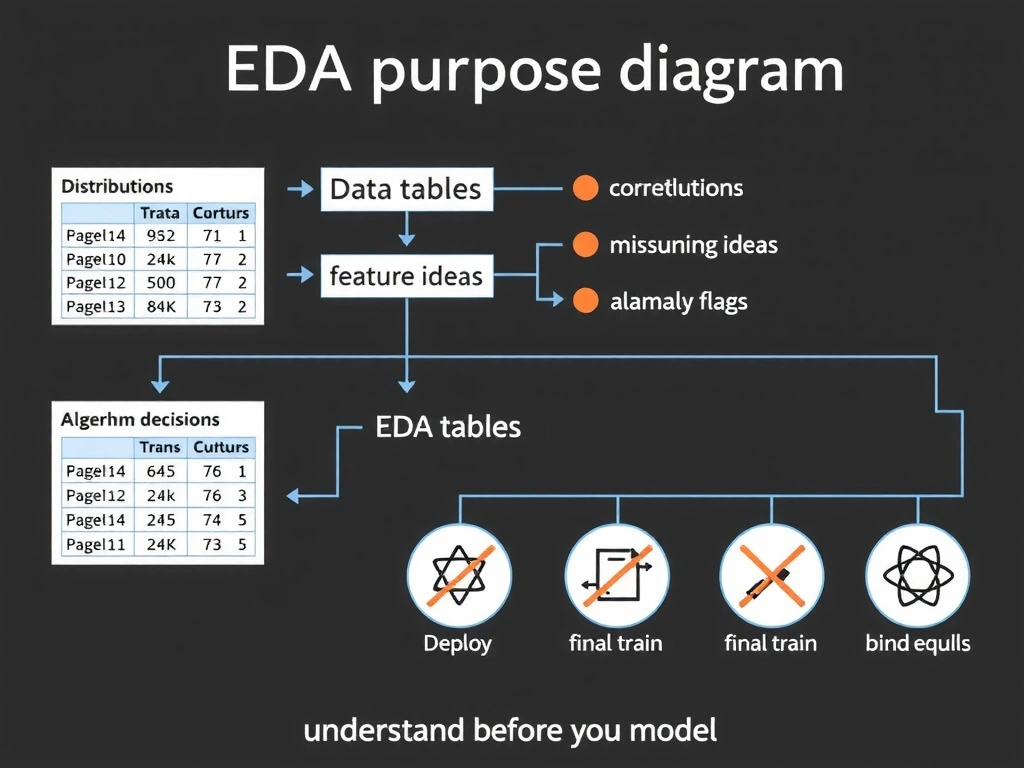
Full Explanation
Exploratory data analysis is the systematic investigation of a dataset prior to, and sometimes alongside, formal modeling. Its main goal is understanding: what variables exist, how they are distributed, whether relationships appear linear or nonlinear, where missingness clusters, whether outliers or label noise are present, how classes balance, and whether temporal or group structure will affect splits and metrics. Visualizations, summary statistics, correlation analysis, stratified breakdowns, and simple provisional models all serve this investigative purpose. Insights from EDA drive cleaning rules, feature engineering ideas, leakage checks, sampling strategies, and realistic expectations for model performance.
The correct option states that purpose clearly—characterize distributions, relationships, patterns, and anomalies before committing to a final model. That understanding reduces wasted training cycles and surfaces business questions (for example, why a key region has sparse labels) early enough to fix data collection.
Deploying a model into production is not EDA; deployment assumes a trained, validated candidate, infrastructure readiness, and operational controls. Running the definitive production training job is also not EDA; training optimizes parameters for a chosen objective and architecture after design decisions informed by exploration. Immediately selecting a best algorithm without inspecting data inverts the workflow: algorithm suitability depends on sample size, feature types, noise level, latency constraints, and interpretability needs that EDA helps reveal.
In practice, effective EDA is iterative and documented. Teams record findings in notebooks or dashboards, agree on inclusion criteria, and define preprocessing that is reproducible in training and inference pipelines. Common pitfalls include treating EDA as optional, peeking so aggressively at the full dataset that test integrity is compromised, or confusing flashy charts with decision-ready insight. A helpful principle is explore enough to de-risk modeling, then freeze evaluation protocols. On exams, if a question asks for the main goal of EDA, prefer answers about understanding structure and anomalies over answers about deployment, final training, or premature algorithm crowning. That distinction separates analysis from later lifecycle stages and matches industry practice for responsible AI development.