
For reliable model evaluation during the testing phase of an AI project, which practice is most important?
Select an answer to reveal the explanation.
Short Explanation and Infographic
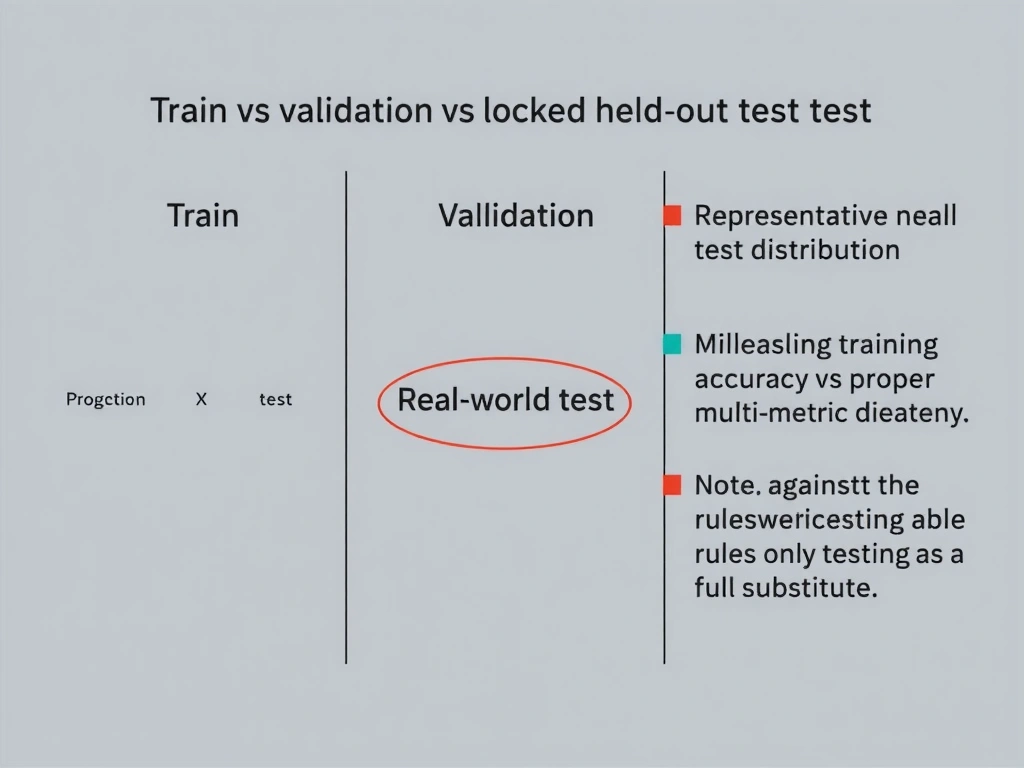
Pay close attention here—this one bites people all the time. Testing means you hold out data the model has never trained or tuned on, and that data should look like production, not a toy subset. Think of it like a practice exam: if you study the answer key and then re-take the same quiz, of course you ace it. That's training-set "success," not reliability. Exam trap: accuracy-only on imbalanced data, or swapping real evaluation for a few hand rules. Your boss wants numbers that survive Friday night traffic, not vanity metrics. Split train, validation, test; lock the test set; pick metrics that match the business risk. Land it: unseen and representative—that's the testing best practice.
Full explanation below image
Full Explanation
Reliable testing estimates how a model will behave on future data it has not optimized against. The foundational practice is to reserve a dedicated test dataset that is excluded from training and hyperparameter tuning, then evaluate on that set only after modeling choices are fixed. The test distribution should mirror expected production conditions as closely as practical—including class balance, feature noise, seasonal effects, and operational constraints—so metrics are decision-useful rather than academic. When teams report performance only on training data, they often overestimate quality because models can memorize patterns and idiosyncrasies; that is a classic overfitting trap.
Relying solely on accuracy is another frequent mistake: under class imbalance, a model can achieve high accuracy by predicting the majority class while failing on rare but high-cost errors; precision, recall, F1, ROC-AUC, PR-AUC, calibration, or cost-weighted metrics may be more appropriate depending on the problem. Comparing to or supplementing with simple rules can be informative for baselines and sanity checks, but a rules-only approach does not replace quantitative evaluation of the learned model on held-out data. Sound evaluation design also prevents leakage: no using test labels for feature engineering, no iterative "peeking" that turns the test set into a second validation set, and clear documentation of splits.
Best practice often uses train, validation, and final test partitions, or nested cross-validation when data is limited, with a frozen final test for reporting. Version the test set carefully so later pipeline changes do not quietly contaminate results. Segment metrics by important cohorts when the business risk is uneven, and compare against a simple baseline so improvements are real rather than illusory. Publish evaluation assumptions next to the numbers so stakeholders know what the scores do and do not prove.
Memory aid: training fits, validation selects, test judges—and the judge must be both unseen and representative of live traffic. Exam questions reward candidates who insist on dedicated real-world-like test data rather than training-set scores, single shallow metrics, or non-statistical shortcuts during the formal testing phase of an AI project lifecycle.