
A data scientist is developing a credit decision model for a bank and must reduce unfair bias. Which step is the essential part of a sound problem-solving process?
Select an answer to reveal the explanation.
Short Explanation and Infographic
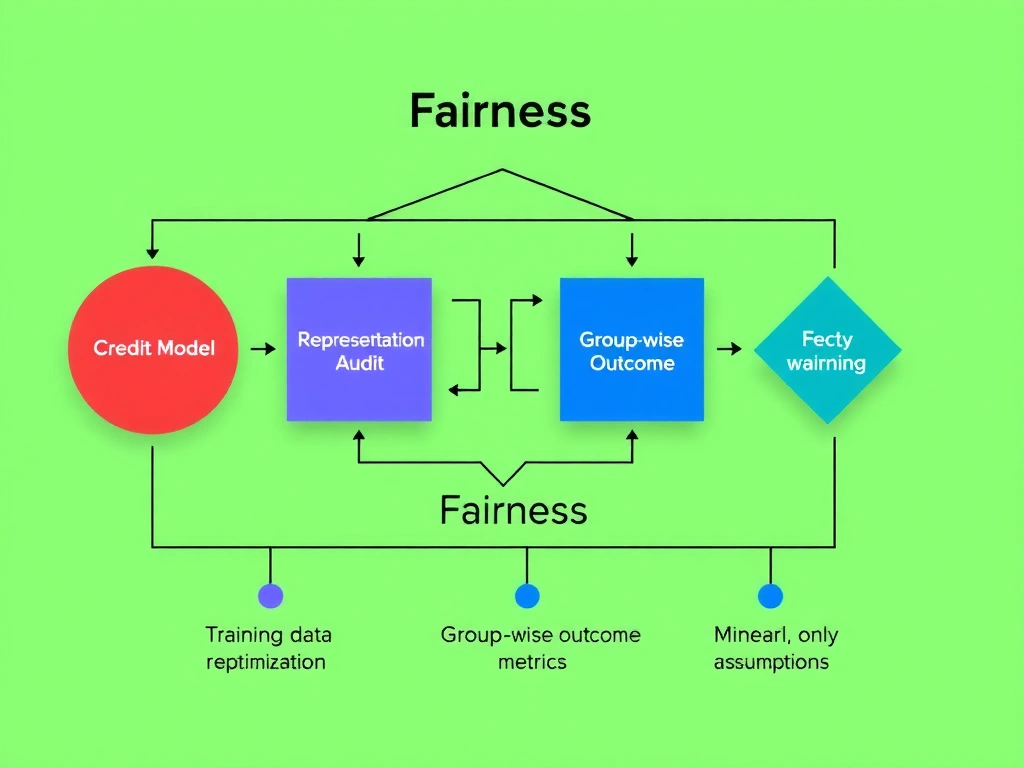
Here's where this bites people in production: a model can look "great" on average and still hammer one group. Your job is to check the training data for who is missing or over-represented, then score outcomes across groups—not just chase one accuracy number. Think of it like a highway sensor that only covers one neighborhood; traffic reports look fine until the other side of town floods. Exam trap: "just use a linear model" or "go unsupervised and bias vanishes." Nope. Bias lives in data, labels, and proxies. Ignore ethics and your boss—and regulators—will walk in eventually. Measure representation, measure fairness metrics, mitigate, retest. That's the process you want locked in.
Full explanation below image
Full Explanation
Fairness-aware model development treats bias as a measurable property of data, labels, features, and decision thresholds—not as a side note after deployment. For a financial credit model, a central problem-solving step is to inspect training data for representation problems (for example, under-sampling of certain applicant groups) and to evaluate model predictions or error rates across relevant groups using appropriate fairness metrics and legal guidance. Representation bias in data can yield models that perform unevenly even when overall accuracy looks strong. Group-aware evaluation makes those gaps visible so teams can apply mitigation: rebalancing, reweighting, feature review for proxy variables, threshold adjustments under policy constraints, or human-in-the-loop review for edge cases.
Ignoring ethical implications and optimizing only aggregate accuracy is a well-known failure mode: high overall metrics can mask disparate impact. Choosing a simple linear model does not eliminate bias because biased labels and features still shape coefficients; model simplicity is not a fairness guarantee. Moving entirely to unsupervised learning does not solve the problem for supervised decision systems: clusters can still segregate along sensitive axes, and business decisions typically still require labels, scores, or policies. A disciplined workflow includes stakeholder definition of fairness goals, data documentation, exploratory analysis by segment, pre-deployment fairness tests, monitoring after launch, and escalation paths when drift or disparity appears.
Keep a living model card that records which groups were checked and which metrics were used so future retrains stay accountable. Involve compliance and product owners early so technical metrics map to policy requirements rather than ad hoc thresholds chosen after a bad headline. When proxies such as ZIP code correlate with protected attributes, document the tradeoff analysis rather than pretending the model is neutral by architecture alone. Re-evaluate after each major data refresh because population mix and label definitions shift over time.
Memory aid: fairness work is data audit plus group evaluation plus mitigation plus monitoring—architecture choice alone is not a fairness strategy. Exam items often reward the candidate who pairs representation checks with cross-group evaluation rather than distractors that dismiss ethics or claim a modeling family removes bias automatically in production credit systems and similar high-stakes scoring environments.