
After a team has clearly stated the business objective for an AI initiative, what should they do next before building models?
Select an answer to reveal the explanation.
Short Explanation and Infographic
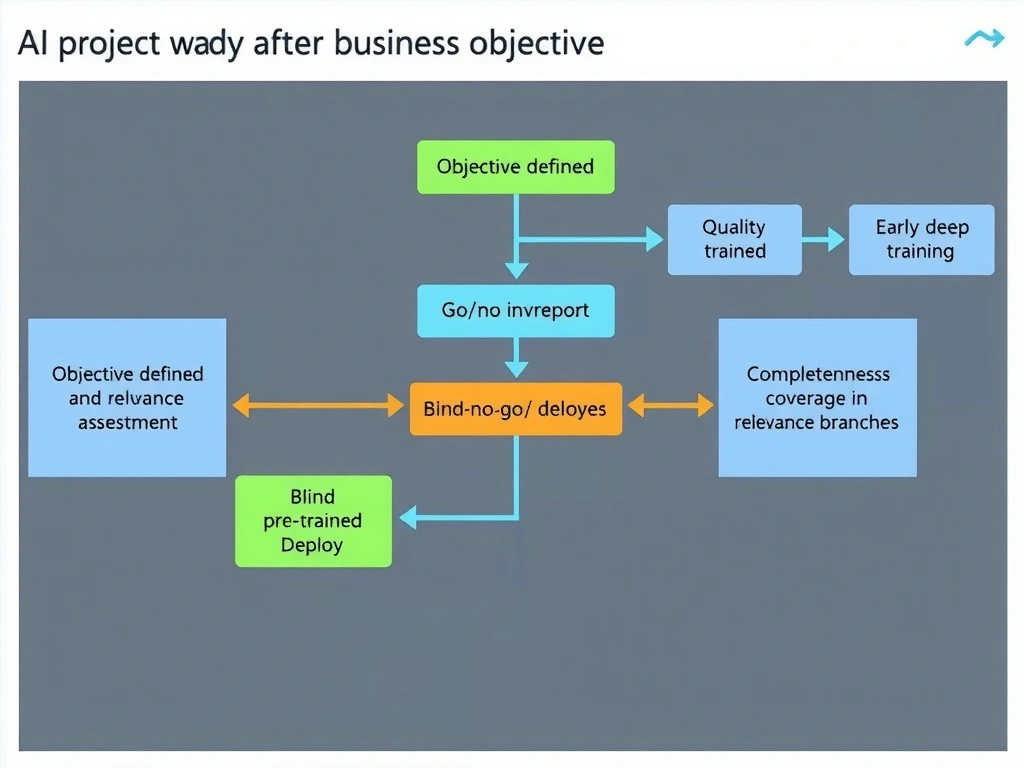
Okay, let's dive in. Your boss walks in and says, "We need AI to cut churn by next quarter." Cool—you've got the objective. What do you do next? Not write the victory report. Not dump a pre-trained model into prod. And not spin up a giant neural net just because it looks impressive. Here's the deal: you collect the data you actually have and dig into whether it's clean, complete, and relevant to that goal. Think of it like this—you wouldn't pour a foundation before surveying the ground. Same idea. Exam trap: folks rush to algorithms because algorithms feel like "real AI." Pay close attention—on the test and in production, understanding data quality and fit comes first. Land it: objective → inspect data → then model. Got it? Sweet. Let's keep rolling.
Full explanation below image
Full Explanation
Effective AI problem analysis follows a deliberate sequence rather than a leap from ambition to architecture. Once the business objective is explicit—what decision will improve, what metric matters, and what constraints exist—the team must determine whether the available information can support that goal. That means inventorying candidate data sources, checking completeness and accuracy, reviewing representativeness over time and segments, clarifying labels or ground truth, and mapping fields back to the objective. Only after this work can the team decide if modeling is warranted, what features are feasible, and which risks (leakage, bias, sparse outcomes) need mitigation.
The correct answer captures this next step: gather what you have and carefully assess quality, coverage, and relevance. Skipping it is a leading cause of failed AI projects. Teams discover too late that labels are inconsistent, key cohorts are missing, features are delayed relative to decisions, or privacy rules block critical attributes. Early data analysis also informs scope: sometimes the right move is fixing instrumentation or process, not training a model at all.
Drafting the final report is premature. Close-out documentation depends on results that do not yet exist and distracts from discovery work. Deploying a pre-trained model immediately confuses availability of a general model with fitness for a specific business context; domain shift, policy constraints, and evaluation requirements still demand data-centric analysis first. Jumping into complex neural network training without data review is a classic resource sink: expensive experiments on the wrong features or noisy targets produce impressive-looking pipelines that fail operationally.
A practical memory aid is Objective → Data feasibility → Design → Train → Evaluate → Deploy → Monitor. Exploratory checks, data dictionaries, simple baseline statistics, and stakeholder review of sample records often surface issues cheaper than a full modeling cycle. Best practice also includes documenting assumptions about freshness, provenance, and consent so governance stays aligned with the objective from day one. On certification exams, when you see a question about sequencing after the business goal is set, prefer data collection and careful analysis over premature reporting, uncritical deployment, or deep training for its own sake.