
During model training, which approach best supports data-privacy best practice when real records contain personal information?
Select an answer to reveal the explanation.
Short Explanation and Infographic
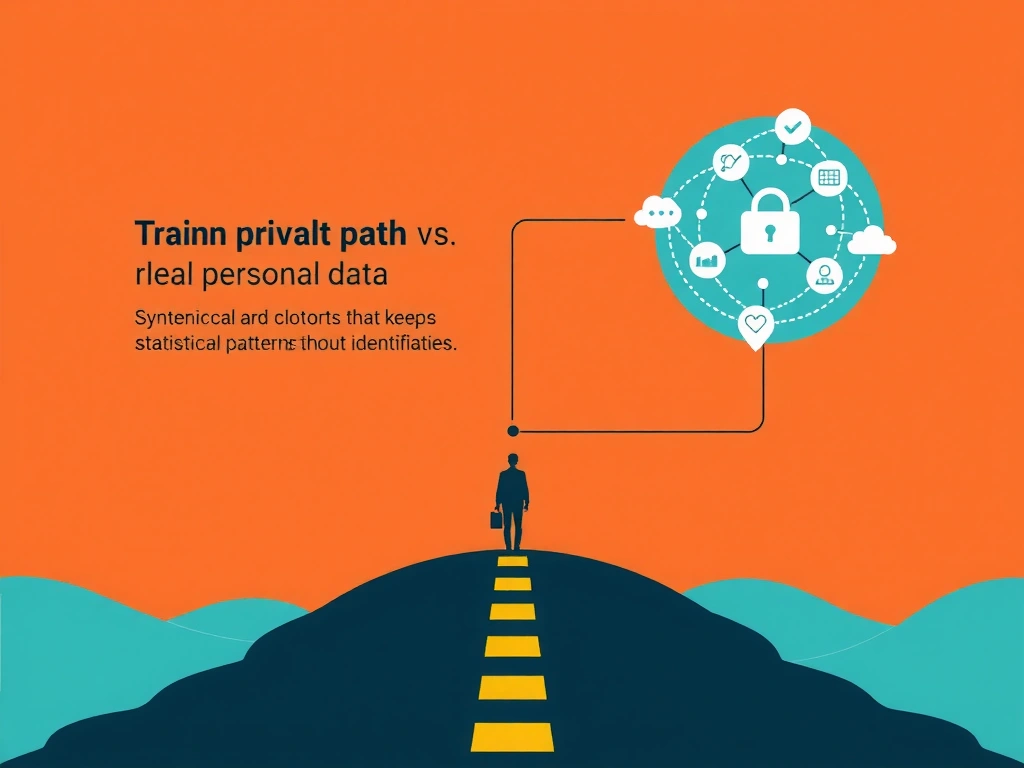
Check this out—privacy during training is about learning the pattern without shipping people's lives in the CSV. Synthetic data is the move when it mimics distributions you need but drops the real names, IDs, and sensitive fields. Think of it like a flight simulator: you practice on something that behaves like the real world without putting passengers at risk. Exam trap: "just don't use data" or "share everything with partners"—both miss the point. You still need signal to train, and you still need governance. Encrypt storage, minimize access, and when personal data is too hot, generate or license synthetic alternatives and validate they don't leak individuals. Land this: privacy-preserving training uses substitutes and controls, not reckless sharing or empty datasets.
Full explanation below image
Full Explanation
Privacy-aware training seeks useful model performance without unnecessary exposure of personal data. One widely taught best practice is to use synthetic datasets that approximate the statistical structure of real data while excluding direct identifiers and carefully limiting sensitive attributes. When synthetic data is generated and validated appropriately—checking utility, membership leakage risk, and distributional fidelity—teams can prototype, debug pipelines, and sometimes train models with substantially lower privacy exposure than raw production extracts. Complementary controls still matter: encryption, access control, retention limits, purpose limitation, and audit logging. The correct choice emphasizes synthetic data as a privacy-preserving substitute rather than as magic that removes all governance work.
Sharing raw personal datasets with external parties without proper legal and technical controls is a classic privacy failure mode and often violates policy or regulation. Storing all training material unencrypted for speed prioritizes convenience over confidentiality and is inconsistent with baseline security practice. Completely refusing to use data avoids privacy incidents only by abandoning learning; it is not an engineering best practice for building models. In practice, organizations often combine approaches: de-identification or aggregation, differential privacy techniques where appropriate, secure enclaves, synthetic data for early stages, and tightly controlled access to limited real data for final calibration under oversight.
Reviewers should also verify that synthetic generators do not memorize rare individuals from seed data. Document data lineage so auditors can see what left the trust boundary and under which legal basis. When partners must collaborate, prefer contracted environments, anonymized or synthetic samples, and least-privilege roles rather than emailing raw extracts. Measure whether models trained on synthetic data still generalize to production distributions; if utility gaps appear, escalate carefully with minimized real samples rather than expanding uncontrolled sharing.
Exam memory aid: privacy best practice reduces identifiable exposure while preserving enough signal to learn—synthetic data is a tool for that tradeoff, not a reason to dump unencrypted personal files or to claim zero data is always required for any model. On certification items, pick the option that keeps useful training signal while removing personal identifiers and enforcing surrounding controls.