
In computer vision training pipelines, what is the primary purpose of data augmentation?
Select an answer to reveal the explanation.
Short Explanation and Infographic
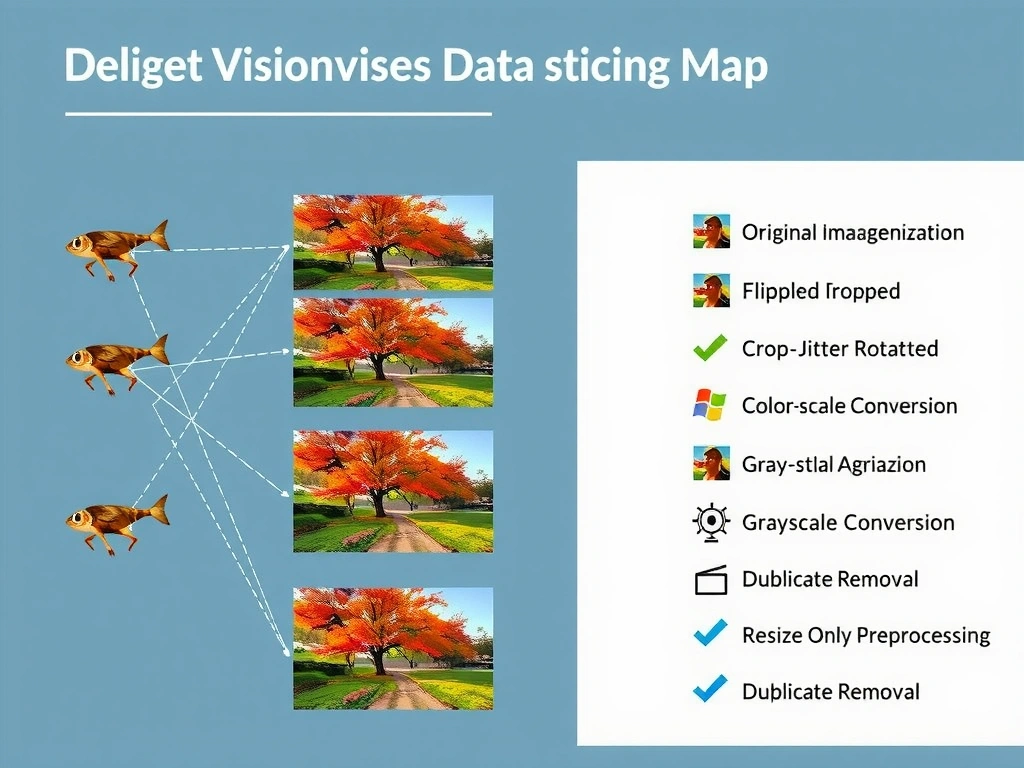
Okay, let's dive in. Data augmentation is your cheap way to grow a vision dataset without hiring more labelers. Think of it like this: you've got one photo of a stop sign—flip it, crop it, tweak brightness, and the model still knows it's a stop sign, but now it saw more angles of reality. That's the goal: manufacture new training examples from transforms of what you already have so the network generalizes better. Exam trap? People confuse augmentation with boring prep jobs like resize or grayscale. Those get tensors into the right shape or color space—they don't intentionally invent variety. Pay close attention: remove duplicates is cleaning; augmentation is the opposite vibe—more useful variation. When your boss wants better accuracy by Friday and you can't collect more photos, augmentation is often the first lever you pull. Hands-on tip: start mild, then increase strength carefully so labels still hold.
Full explanation below image
Full Explanation
Data augmentation in computer vision is a family of techniques that expand the effective size and diversity of a labeled training set by applying label-preserving—or carefully controlled—transformations to existing images. Common geometric transforms include horizontal flips, random crops, rotations, translations, and affine warps. Photometric transforms include brightness, contrast, saturation, and hue jitter, as well as blur or noise injection when those distortions match deployment conditions. More advanced strategies such as mixup, CutMix, or policy-based auto-augmentation compose multiple operations. The model therefore observes many plausible variants of each original example, which reduces overfitting when data are limited and improves robustness to viewpoint, lighting, and scale changes that appear in production.
The correct answer states this generative purpose clearly: new training examples arise from transforms applied to existing images. That is distinct from mere formatting. Converting images to grayscale discards color channels and may be appropriate for some tasks, but it is not the definition of augmentation and often removes useful features. Resizing or letterboxing to a fixed spatial size is almost always required so batches share a common tensor shape for the network; it standardizes inputs rather than diversifying them. Removing duplicates is a cleaning or quality-control step that reduces memorization of repeated near-identical samples; it shrinks redundancy instead of synthesizing variation.
Practitioners choose augmentation policies that respect label semantics. Aggressive random erasing might be fine for classification yet harmful for fine-grained detection if objects disappear. Medical and industrial imaging often need domain-specific transforms that mimic sensor noise rather than natural-photo flips. Validation and test sets typically receive only deterministic preprocessing so metrics remain comparable, while training applies stochastic augmentation each epoch. On exams, map the phrase “generate new training examples via transformations” to augmentation, and keep preprocessing, cleaning, and architecture choices in separate mental buckets. Effective pipelines combine sufficient real data, sensible cleaning, consistent preprocessing, and well-tuned augmentation rather than relying on any single step alone.