
A retailer deploys an AI system that personalizes product recommendations for each shopper. Which challenge is typically the most central ongoing concern in this setting?
Select an answer to reveal the explanation.
Short Explanation and Infographic
Check this out—personalization is never a "train once, ship forever" story. Shoppers change tastes, seasons rotate inventory, and last month's hot item is this month's clearance rack. Here's the deal: the major challenge is keeping the recommender current as preferences and catalogs move. Think of it like a radio station that only plays last year's hits—technically it's still music, but nobody sticks around. Exam trap: shiny options about "perfect precision," "tiny compute cost," or "can't deploy anywhere" sound dramatic but miss the real ops pain. In production you wire feedback from clicks and purchases, retrain or update embeddings on a schedule, and watch for drift. If your boss asks why conversions slipped after a holiday, "the model got stale" is often the first place you look. Stay curious, log interactions, and plan the update loop up front.
Full explanation below image
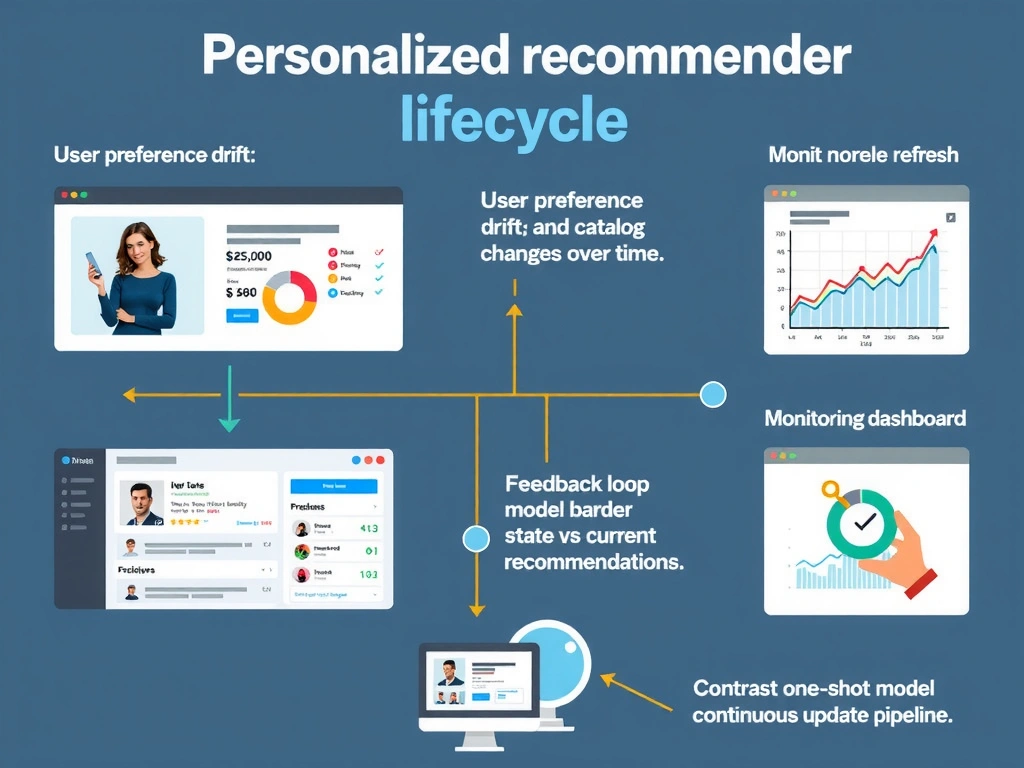
Full Explanation
Personalized recommendation systems map users, items, and context to ranked suggestions intended to improve engagement, conversion, or satisfaction. Unlike a static image classifier trained on a fixed label taxonomy, recommenders sit in a non-stationary environment. User interests evolve, new products enter the catalog, prices and promotions change, and feedback loops amplify whatever the model previously ranked highly. As a result, a model that performed well at launch can quietly degrade unless teams retrain, fine-tune online components, refresh features, or apply continual learning strategies with careful safeguards.
The correct answer therefore highlights the need to constantly update the system so changing preferences—and related catalog dynamics—are reflected. That operational reality drives MLOps practices specific to recommendations: scheduled retraining, feature store freshness, A/B testing, offline replay metrics such as NDCG or recall@k, online metrics such as CTR and revenue per session, and monitoring for popularity bias or filter bubbles. Cold-start for new users and items, exploration–exploitation trade-offs, and fairness across creators or sellers often compound the refresh problem, but temporal drift remains a central theme.
Distractors reverse or misstate the difficulty. Extremely high precision is not a typical chronic problem; if anything, sparse implicit feedback and noisy clicks make evaluation hard. Claiming negligible compute cost ignores candidate generation over large catalogs, approximate nearest neighbor search, real-time feature lookup, and multi-stage ranking under tight latency budgets. Asserting that models cannot run on ordinary infrastructure is false for the vast majority of commercial recommenders, which deploy on standard cloud microservices with GPUs only when deep models require them.
Design guidance: capture interaction logs with timestamps, separate training from serving features carefully to avoid leakage, retrain on sliding windows that emphasize recent behavior when appropriate, and maintain fallback popularity or business-rule ranks when personalized scores are stale or unavailable. On an exam, when a scenario stresses personalization in the wild, look for answers about preference change, continuous updates, and feedback—not about precision being "too high" or deployment being impossible.