
In an end-to-end AI engineering pipeline, what is the primary purpose of a production monitoring system?
Select an answer to reveal the explanation.
Short Explanation and Infographic
Check this out: once your model is live, the work isn't over—it's just moved. Think of monitoring like a smoke detector for ML. It watches whether predictions still make sense, whether inputs look weird compared to training, and whether quality is sliding. That's data drift and model degradation in plain English. Here's the trap: people mix monitoring up with writing code, cleaning data, or storing the training set. Those are other jobs in the pipeline. Imagine your boss walks in after a silent accuracy drop that nobody saw for three weeks—not a fun meeting. You want dashboards, alerts, and clear owners. Trust me on this: ship without monitoring and you're flying blind. Primary purpose = track production performance and catch drift/degradation early so you can retrain, roll back, or fix data. Got it? Let's keep rolling.
Full explanation below image
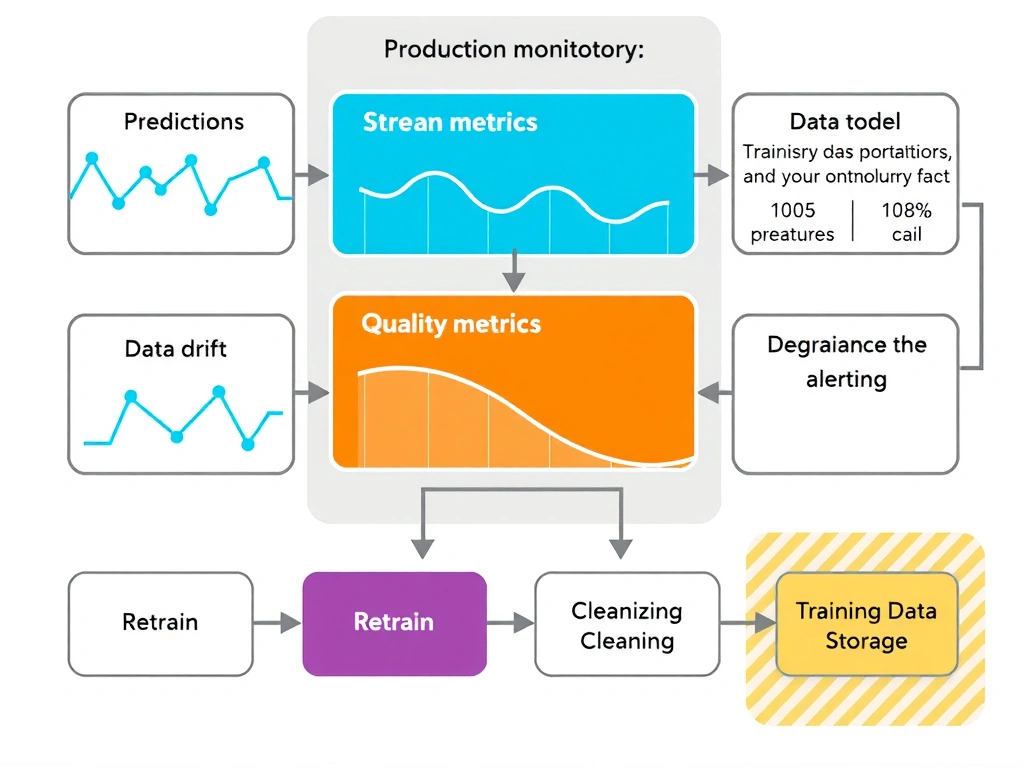
Full Explanation
After a model is deployed, the AI engineering pipeline does not end. Production environments continuously generate new inputs that may differ from the training distribution, and downstream systems can change how labels or feedback are collected. A monitoring system exists primarily to observe the live model: prediction quality where ground truth arrives with lag, proxy metrics when labels are delayed, service-level indicators such as latency and error rates, and statistical checks for data drift, concept drift, or sudden feature anomalies. When degradation is detected, teams can investigate root causes, retrain, recalibrate thresholds, or roll back to a previous champion model.
This purpose is distinct from other pipeline components. Writing model code is a development activity supported by notebooks, repositories, and CI. Cleaning and preprocessing historical data belong to data preparation before or during training workflows. Storing the labeled training corpus is a responsibility of data lakes, feature stores, or training datasets—not of the monitor itself, even though monitors may persist prediction logs and intermediate telemetry for analysis.
Effective monitoring design defines ownership, alert thresholds, dashboards for technical and business stakeholders, and playbooks that connect alerts to actions (investigate feature pipeline, refresh training data, run shadow evaluation, or trigger retrain). Best practices include separating infrastructure health from ML health, tracking both input distributions and output distributions, and avoiding sole reliance on a single offline metric computed only at train time.
Exam and job memory aid: train builds capability; deploy delivers capability; monitor protects capability. If a choice describes coding, cleaning, or archival storage, it is not the main purpose of production monitoring. If it describes tracking live performance and detecting drift or degradation, it matches the monitoring stage of the AI engineering pipeline.