
A research team needs an agent that improves at a multi-level video game by interacting with the environment, receiving scores after actions, and adjusting behavior over many episodes. Which AI paradigm is the most appropriate primary approach?
Select an answer to reveal the explanation.
Short Explanation and Infographic
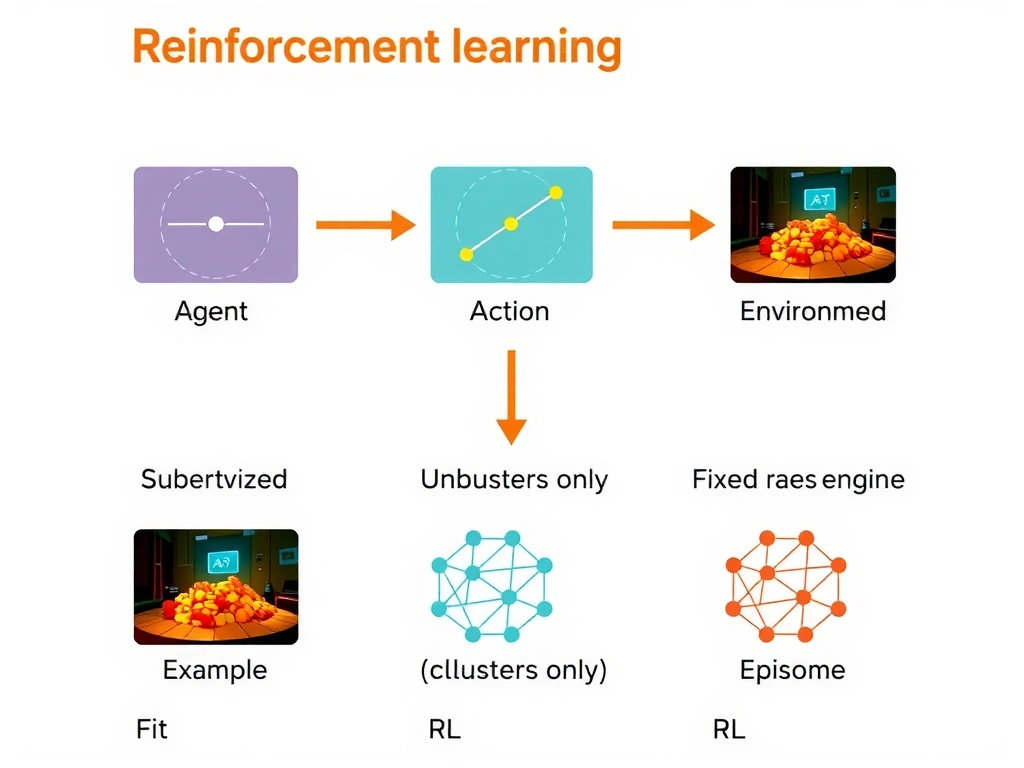
Here's where it gets fun. Your agent plays, scores points (or dies), and gets better. That's reinforcement learning—trial, error, reward. Think of it like training a dog: good behavior, treat; bad behavior, no treat. No massive spreadsheet of "correct move for every frame" required like pure supervised learning wants. Unsupervised clustering might group similar screens, but it doesn't chase a high score. Hard-coded rules? Fine for tic-tac-toe on a napkin, brittle for rich games. Exam trap: dumping every problem into supervised learning because that's what people study first. Imagine your boss walks in: "Make it beat level 12." You reach for RL—state, action, reward, policy. Remember: interactive goals + delayed rewards = reinforcement learning. Practice a tiny gridworld and it'll click.
Full explanation below image
Full Explanation
Reinforcement learning (RL) studies sequential decision-making. An agent observes a state, selects an action, transitions in an environment, and receives a scalar reward (or cost). Over many episodes it improves a policy—mapping states to actions—to maximize expected cumulative reward. Multi-level games fit this template naturally: the screen or internal game state is the observation, controller inputs are actions, points and win/loss conditions define rewards, and long-term strategy matters more than a single independent classification.
Supervised learning is powerful when abundant input–label pairs exist, such as classifying images or predicting a target from tabular features. In rich games, obtaining an optimal labeled action for every state is often impractical, and independent example assumptions ignore temporal credit assignment—the need to connect delayed rewards to earlier decisions. Behavioral cloning from expert demos can assist, but the core paradigm for learning from interactive scores remains RL (sometimes hybridized with supervised pretraining).
Unsupervised learning discovers structure—clusters, density models, representations—without task rewards. Representation learning can help RL agents, yet clustering screenshots alone does not optimize gameplay. Static rules-based systems encode human heuristics. They can be effective in narrow, fully understood games but scale poorly as state spaces grow and typically do not improve automatically from interaction outcomes.
Practical RL systems use algorithms such as Q-learning, policy gradients, or actor–critic methods, often with deep function approximators for high-dimensional observations. Success still depends on reward design, exploration, and evaluation against holdout levels to avoid brittle memorization. For exam purposes, match the problem shape: labeled targets → supervised; structure without labels → unsupervised; agent–environment loop with rewards → reinforcement learning. The game-playing research scenario is the textbook RL use case.