
After a team finishes cleaning its dataset for an AI product—handling missing values, fixing types, and removing obvious junk—what is the most appropriate next stage in a standard AI engineering pipeline?
Select an answer to reveal the explanation.
Short Explanation and Infographic
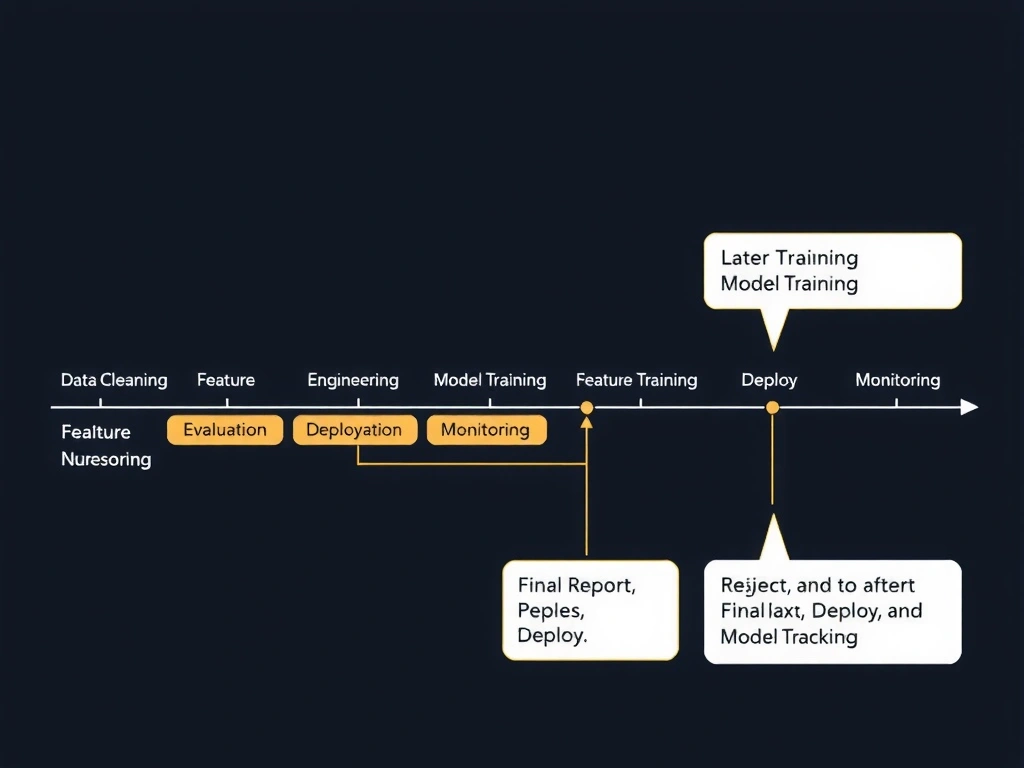
Okay, let's dive in. You just scrubbed the data—nice work. What next? You don't jump to the victory lap report or ship something half-baked to prod. Think of cleaning like prepping ingredients: now you cook. That means feature engineering—turning clean fields into signals the model can use—and then training and evaluating models. Model tracking is smart hygiene, but it's not the next pipeline stage after cleaning. Deployment comes after you've actually got a model worth serving. Exam trap: people reorder the AI lifecycle and put deploy or docs too early. Imagine your boss walks in: "Data's clean—are we live?" Your answer: "Next we engineer features and train." Remember the flow: clean → features + train → evaluate → deploy → monitor. Stick with that and you'll nail both the job and the exam.
Full explanation below image
Full Explanation
A typical AI engineering pipeline moves from problem framing and data collection through preparation, modeling, evaluation, deployment, and monitoring. Data cleaning sits in the preparation phase: it corrects invalid values, standardizes formats, treats missingness according to policy, deduplicates records, and removes clearly unusable rows. Cleaning improves reliability of later stages but does not by itself produce features or a predictive model.
Immediately after cleaning, practitioners transform prepared tables or streams into model-ready representations—feature engineering and related selection or encoding—and then train candidate algorithms on those representations. Feature work may include scaling, encoding categoricals, creating interaction or temporal features, embeddings, or domain-specific transforms. Training then fits parameters under a chosen loss or objective, usually with cross-validation or a held-out split. Only after offline evaluation (and often fairness or robustness checks) does the pipeline advance toward packaging, deployment, and production monitoring.
Model tracking and experiment lineage are important MLOps practices that should run alongside training, but they are supporting infrastructure rather than the sequential "next stage" after cleaning. Generating a final report is a late-stage communication activity that assumes results exist—metrics, decisions, and often post-deployment evidence. Deploying before feature engineering and training skips the core modeling work and risks serving unvalidated behavior.
Memory aid for the exam and for production planning: clean prepares the canvas; features paint the signal; training fits the model; evaluation grades it; deployment serves it; monitoring keeps it honest. Placing feature engineering and model training next after cleaning preserves technical correctness and matches standard lifecycle diagrams used in AI engineering curricula and industry practice. Teams that jump from clean data straight to production often discover that unengineered raw fields underperform and that unvalidated models fail basic acceptance tests, which is exactly why the pipeline order matters on both the job and the exam.