
Which practice is commonly recommended in AI engineering to make a trained model more efficient at serving time without abandoning learned quality entirely?
Select an answer to reveal the explanation.
Short Explanation and Infographic
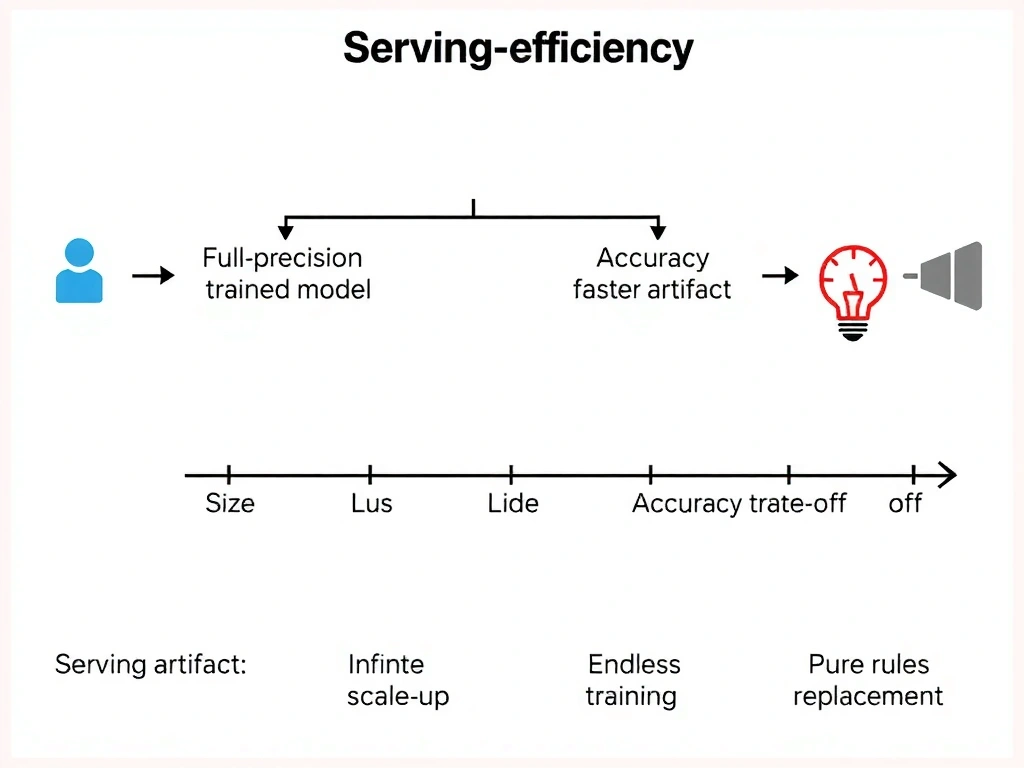
Check this out—your model works, but the boss wants it on a phone and under a tight latency SLA. You don't always retrain a monster from scratch. You slim what you already learned: prune away dead weight, quantize floats down so math is cheaper, and watch accuracy so you don't gut quality. Think of it like packing for a flight: same trip, smaller suitcase, still bring the essentials. Exam trap: "just make it bigger," "train forever," or "throw ML away for pure rules." Those miss the efficiency play. Pay attention: pruning and quantization are the classic post-training or during-training compression moves for serving. Land the takeaway: smaller, faster inference with controlled accuracy trade-offs. Nice and clean—keep going.
Full explanation below image
Full Explanation
Deployed models must satisfy operational constraints: memory footprint, cold-start time, hardware cost, energy use, and prediction latency. Accuracy on a validation set is necessary but not sufficient if the model cannot meet service-level objectives in production. AI engineering therefore includes a family of model-efficiency techniques that reduce computational and storage requirements while attempting to preserve task performance within an acceptable band.
Two widely taught techniques are pruning and quantization. Pruning removes weights, channels, attention heads, or other structures that contribute little to predictions, yielding a sparser or smaller network. Structured pruning can map well to real hardware speedups; unstructured pruning may need specialized kernels. Quantization represents weights and activations with lower-precision numerics (for example, 8-bit integers instead of 32-bit floats), cutting memory bandwidth and enabling faster arithmetic on CPUs, GPUs, and edge accelerators. Related methods include knowledge distillation into smaller students, operator fusion, and graph optimization in serving runtimes. Teams typically measure accuracy, latency, throughput, and model size before and after compression and may fine-tune after aggressive changes.
The correct option names this best-practice pattern: use pruning or quantization (among similar methods) to reduce size and inference time while retaining acceptable effectiveness. That is the engineering sweet spot between quality and cost.
Distractors reflect popular but incomplete strategies. Making the model as large as possible may improve capacity on hard tasks yet usually increases serving cost and latency; size is not an efficiency goal. Training for a very long time without disciplined early stopping or validation can overfit and burn compute without guaranteeing faster inference. Replacing the model with a pure rules-based system abandons learned generalization and is not the standard efficiency recipe for an already trained neural or statistical model, though hybrid systems may still use rules for guardrails.
Principle: optimize for the deployment envelope. Profile the bottleneck, choose compression or architecture changes that target that bottleneck, validate quality on representative inference data, and monitor production. Memory aid: big model in the lab, lean model at the edge—prune and quantize to ship.