
During the lifecycle of a deployed predictive system, how do training data and inference data differ in purpose?
Select an answer to reveal the explanation.
Short Explanation and Infographic
Okay, let's dive in. Training data is the gym—you work out on examples with answers so the model learns the pattern. Inference data is game day—new plays coming in after deployment, and the model has to call them without the answer key taped to the ball. Think of it like studying past exams, then sitting a brand-new one. Boss walks in: "Why did we retrain on last quarter's tickets but score today's tickets live?" That's training versus inference. Exam trap: flipping the two, claiming they're identical, or insisting inference rows always have labels. Labels for monitoring may arrive later, but at prediction time you're usually flying without them. Land it: train to learn, infer to predict on unseen inputs. You've got this—keep rolling.
Full explanation below image
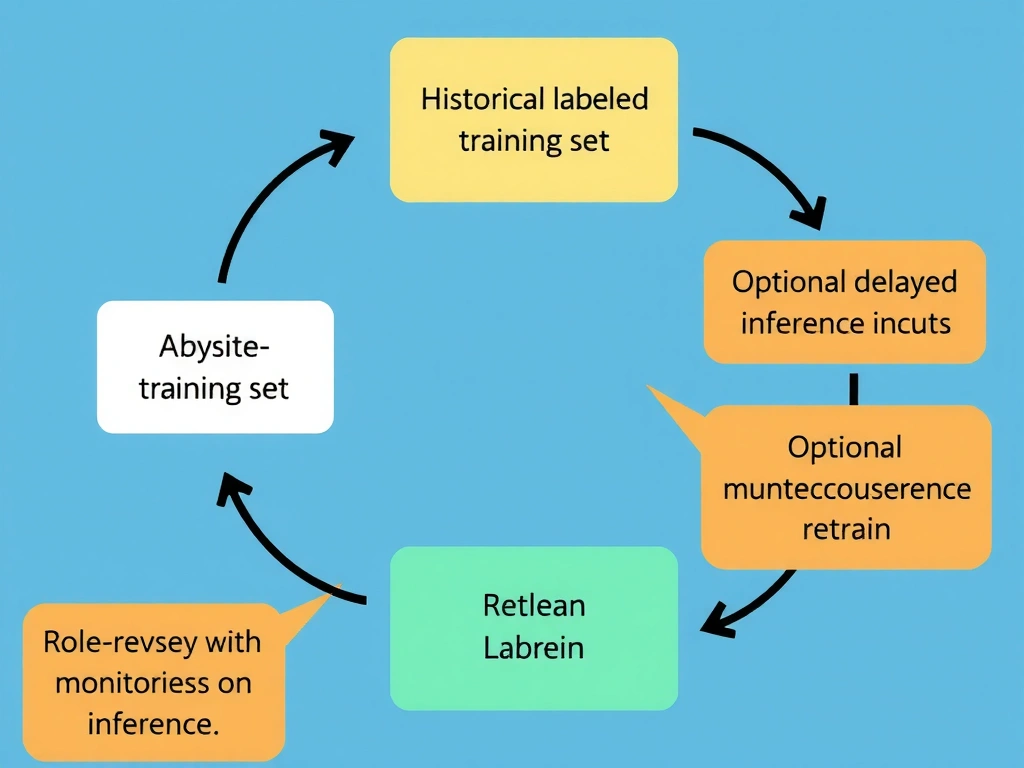
Full Explanation
Machine learning systems separate the phase in which a model is learned from the phase in which a learned model is applied. Training data consists of historical examples used to estimate parameters, trees, embeddings, or other representations. In supervised settings those examples typically include features and target labels; unsupervised or self-supervised setups still use a designated training corpus, even if labels are implicit. The training process may also carve out validation and test splits for development-time evaluation, but those splits remain part of the model-building lifecycle rather than live scoring.
Inference data, by contrast, is the stream or batch of inputs presented to an already trained model so it can emit predictions, rankings, classifications, or generations in production (or in a staging environment that mimics production). Those inputs are new relative to the fitted parameters: they may come from current users, sensors, documents, or transactions. At the moment of prediction they often lack ground-truth labels. Labels may be collected later for monitoring, feedback loops, or retraining, but standard inference does not require them.
The correct answer states this division cleanly: training data fits the model; inference data is fresh production (or post-deployment) input used to make predictions. That distinction underpins data contracts, feature parity, latency requirements, and monitoring design. Training jobs can tolerate batch latency and heavy feature joins; inference paths often demand strict SLAs, online feature lookups, and careful handling of missing fields.
Distractors encode common misconceptions. Reversing the roles confuses training with evaluation or serving and will break every pipeline design question. Claiming training and inference data are always the same labeled table ignores distribution shift, time, and the fact that live inputs may not be labeled. Asserting that inference data must always carry labels confuses optional online learning or delayed feedback with ordinary predictive serving.
Best practices include documenting schemas for both stages, ensuring feature transformations match (or are mediated by a feature store), monitoring for train–serve skew and data drift, and scheduling retraining when inference distributions move away from the training distribution. Memory aid: training is practice with answers; inference is the live performance without the answer sheet in hand.