
In a multi-team production ML platform, what is the primary role of a feature store?
Select an answer to reveal the explanation.
Short Explanation and Infographic
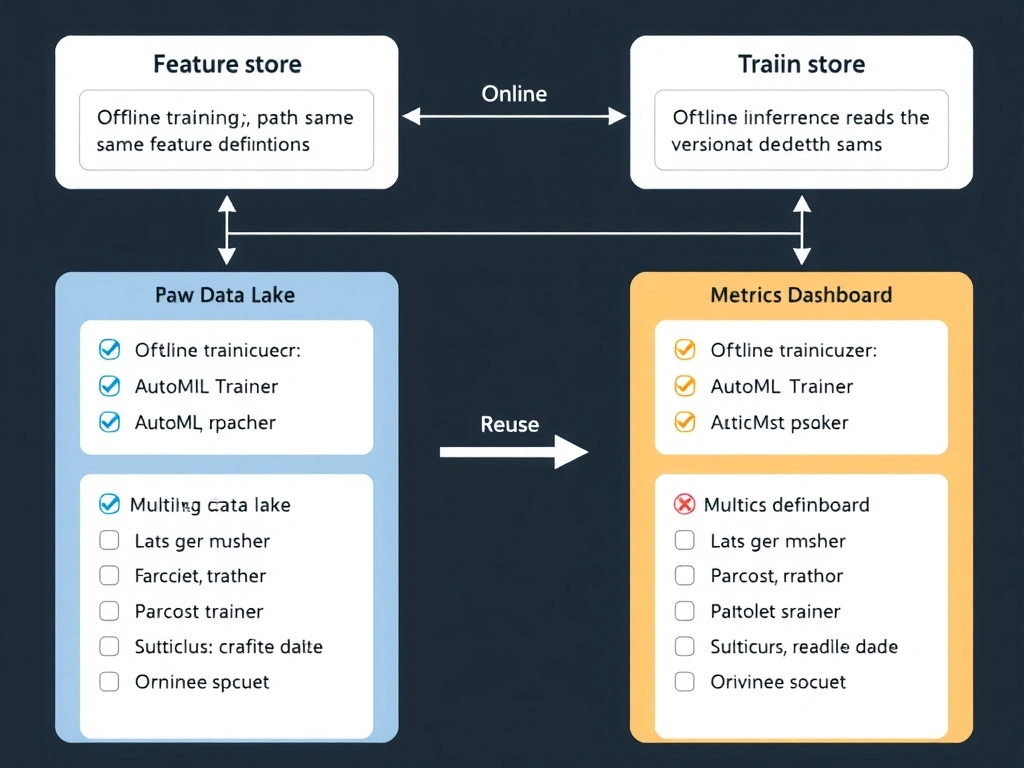
Here's the deal: when five teams each invent their own "customer_spend_30d" column, your models disagree and production bites you. A feature store is the shared pantry—define a feature once, version it, compute it offline for training, and serve the same logic online at prediction time. Think of it like this: one recipe book for the whole kitchen, not five sticky notes on different fridges. Boss walks in and asks why two models scored the same user differently? Without a feature store, good luck. Exam trap: people pick "raw data lake," "auto trainer," or "metrics dashboard" because those live nearby in MLOps. Remember: feature store = consistent, reusable, versioned features for train and serve. Got it? Sweet. Keep that straight and you're already ahead.
Full explanation below image
Full Explanation
A feature store is an MLOps building block whose core purpose is to provide a centralized, consistent, and versioned repository of features that multiple models and teams can share. In large organizations, feature engineering is expensive and error-prone if each project reimplements similar transforms from scratch. Worse, the classic train–serve skew problem appears when training pipelines compute features one way and online services compute them another way. Feature stores address both issues by treating features as first-class products: named, documented, typed, versioned, and materializable for batch (offline) training as well as low-latency (online) serving.
Operationally, engineers register feature definitions—for example, rolling aggregates, embeddings, or entity attributes—along with the pipelines that produce them. During model development, training jobs pull historical feature values point-in-time correctly so labels are not contaminated by future information. After deployment, inference services request the same feature names for live entities and receive values produced by the same definitions. Governance benefits follow: lineage, access control, reuse metrics, and reduced duplication across recommendation, fraud, ranking, and churn models.
The correct option captures this mission: a shared, versioned catalog that stores and serves features consistently across models and teams for offline and online paths. That is the distinctive value of a feature store relative to adjacent platform pieces.
The distractors describe real systems that sit near feature stores but are not substitutes. Automated training or AutoML systems choose algorithms and fit models; they consume features rather than define the shared feature layer. A raw data lake or warehouse holds source events and tables before curated feature logic is applied; dumping unprocessed files is not the same as serving consistent engineered features. Metrics warehouses and model monitoring tools track accuracy, latency, drift, and SLOs; they measure models rather than providing the feature substrate those models depend on.
Best practice is to adopt a feature store when multiple consumers need the same entity features, when train–serve consistency is critical, or when feature reuse is a strategic goal. Pair it with clear ownership of feature definitions, point-in-time correctness in training, and monitoring of online feature freshness. Memory aid: features are the ingredients; the feature store is the shared kitchen inventory—not the oven (trainer), not the farm (raw data), and not the thermometer (metrics).