
Which approach best reflects an AI engineering best practice for protecting data privacy when building and operating models?
Select an answer to reveal the explanation.
Short Explanation and Infographic
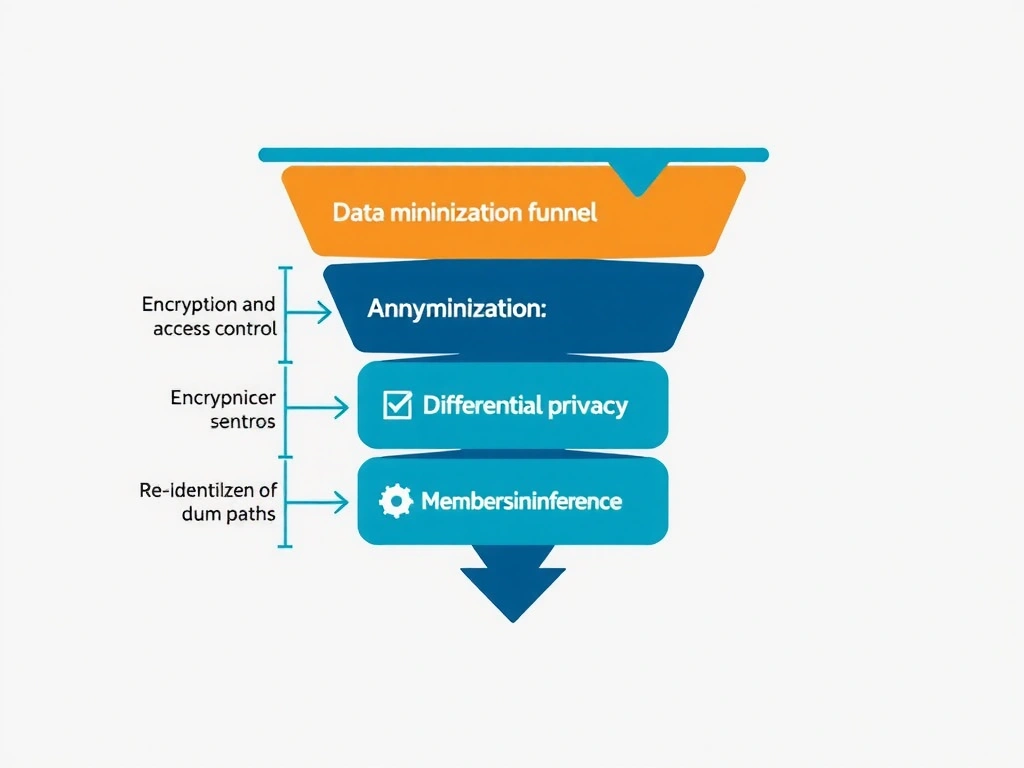
Let's talk privacy like it's a production outage waiting to happen—because a leak feels exactly like that. You can't always avoid sensitive data, but you can handle it like a pro: minimize what you collect, lock it down, and use techniques like anonymization and differential privacy so models learn patterns without turning into a gossip column about real people. Think of differential privacy as adding carefully calibrated noise so one person's record can't be confidently plucked out of the results. Exam trap answers go extreme: store everything in the clear, dump data on the internet, or pretend you'll never touch sensitive fields again. Real engineering is balanced—legal basis, purpose limitation, access control, encryption, and privacy tech working together. Remember: protect people first, then train models. That mindset keeps you out of trouble on the job and on the test.
Full explanation below image
Full Explanation
Data privacy in AI engineering is the discipline of collecting, storing, processing, and sharing information in ways that protect individuals and organizations from unauthorized exposure while still enabling legitimate model development. Privacy failures are not only ethical harms; they create regulatory, contractual, and reputational risk. Best practice is multi-layered: data minimization and purpose limitation, strong access control and encryption, secure training and logging pipelines, vendor diligence, and specialized privacy-enhancing technologies when re-identification or membership inference risks remain.
Among the options, applying techniques such as anonymization and differential privacy—chosen to match data sensitivity and the threat model—is the sound best practice. Anonymization and de-identification remove or transform direct and indirect identifiers so residual risk of linking records to people is reduced (understanding that perfect anonymization is hard and quasi-identifiers still matter). Differential privacy provides a mathematical framework that bounds how much any single individual's data can influence outputs or released statistics, often by adding calibrated noise and tracking a privacy budget. Related tools include k-anonymity-style protections, secure enclaves, federated learning for on-device signals, and careful synthetic data generation with leakage tests. These methods do not replace governance; they implement it technically.
Storing data in simple unencrypted form ignores confidentiality fundamentals: encryption at rest and in transit, key management, and least-privilege access are baseline controls, especially for personal or regulated data. Claiming one should never use sensitive data at all is an oversimplification. Some high-value, lawful use cases require sensitive attributes under strict necessity, consent or other legal bases, retention limits, and safeguards; the engineering response is minimization and protection, not a universal ban that may be unrealistic. Sharing all sensitive data publicly confuses transparency with disclosure of personal information and is categorically unsafe.
Practical checklist for teams: classify data, map flows, apply retention schedules, separate production personal data from research sandboxes, prefer aggregated features when possible, audit model outputs for memorization, and document DPIAs or equivalent assessments where required. Train staff not to paste secrets into external LLM tools. For exams, associate privacy best practice with concrete safeguards—anonymization, differential privacy, encryption, access control—rather than extremes of "share everything" or "never touch sensitive fields." Privacy-by-design keeps models useful without treating people as unprotected training fuel.