
An online retailer plans to use a generative AI system to produce product visuals for the catalog. Which best practice should guide generation quality for shoppers?
Select an answer to reveal the explanation.
Short Explanation and Infographic
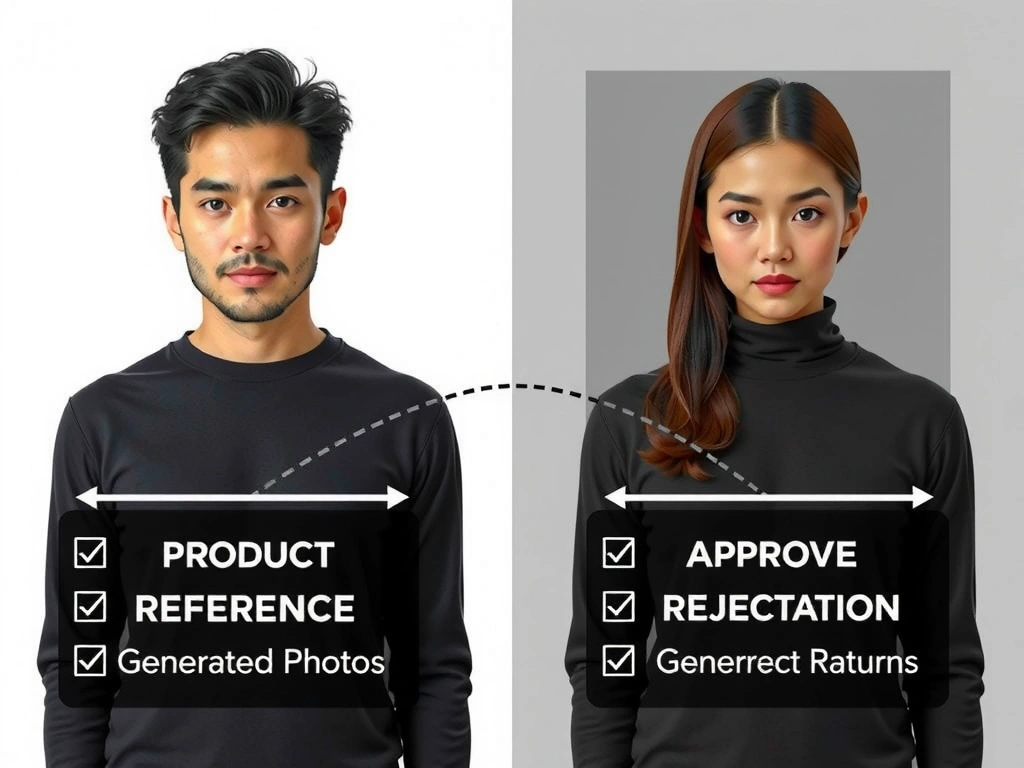
Here's where it gets real for e-commerce. Your generated product shots aren't art-for-art's-sake—they're a promise to the customer. If the AI warps the color, invents a feature, or stretches the silhouette, people feel tricked when the box arrives. Think of it like a menu photo that looks nothing like the plate—nobody comes back. So the best practice is simple: keep images realistic and true to the product, no misleading distortion. Exam noise will tempt you with "never use pretrained," "only one product type," or "just use linear models." Those miss the point. Pretrained generators are fine when you control quality. The hill you die on is fidelity and honesty in what shoppers see. Pay attention—trust is the metric that quietly kills conversion when images lie.
Full explanation below image
Full Explanation
Generative models can accelerate catalog creation by synthesizing lifestyle scenes, missing angles, or localized creatives, but retail imagery carries a truth-in-advertising obligation. Shoppers use product photos to form expectations about appearance, materials, scale, and features. Best practice for this use case is therefore fidelity: generated images should look realistic and should not distort the product in ways that misrepresent what will be shipped. Quality review should check color accuracy, geometry, branding marks, accessory completeness, and absence of hallucinated attributes.
The correct option captures that requirement directly—realistic, undistorted product representation. Operationally this means human-in-the-loop review for high-risk SKUs, automated detectors for artifacts, comparison against reference photos when available, clear internal policies for acceptable retouching versus deceptive alteration, and disclosure practices consistent with platform and regulatory expectations. When generation fails fidelity checks, regenerate, edit with controlled tools, or fall back to photography rather than publish misleading assets.
Restricting generation to a single product type forever is not a best practice; catalogs are multi-category by nature. Scope control during a pilot can be wise, but the principle the exam is testing is image integrity, not permanent category limits. Avoiding all pre-trained models is also not required. Foundation models fine-tuned or guided with product references often improve quality and cost efficiency; the safeguard is evaluation and governance, not a ban on pretraining. Suggesting a simple linear model as an image generator confuses supervised tabular regression with generative computer vision; linear models do not synthesize photorealistic product imagery and are not a substitute architecture for this task.
Additional practices complement fidelity: maintain brand style guides as conditioning constraints, log prompts and seeds for reproducibility, watermark or metadata-tag synthetic assets for internal traceability where policy requires, and measure downstream metrics such as return rates tied to "item not as pictured." In regulated categories (for example cosmetics claims or children's products), legal review may be mandatory. For certification questions, prioritize the customer-facing integrity rule—realistic, non-distorting product depiction—over unrelated restrictions about pretraining or linear models. Generative AI is a productivity lever only when outputs remain honest visual descriptions of the goods you sell.