
Which statement best captures a central goal of Explainable AI (XAI)?
Select an answer to reveal the explanation.
Short Explanation and Infographic
Okay, real talk: bosses and regulators don't just want accuracy—they want to know why the model said what it said. That's Explainable AI. Think of a loan system that denies someone; XAI is the toolkit and mindset that helps you show the factors behind that call instead of shrugging at a black box. Exam trap options talk about making models smaller, faster, or 'a type of generative AI.' Wrong axes. Compression and speed matter, sure, but they're not the XAI mission statement. Transparency, interpretability, human-meaningful reasons—that's the target. When ethics and governance show up on the test, wire XAI to understanding and accountability. You're building trust, not just FLOPS.
Full explanation below image
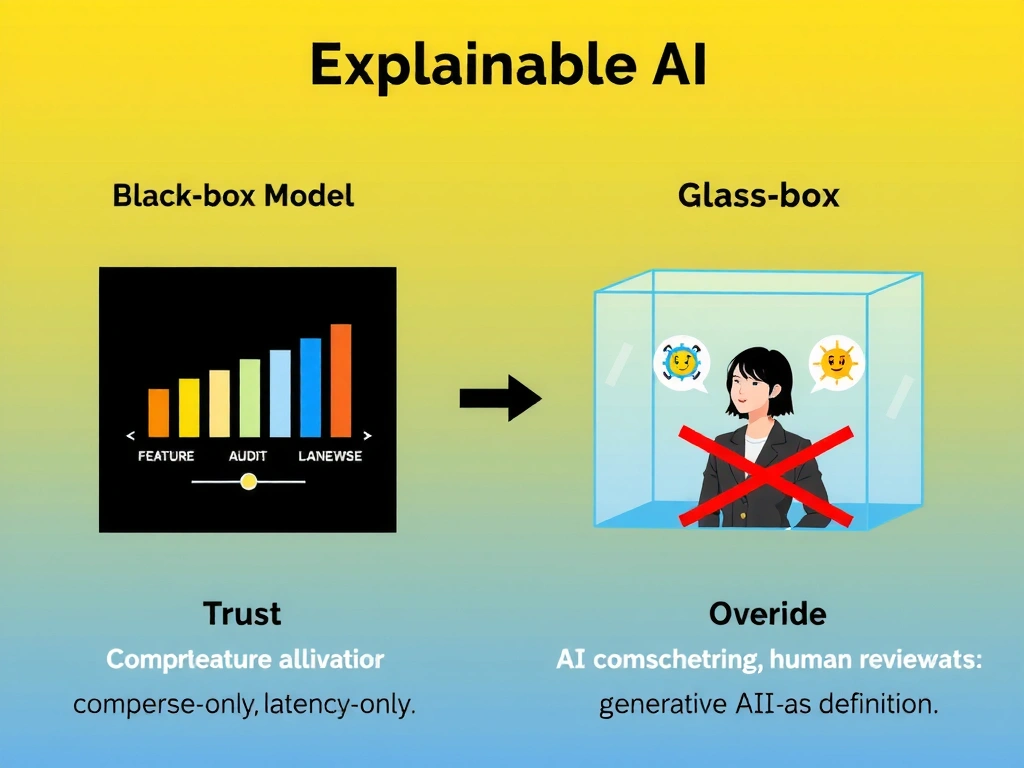
Full Explanation
Explainable AI (XAI) is the set of methods, design practices, and governance expectations aimed at making artificial intelligence systems’ internal logic and outputs understandable to humans. Stakeholders—developers, domain experts, users, auditors, and regulators—need insight into why a model produced a score, ranking, or action so they can validate correctness, detect bias, meet compliance duties, and decide when to override automation. Techniques range from intrinsically interpretable models (sparse linear models, rule lists, shallow trees) to post-hoc explanations for complex models (feature attributions, saliency maps, counterfactuals, example-based explanations, and concept-based methods). Documentation artifacts such as model cards and datasheets complement algorithmic explanations.
XAI is not synonymous with model compression: reducing parameters or quantizing weights targets footprint and cost, which may even trade off against transparency if aggressive optimization obscures behavior. Likewise, maximizing runtime efficiency is a performance engineering goal; a blazingly fast opaque system can still fail XAI requirements. Generative AI refers to models that synthesize text, images, audio, or other media; explainability may be applied to generative systems, but XAI is not defined as a generative model class.
In regulated and high-stakes domains—credit, healthcare, hiring, safety-critical control—explainability supports accountability and user rights. Best practices include selecting explanation types that match the audience, measuring explanation fidelity and stability, avoiding misleading rationalizations, and combining monitoring with human review pathways. For exam questions, anchor XAI to transparency and human understanding of decisions. If an option emphasizes size, pure speed, or equates XAI with generative modeling, reject it. The lasting takeaway: performance metrics answer how well a model predicts; XAI answers how and why those predictions arise in terms people can scrutinize.