
In natural language processing, what does the TF-IDF representation measure?
Select an answer to reveal the explanation.
Short Explanation and Infographic
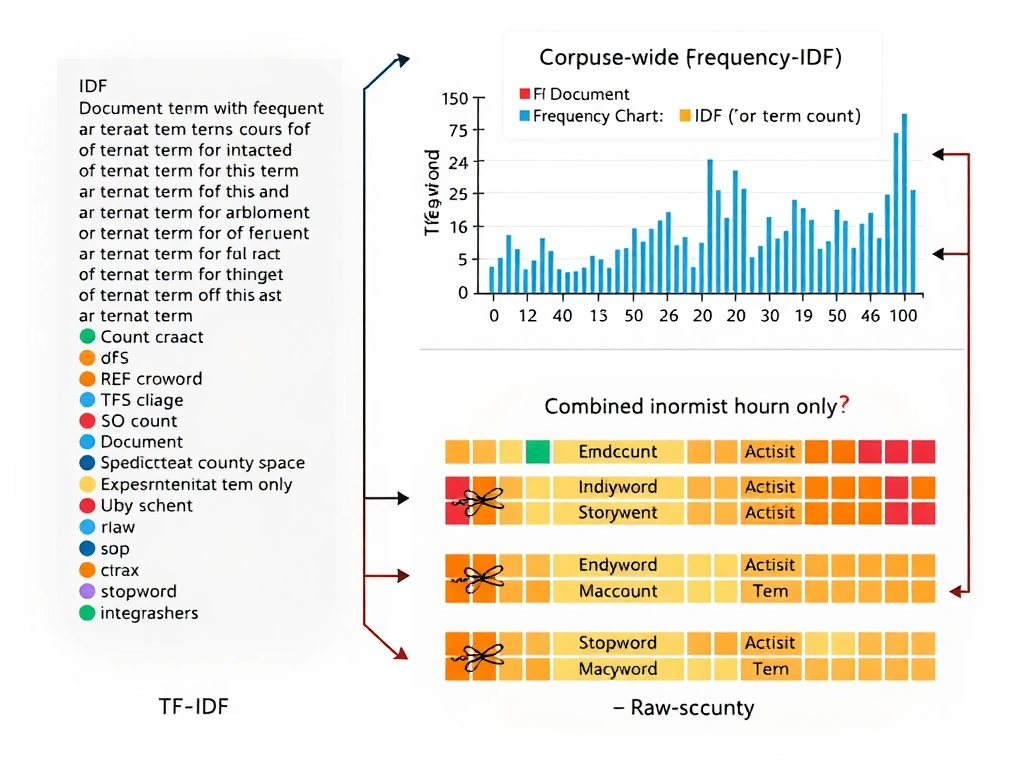
TF-IDF sounds fancy until you unpack the acronym with me. Term Frequency: how much does this word show up in this document? Inverse Document Frequency: how special is it across the whole pile of documents? Multiply those ideas and common glue words shrink while distinctive content words pop. That's it—importance scoring, not magic mind reading. Exam trap: calling TF-IDF an embedding, a plain word count, or 'just stopword removal.' Embeddings learn meaning geometry; raw counts ignore corpus rarity; stopword lists are a different tool. When the question asks what TF-IDF is, go importance = local frequency × global rarity. Nail that and related questions get easier. Keep practicing on real corpora if you can.
Full explanation below image
Full Explanation
TF-IDF is a classic sparse vectorization method used in information retrieval and traditional NLP pipelines. For each term t in document d, a term-frequency component measures how often t occurs in d (raw count, log-scaled count, or normalized variants). An inverse-document-frequency component measures how uncommon t is across the corpus—often log(N / df_t) where N is the number of documents and df_t is the number of documents containing t. The product yields a weight that is high when a term is frequent in a specific document yet rare globally, and low when a term is ubiquitous. Documents become vectors of these weights for similarity search, clustering, or linear classification.
TF-IDF is not a neural word embedding: embeddings learn dense geometries that capture synonymy and analogy-style relationships, whereas TF-IDF dimensions correspond to vocabulary terms and remain sparse. It is more than a simple word count because the IDF factor reweights counts using collection statistics. It is also not equivalent to stopword removal, even though both reduce the influence of very common tokens; IDF soft-weights the entire vocabulary rather than applying a binary keep/delete list, and analysts may still remove stopwords as a separate step.
Understanding TF-IDF supports intuition for BM25 and other retrieval functions and clarifies why classical text features emphasize distinctive tokens. On exams, prefer definitions that mention both within-document frequency and across-corpus rarity. Implementation tips include fitting IDF on training documents only, handling out-of-vocabulary terms carefully, and considering sublinear TF scaling. Those details keep vectorizers honest in production while the conceptual core stays stable: TF-IDF quantifies term importance for a document relative to a corpus, not semantic embedding geometry or mere counting.