
In text normalization for NLP, how does stemming primarily differ from lemmatization?
Select an answer to reveal the explanation.
Short Explanation and Infographic
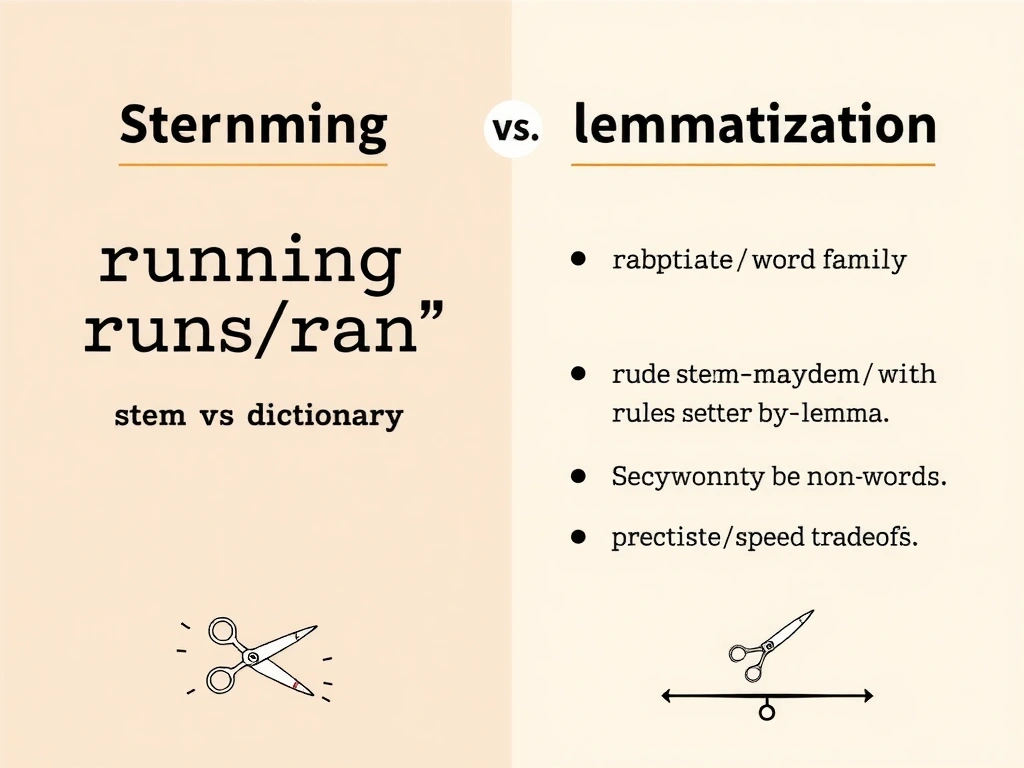
Here's the deal with stems versus lemmas—people mix them up forever. Stemming is the rough chainsaw: rules rip off endings so 'running,' 'runs,' 'ran' might collapse to something like 'run'… or a weird stump that isn't even a real word. Lemmatization is the careful librarian: it checks a dictionary and grammar so you get a proper base form—'better' to 'good' when the analyzer is smart enough. Exam trap says they're the same, or one is for numbers, or one is 'supervised learning.' Nope. Fast-and-crude versus slower-and-cleaner—that's the mental model. If your pipeline can afford it and you care about readable tokens, lean lemma; if you need speed and fuzzy grouping, stem. Got it? Sweet.
Full explanation below image
Full Explanation
Stemming and lemmatization both reduce morphological variants so that related word forms share a common feature key, which can shrink vocabulary size and help classical NLP models generalize. Their mechanisms differ. Stemming uses rule-based or algorithmic procedures (Porter, Snowball, and similar stemmers) that strip suffixes and sometimes prefixes according to handcrafted patterns. The result is often a truncated stem that may not be a valid surface word, and over-stemming or under-stemming errors are common. Lemmatization aims to return the lemma—the canonical dictionary form of a word—using vocabularies and morphological analysis, often informed by part-of-speech tags (for example, 'mice' → 'mouse', 'running' as a verb → 'run'). Because it consults linguistic resources, lemmatization is generally more precise and readable, at higher computational and dependency cost.
The distractors misframe the techniques as supervised versus unsupervised learning problems, as numeric versus textual operations, or as identical algorithms. Those characterizations do not match standard NLP definitions. In pipeline design, choose stemming for speed and rough conflation on noisy text, and lemmatization when interpretability and correct base forms matter—for information retrieval, feature engineering ahead of logistic regression or SVMs, or linguistic analysis. Modern neural NLP sometimes skips both in favor of subword tokenizers, yet exams still expect the classical contrast: crude affix stripping versus dictionary-guided base forms.
Memory aid: stemmer = scissors; lemmatizer = dictionary. If the option mentions rules chopping endings versus lexicon-aware base forms, that is the correct distinction. Always validate on your language and domain: aggressive English stemmers can hurt tasks that need fine morphological signal, while careful lemmatization may require accurate POS tagging to pick the right lemma.