
A vision system must keep following one particular vehicle as it moves across successive video frames. What is the name of this computer-vision task?
Select an answer to reveal the explanation.
Short Explanation and Infographic
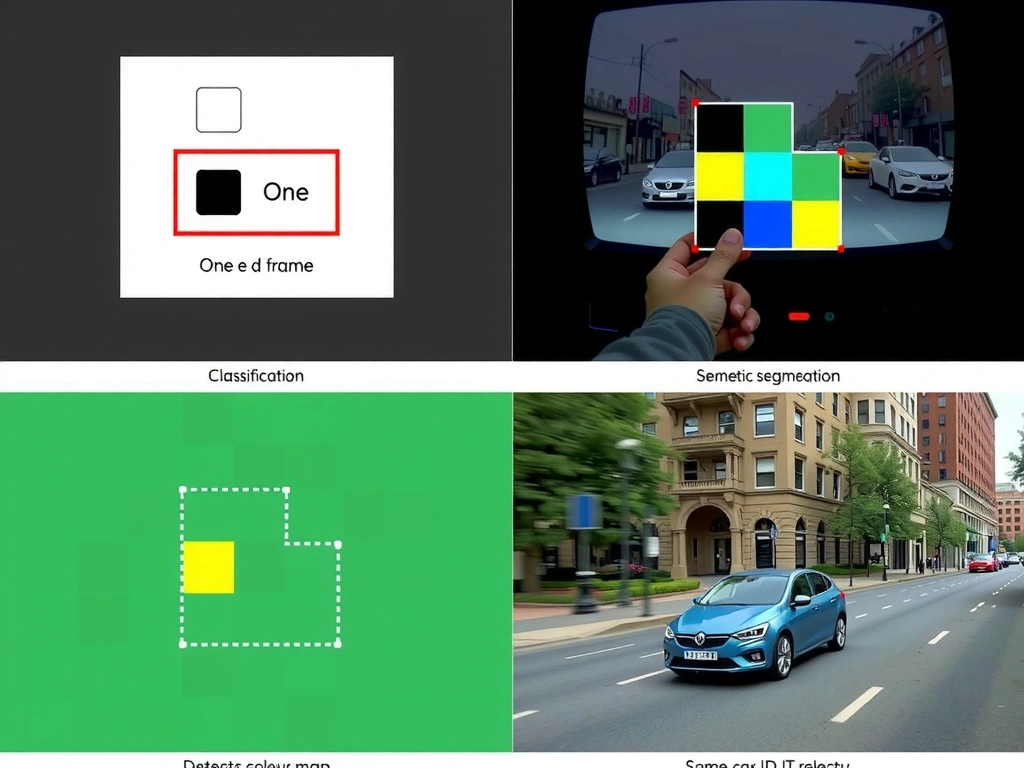
Pay close attention here, because these vision task names trip people up constantly. If the goal is 'keep your eye on that car as it rolls through the clip,' you're in object-tracking land. Detection says 'there's a car here' in one frame. Tracking says 'it's the same car in the next frames.' Classification just stamps the whole picture—cat, dog, whatever. Semantic segmentation paints every pixel with a class label, which is powerful for scene understanding, but it still isn't identity-over-time. Think of it like security cameras: finding people is detection; following one person through the mall is tracking. Exam trap is picking detection because it sounds close. Remember: multi-frame identity continuity = tracking. Got it? Let's keep rolling.
Full explanation below image
Full Explanation
Computer vision tasks sound similar but answer different questions. Image classification asks what is present in an image as a whole and returns a category label without spatial detail. Object detection asks which object categories appear and where, typically outputting bounding boxes (or similar) per frame. Semantic segmentation assigns a class label to every pixel, producing a dense map of regions such as road, sidewalk, or building, still without necessarily distinguishing two cars as separate identities over time. Instance segmentation goes further by separating instances, yet the core multi-frame problem of maintaining a consistent identity as an object moves is object tracking.
Object tracking links detections or embeddings across frames so that a specific target—here, a particular car—receives a continuous trajectory. Practical systems often combine a detector with a tracker (for example detection-plus-association methods using motion models, appearance features, or joint detection-tracking architectures). Challenges include occlusions, camera motion, similar-looking objects, and re-identification after the target leaves and re-enters the scene. Evaluation often uses multi-object tracking metrics such as MOTA or identity switches, which reward correct temporal association rather than single-frame box quality alone.
Why the distractors fail: semantic segmentation explains scene layout but not 'which car is which' across time; classification ignores localization entirely; detection alone is usually per-frame and does not guarantee temporal association. On exams, map verbs carefully: classify (global label), detect (localize classes), segment (pixel classes), track (follow identity over time). For video analytics, surveillance, sports, and autonomous systems, tracking is the label that matches continuous following of a chosen object. When a prompt emphasizes movement through frames and a specific instance, choose object tracking and reserve detection for single-frame localization without the temporal link. A useful memory aid is 'detect finds it once; track keeps the same ID alive across the video.'