
While building a sentiment model on product reviews, a practitioner represents text with TF-IDF instead of a plain bag-of-words count vector. What is the primary advantage of TF-IDF in this setting?
Select an answer to reveal the explanation.
Short Explanation and Infographic
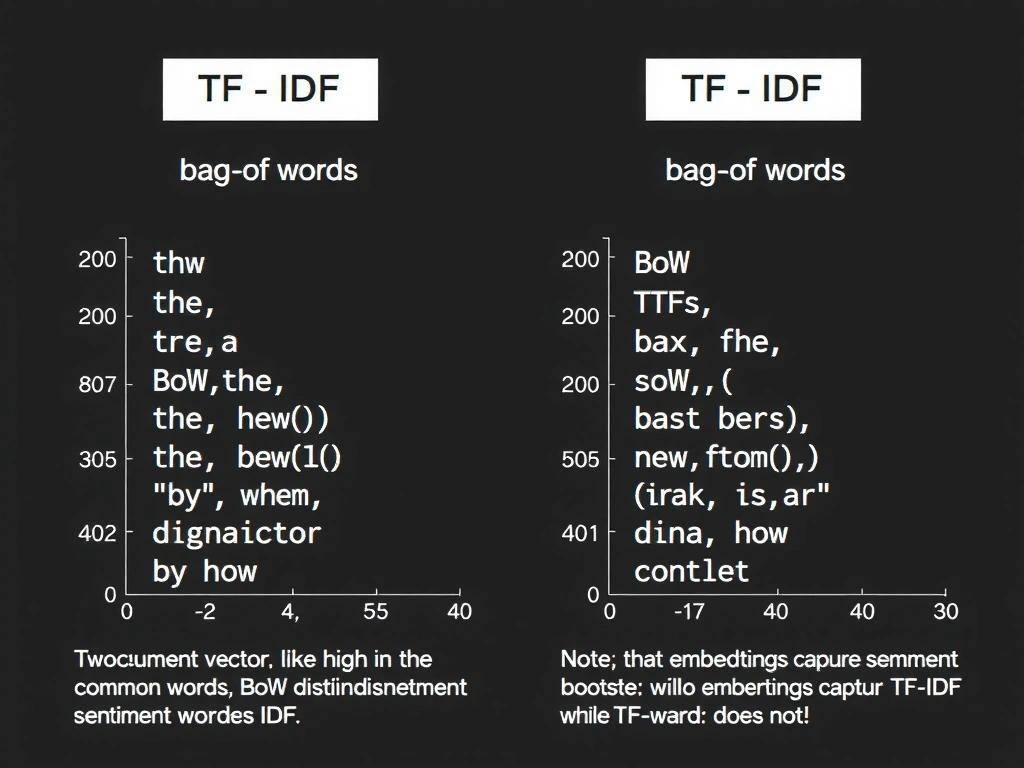
Check this out: bag-of-words just tallies how often each word shows up. That's fine until every review is stuffed with 'the,' 'and,' and 'product'—and those drown out the words that actually scream positive or negative. TF-IDF fixes that by asking two questions: how often does this term appear in this review, and how rare is it across all reviews? Super common words get squashed; distinctive ones get a boost. Exam trap: claiming TF-IDF is 'faster,' 'smaller,' or 'understands meaning.' Nope—it's still word counts with smart weighting, not embeddings. Think of it like a noisy restaurant: bag-of-words hears every fork clink equally; TF-IDF turns down the constant chatter so you hear the unique voice at your table. That's why sentiment pipelines loved TF-IDF for years.
Full explanation below image
Full Explanation
Bag-of-words (BoW) represents a document as a vector of raw term counts (or binary presence) over a fixed vocabulary. While simple and effective as a baseline, BoW treats every occurrence equally: extremely common words that appear in nearly every review can dominate the representation even when they carry little sentiment-specific signal. TF-IDF (term frequency–inverse document frequency) addresses this by combining two statistics. Term frequency (TF) measures how often a term occurs within a document, so words emphasized in that review remain prominent. Inverse document frequency (IDF) measures how rare a term is across the entire corpus; terms that occur in almost all documents receive low IDF weights, while distinctive terms receive high weights. The product emphasizes words that characterize a particular review relative to the collection.
This weighting is the main practical advantage for classic sentiment and topic-style linear models: classifiers see features that better separate classes instead of being overwhelmed by stopword-like mass. TF-IDF is not primarily chosen because it is faster; computing IDF requires a pass over document frequencies and can be slightly more work than pure counts. Memory footprints are typically comparable because both yield high-dimensional sparse vectors, though dimensionality reduction or hashing may be applied independently. Critically, TF-IDF does not capture distributional semantics: synonyms and related phrases remain orthogonal features unless engineered otherwise. Dense embeddings and large language models address meaning more directly, but TF-IDF remains a strong, interpretable baseline and a frequent exam topic.
When comparing options, remember: advantage over BoW equals importance weighting via corpus rarity, not speed, RAM, or deep semantics. Pair TF-IDF with sensible tokenization, optional stopword lists, n-grams, and cross-validated classifiers for a transparent NLP pipeline before escalating to neural encoders.