
An environmental team trains a convolutional neural network on satellite imagery to flag deforestation. Before feeding tiles into the CNN, which preprocessing step is most commonly applied to the pixel intensities?
Select an answer to reveal the explanation.
Short Explanation and Infographic
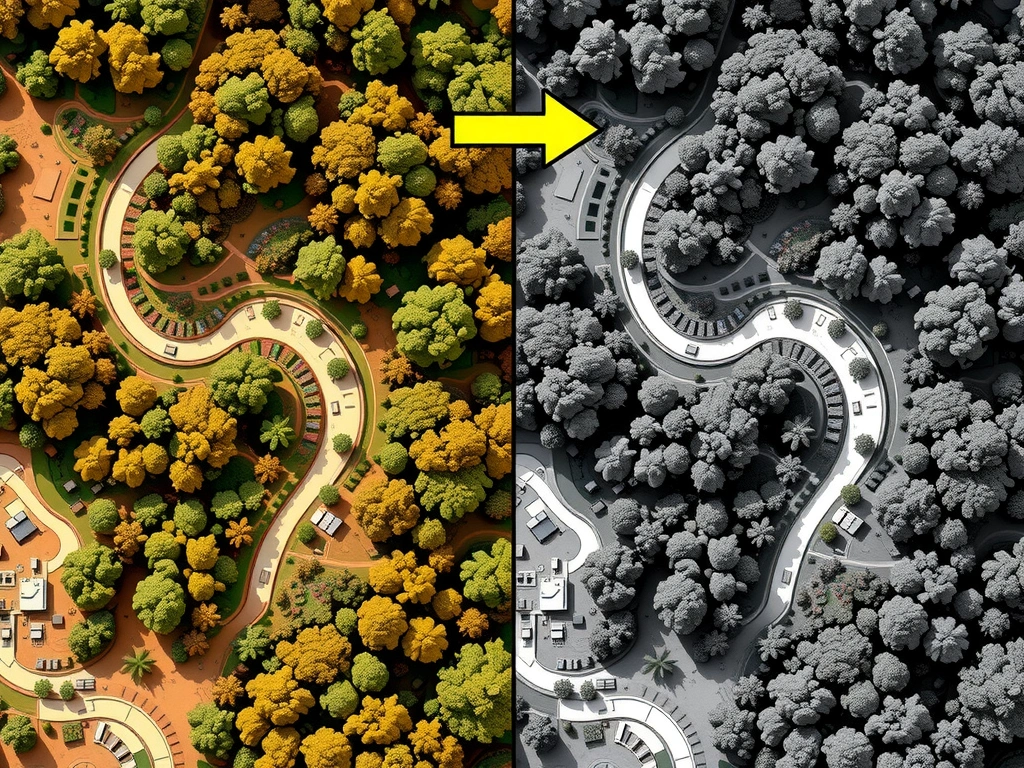
Okay, let's dive in. You've got satellite tiles headed into a CNN—what do almost every serious image pipeline do first with the numbers? Normalize those pixel values. Think of it like turning every photo's brightness dial to the same scale so the network isn't fighting random 0–255 swings. Boss walks in and asks why training is exploding or crawling? Often the pixels never got scaled. Exam trap: blur, random color-space swaps, or grayscale sound 'preprocessing-y,' but they either trash detail or strip channels you might need for deforestation cues. Keep multi-band info when it helps, resize consistently, and put intensities on a shared scale—0–1 or standardized. That's the boring step that makes everything else train cleaner. Trust me on this.
Full explanation below image
Full Explanation
Convolutional neural networks are sensitive to the numeric scale of their inputs. Satellite and other digital images are typically stored with integer channel values (for example 0–255 for 8-bit RGB, or sensor-specific ranges for multispectral products). Feeding raw, unscaled intensities can slow optimization, cause unstable gradients, and make batch statistics harder to learn. Therefore, a standard preprocessing step is to normalize pixels—commonly by dividing by 255 to map values into [0, 1], or by subtracting a dataset mean and dividing by a standard deviation so each channel is approximately zero-centered with unit variance. Many frameworks and pretrained backbones document exact normalization constants; matching them is important when fine-tuning.
Aggressive Gaussian blur is generally counterproductive as a default: it removes high-frequency spatial information that encodes edges of clearings, roads, and canopy texture. Color-space transforms (HSV, LAB, and so on) are sometimes used for illumination robustness or hand-crafted features, but they are not the primary, nearly universal step that normalization is. Converting to grayscale reduces dimensionality and can help monochrome tasks, yet deforestation detection often benefits from color or multi-band spectral responses (for example vegetation indices derived from multiple channels). Dropping channels without analysis risks losing discriminative signal.
In a solid computer-vision pipeline you typically combine geometric consistency (resize/crop), intensity normalization, optional augmentation (flips, modest color jitter), and sensor-specific calibration when available. For exam purposes, when a question highlights preprocessing for CNN imagery and lists normalization against blur, gratuitous color conversion, or forced grayscale, choose the scaling of pixel values. It is foundational, low-risk, and directly supports stable learning—exactly what production teams apply before more specialized transforms.