
A news analytics pipeline must locate and label mentions of people, organizations, and places inside article text. Which NLP task does this describe?
Select an answer to reveal the explanation.
Short Explanation and Infographic
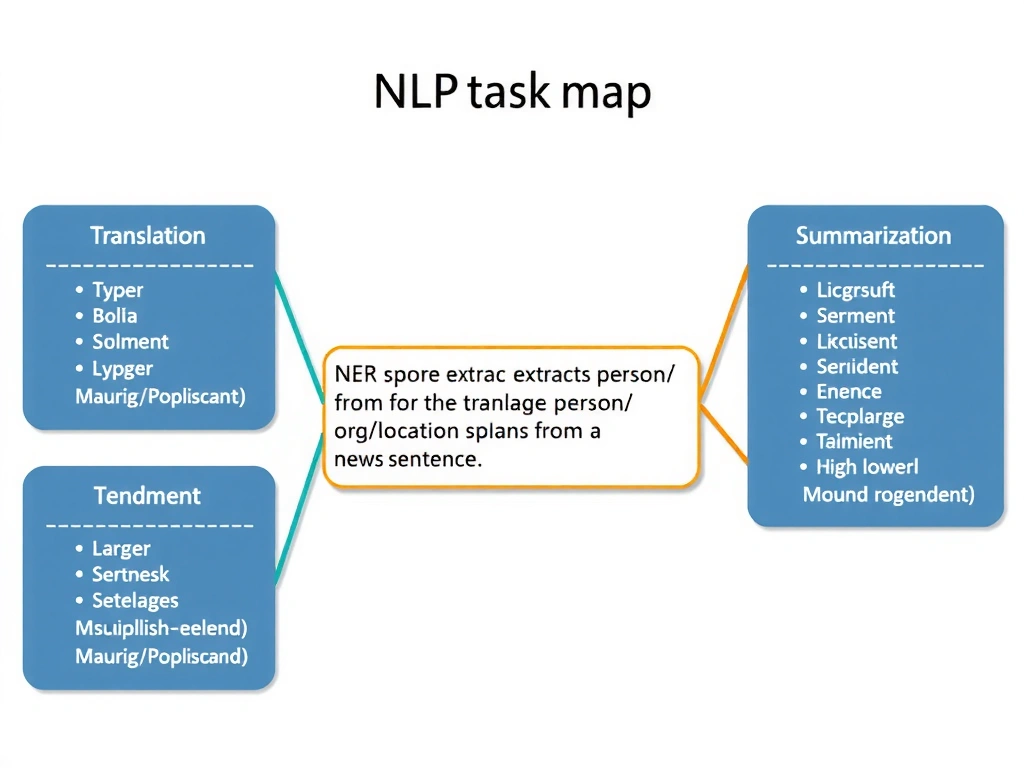
Okay, let's dive in. Your pipeline isn't rewriting the article, translating it, or scoring how positive it sounds—it's hunting for names that matter: people, companies, cities. That's classic Named Entity Recognition. Think of it like highlighting badges on a badge board: "Alice" is a person, "Acme Corp" is an org, "Berlin" is a place. Machine translation moves languages. Sentiment asks "happy or mad?" Summarization asks "give me the short version." Exam trap: lumping every text job into "NLP magic." When the boss walks in and wants structured entity lists from news feeds for a knowledge base, you say NER. Pay attention—entity types and spans are the giveaway. You've got this.
Full explanation below image
Full Explanation
Named Entity Recognition (NER) is the natural language processing task of detecting spans of text that refer to real-world or domain entities and assigning them categorical labels such as person, organization, location, date, product, or custom types. In a news analytics system, extracting people, organizations, and places is a textbook NER requirement: the model (or rule-based pipeline) must both locate token sequences and classify them so downstream systems can index, link, or graph those entities.
Other popular NLP tasks solve different problems. Machine translation maps meaning from a source language into a target language; success is measured by fluency and adequacy of the translation, not by producing typed entity inventories. Sentiment analysis estimates affective polarity or emotion at document, sentence, or aspect level; it answers how text feels, not which named actors appear. Text summarization produces a condensed version of source content—extractive or abstractive—without systematically labeling entity classes.
In modern stacks, NER often appears as token classification over BIO/BILOU schemes, as span prediction, or as structured output from large language models with constrained schemas. Outputs frequently feed entity linking (connecting "Apple" to a knowledge-base ID), relation extraction, and search facets. Best practices include consistent annotation guidelines, handling nested and multi-token entities, evaluating precision/recall/F1 per entity type, and monitoring domain shift when moving from general news to specialized verticals.
A practical memory aid: if the business outcome is "structured names and places from free text," think NER; if the outcome is "another language," "mood score," or "shorter text," pick the matching task instead. Exam scenarios that list people, organizations, and locations are almost always pointing at Named Entity Recognition rather than broader or adjacent NLP capabilities.