
During computer-vision preprocessing, what is the primary reason teams normalize pixel intensities before training a neural network?
Select an answer to reveal the explanation.
Short Explanation and Infographic
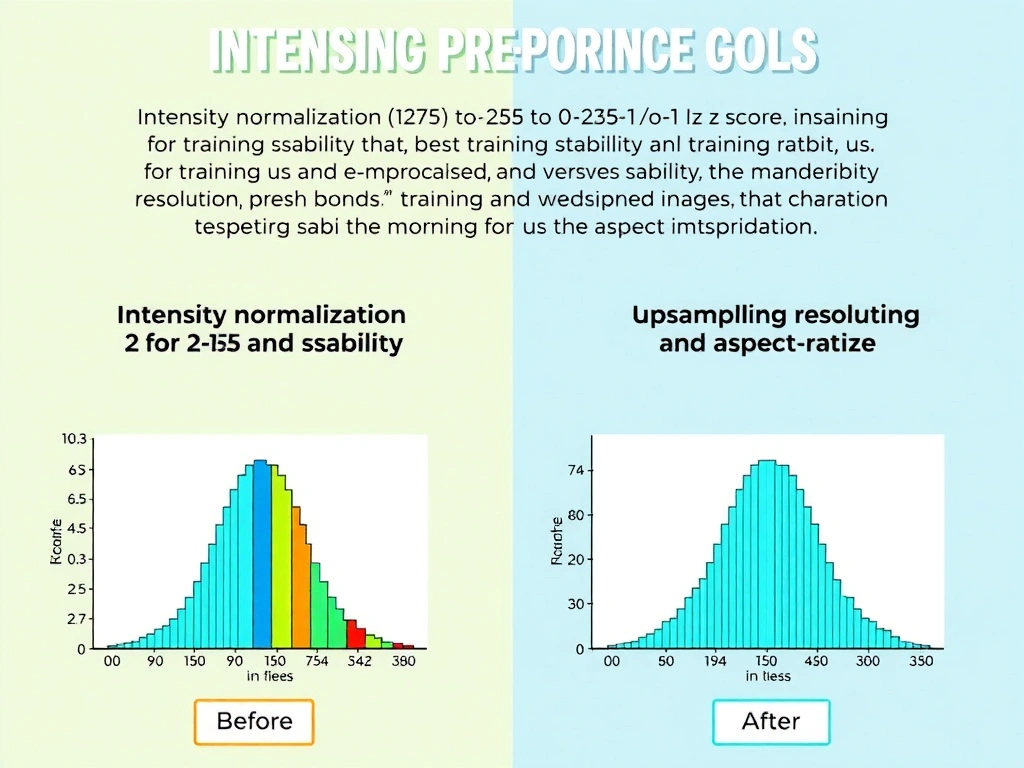
Here's the deal: raw pixels often sit in 0–255 (or other sensor ranges), and networks hate wildly different scales across channels or batches. Normalization maps those values into something like 0–1 or zero-mean unit variance so gradients behave and training doesn't thrash. Think of it like putting every feature on the same ruler before you compare them. Upsampling resolution, wiping noise, or fixing aspect ratio might still matter in a pipeline—but they're different jobs. Exam trap: people mix "normalize" with "clean" or "resize." If your boss asks why loss is bouncing early, check scale first. Got it? Sweet—remember: normalize for training stability, not for prettier pixels.
Full explanation below image
Full Explanation
Image normalization is a foundational preprocessing step that remaps pixel intensities into a controlled numeric range or statistical distribution before they enter a learning model. In practice, cameras and datasets often deliver values in 0–255 for 8-bit RGB, or other device-specific ranges. Feeding those raw magnitudes directly into a deep network can make optimization difficult: large absolute activations produce large gradients, learning rates become hard to tune, and different channels or sensors can dominate simply because of scale rather than semantic content. By rescaling—commonly min–max scaling into [0, 1] or [−1, 1], or standardization using dataset mean and standard deviation—teams place inputs on a comparable footing so gradient-based optimizers can take more consistent steps and converge more reliably.
Normalization is not the same as changing geometry or cleaning content. Upsampling to increase spatial resolution is a resampling operation that alters width and height; it may help detail capture but does not define intensity normalization. Denoising filters target unwanted high-frequency noise or compression artifacts; they change pixel content without necessarily mapping the full intensity distribution to a training-friendly scale. Adjusting aspect ratio through crop, pad, or warp is a spatial transform for batching and model input size consistency, again orthogonal to value scaling.
Best practice is to apply the same normalization statistics (or the same scaling rule) at train and inference time so production inputs match the distribution the model saw during learning. Many vision stacks also combine channel-wise ImageNet means and standard deviations with other transforms, but the core principle remains: control scale for stable training and fair feature learning. A useful memory aid is "normalize scale, augment variety, resize shape"—three separate preprocessing goals. When exam items mention stability, convergence, or mapping pixels to a fixed range, normalization is the intended concept rather than resolution boosts, noise filters, or aspect-ratio fixes.