
Why would a team run a zero-shot prompting experiment with a large language model?
Select an answer to reveal the explanation.
Short Explanation and Infographic
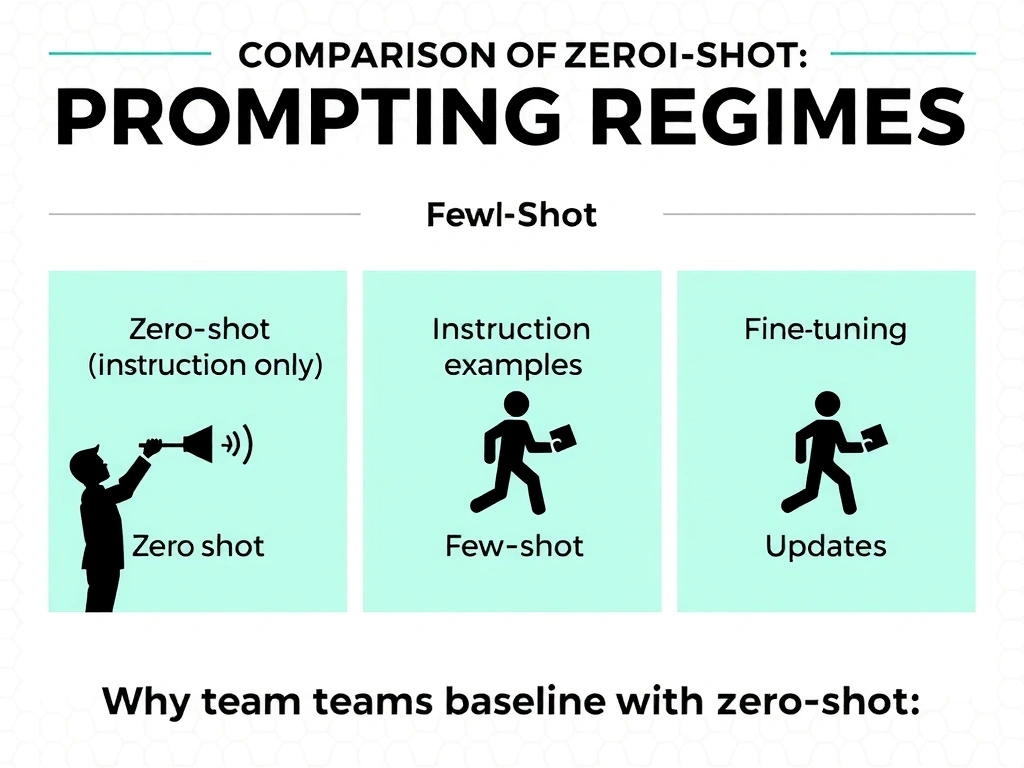
Check this out: zero-shot means you give the model the job description and nothing else—no sample answers, no demos. You're asking, "Can you do this cold?" That's super useful before you burn time crafting few-shot examples. Think of it like a pop quiz with instructions only. You're not retraining creativity, not sweeping learning rates, and not stuffing the prompt with dozens of labeled pairs—that's few-shot land. Exam trap: mixing zero-shot with "lots of examples" or with fine-tuning. If the boss wants a quick baseline on a brand-new task, start zero-shot, then compare. Land the takeaway: zero examples in the prompt, still expect a task-shaped answer.
Full explanation below image
Full Explanation
Zero-shot prompting evaluates a pretrained language model on a task by providing a natural-language instruction or question without including any complete input–output demonstrations in the prompt. The goal is to understand how much capability the model already has from pretraining and alignment: can it follow the instruction, map novel inputs to the desired format, and produce usable answers without in-context examples?
This experimental setup is valuable as a baseline. Teams often start with zero-shot prompts, measure quality, then add few-shot exemplars, retrieval, or tools if performance is insufficient. Zero-shot results also inform product decisions about whether a model can support a workflow "out of the box" versus requiring curated examples, fine-tuning, or specialized agents.
Common misconceptions reverse the definition. Zero-shot is not model training: you are not updating weights to increase creativity, nor are you running a hyperparameter search over optimizers, learning rates, or batch sizes. Those activities belong to training and experiment tracking. Likewise, evaluating a model with a large number of labeled demonstrations in the prompt is few-shot (or many-shot) prompting; that regime tests in-context learning from examples rather than pure instruction following.
In practice, strong zero-shot prompts still need clear task statements, output constraints, and success criteria, even without examples. Teams should separate sampling settings (temperature, max tokens) from the shot count concept. For exams and design reviews, remember the progression: zero-shot (instruction only) → few-shot (a handful of demos) → fine-tuning or RAG when prompting alone is not enough. The key reason to run a zero-shot experiment is therefore to assess task performance without explicit training for that task and without in-prompt examples. Document baselines carefully so later few-shot gains are measurable rather than anecdotal.