
In a standard machine learning project lifecycle, which phase focuses on gathering raw inputs, fixing quality issues, and shaping them into features ready for training?
Select an answer to reveal the explanation.
Short Explanation and Infographic
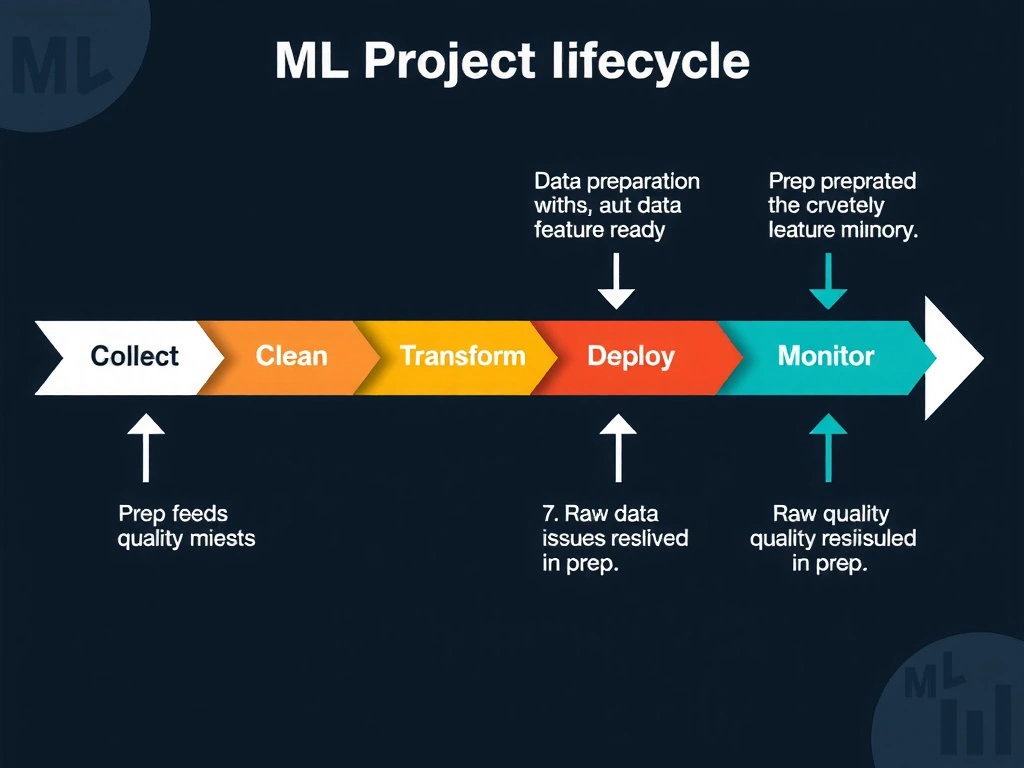
Let's keep the lifecycle straight. Before you train anything fancy, you collect the data, clean it, and shape features. That's data preparation—the unglamorous phase that saves you later. Boss wants a model by Monday? If prep is sloppy, Monday becomes "why is production on fire." Exam trap: evaluation, deployment, and hyperparameter tuning sound official, but they come after you already have training-ready data. Think of prep as mise en place in a kitchen—chop and measure before you cook. Land it: collect + clean + ready-for-training = data preparation. Got it? Sweet.
Full explanation below image
Full Explanation
Machine learning projects are commonly described as a sequence of stages: problem framing, data preparation, model training, evaluation, deployment, and monitoring. Data preparation encompasses collecting raw inputs, assessing quality, cleaning errors and missingness, joining sources, splitting datasets carefully to avoid leakage, and engineering or selecting features suitable for learning algorithms. This phase sets the ceiling for what later modeling can achieve; sophisticated architectures cannot compensate for systematically wrong labels or leaked targets. In many organizations this work also includes defining data contracts with upstream owners, documenting known limitations, and building reproducible transformation scripts so that training sets can be regenerated when sources change.
The correct answer is data preparation because the activities named—collecting, cleaning, and preparing raw data for training—define that stage. Adjacent work such as exploratory data analysis often sits alongside preparation, and feature stores or transformation pipelines may industrialize it in mature MLOps settings. Still, conceptually, those activities are not evaluation, deployment, or tuning. Teams that skip thorough preparation often discover train–serve skew, silent null floods, or label leakage only after expensive training runs fail to generalize.
Model evaluation estimates generalization using held-out or cross-validated metrics and error analysis; it assumes prepared train and test sets already exist. Model deployment packages and serves a chosen model behind APIs, batch jobs, or edge runtimes, with concerns such as latency, rollback, and access control. Hyperparameter optimization searches configuration spaces during or after training setup; it is part of modeling methodology, not the primary home of collection and cleaning. A practical checklist for the preparation phase includes schema validation, outlier review, stratified or time-aware splits, feature documentation, and a freeze of training artifacts before modeling experiments begin. Memory aid: preparation builds the ingredients; training cooks; evaluation tastes; deployment serves. Exam stems that list gather/clean/prepare map to data preparation every time.