
During the data collection and cleaning stage of a real-world AI project, what problem do teams most commonly face?
Select an answer to reveal the explanation.
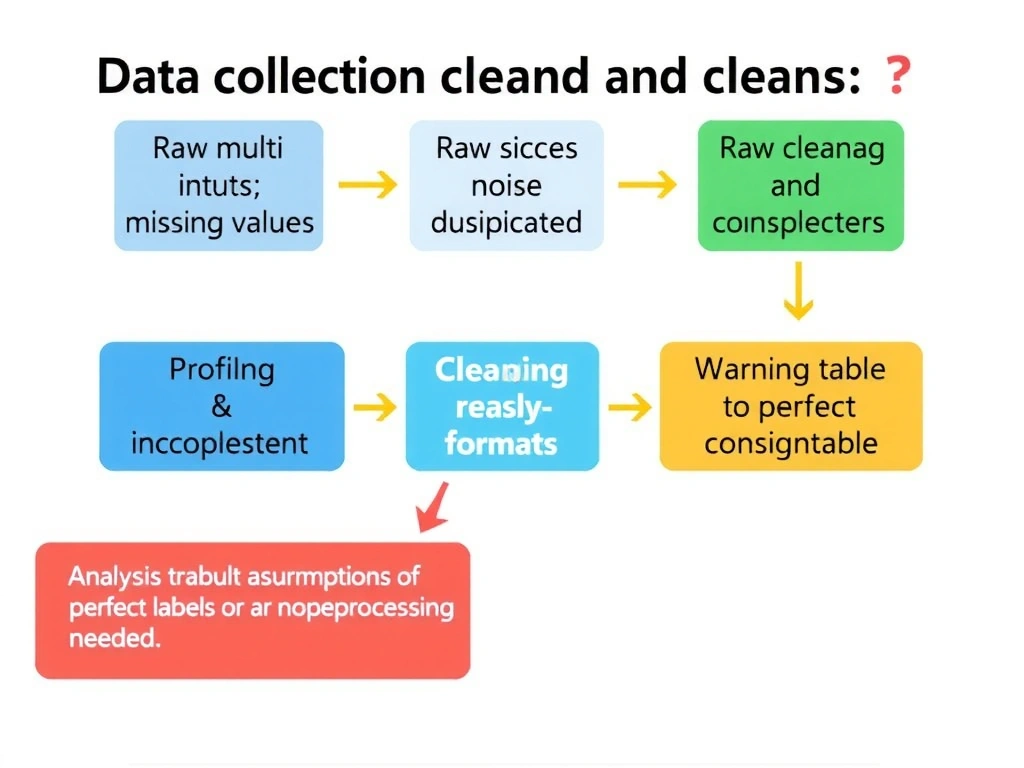
Short Explanation and Infographic
I remember when a project looked "ready" until we opened the CSV—duplicate IDs, half-blank fields, timestamps in three formats, labels that disagreed with the photos. Here's the deal: collection and cleaning is where AI projects live or die. Real data is messy, noisy, incomplete, and inconsistent. Your job is to profile it, fix what you can, and document the rest. Exam trap: options that claim data is always perfect, always structured, or that models magically clean themselves. Don't take the bait. Land it: dirty data is normal—plan for cleaning. You've done the right thing learning this early; it stacks the odds in your favor on the job and the exam.
Full explanation below image
Full Explanation
In applied machine learning, the collection and cleaning phase acquires raw observations from databases, logs, sensors, vendors, or human annotation pipelines and transforms them into trustworthy training and evaluation sets. Real sources introduce missing values, outliers, duplicated entities, schema drift, conflicting labels, biased sampling, and inconsistent units or encodings. Teams spend substantial effort profiling distributions, validating referential integrity, reconciling identifiers, normalizing formats, and defining rules for drop, impute, or repair decisions. Poor cleaning propagates into biased models, fragile metrics, and costly rework after deployment.
The correct statement is that data is often messy, noisy, incomplete, and inconsistent. That reality drives practices such as data contracts, automated quality checks, labeling guidelines, inter-annotator agreement measurement, and lineage tracking. Cleaning is iterative: issues discovered during modeling send teams back to the source. Documentation of known limitations is part of responsible delivery, especially when data gaps correlate with protected groups or safety-critical edge cases.
Distractors paint an idealized world that exams use as traps. Perfect labels without review almost never exist at scale; labeling is expensive and error-prone. Fully structured, complete relational fields are not guaranteed when free text, images, or multi-system exports are involved. Models may tolerate some noise, yet they do not eliminate the need for preprocessing, leakage checks, and quality gates. Memory aid: “garbage in, garbage out” is not a cliché in ML—it is a project plan. When asked for a main challenge of collection and cleaning, choose messiness and inconsistency over any claim that data arrives pristine or self-healing. In practice, document the decision criteria you used so teammates can reproduce the evaluation. Prefer metrics and checks that match the business risk, not vanity scores. When reviewing distractors on an exam item, name the misconception each option encodes: wrong learning paradigm, wrong evaluation stage, or a metric that optimizes the wrong objective. A reliable memory aid is to restate the concept in one sentence, then ask which option alone matches that definition without adding unrelated goals. Finally, connect the idea to a production workflow step—data prep, training, validation, or monitoring—so the correct answer stays grounded in how systems are actually built and governed.