
What is the key distinction between object detection and image classification in computer vision?
Select an answer to reveal the explanation.
Short Explanation and Infographic
Here's the simple split you've got to nail. Image classification looks at the whole photo and says, "cat" or "not cat." Object detection says, "there's a cat here, a dog there," with locations—usually boxes—and it can handle multiple objects. Think of classification as naming the album cover and detection as sticky-noting every band member in the group shot. Exam trap: "detection is only for cars," or mixing in segmentation masks, or inventing algorithm-only differences like k-means. Land it: classification = one (global) label; detection = locate + label instances. Stick with me—this comparison is pure free points if you keep the definitions clean.
Full explanation below image
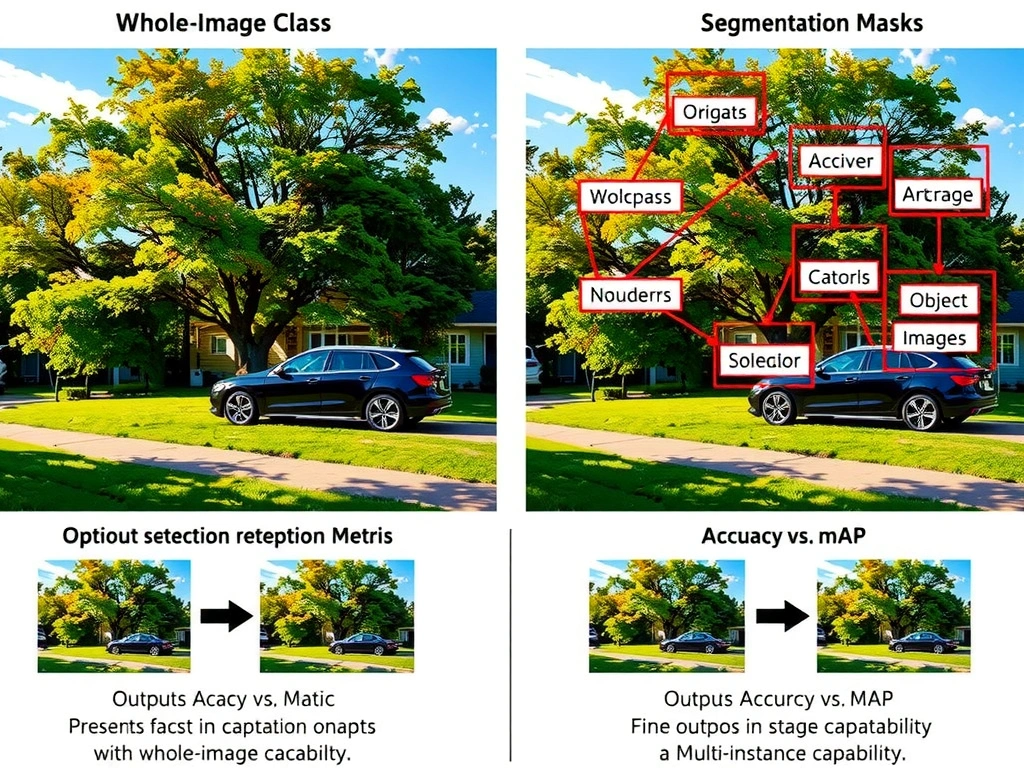
Full Explanation
Image classification maps an entire image to one or more category labels without specifying where evidence appears. Object detection jointly predicts object categories and spatial locations, most often as bounding boxes with confidence scores, and supports multiple instances of multiple classes in a single frame. That localization requirement makes detection harder and denser in output structure: models must handle varying object scales, occlusions, and non-maximum suppression among overlapping proposals or predictions. Metrics differ accordingly—top-1 or top-5 accuracy and cross-entropy for many classification settings versus mean average precision over IoU thresholds for detection.
The correct distinction is therefore functional: detection identifies and locates objects; classification labels the image holistically. Instance and panoptic segmentation go further by producing pixel-precise masks per instance or per stuff/thing category, which is a third family of tasks often confused with detection on exams. Application domains for detection include retail shelf analytics, manufacturing defect localization, sports player tracking, medical lesion finding, and, yes, autonomous driving—but the technique is not limited to vehicles.
Distractors fail by over-restricting domain, conflating segmentation with classification, or inventing false algorithm pairings. Detection is not exclusive to self-driving systems. Classification does not require pixel masks; that is segmentation. Detectors absolutely emit class labels together with boxes. Neither task is defined as “linear regression versus k-means”; modern systems for both are commonly deep convolutional or transformer models trained with supervised losses appropriate to their outputs. Memory aid: classification = whole-image tag; detection = boxes + tags; segmentation = pixel maps. When a question asks for the main difference between detection and classification, choose localize-multiple-objects versus single global label.