
What is the main goal of chain-of-thought prompting when interacting with a large language model?
Select an answer to reveal the explanation.
Short Explanation and Infographic
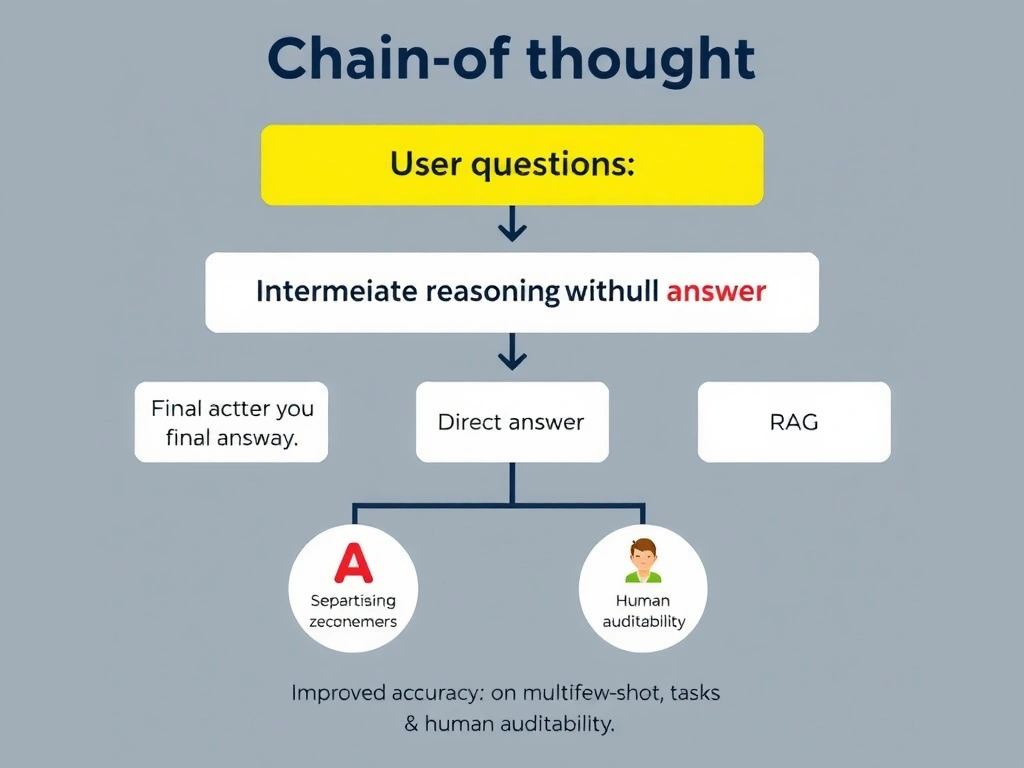
Okay, let's dive in. Hard questions—math, logic, multi-hop facts—trip models when they leap straight to an answer. Chain-of-thought prompting says, "Show your work." You nudge the model to write intermediate steps, and accuracy often climbs because the reasoning path is laid out in the open. Think of it like a student on a whiteboard: partial credit and fewer silent arithmetic goofs. Exam trap: people pick "make it shorter," "one token only," or "force citations." CoT is about reasoning steps, not brevity or retrieval. Land it: chain-of-thought = visible intermediate reasoning for better multi-step answers. Trust me on this—practice writing CoT prompts yourself.
Full explanation below image
Full Explanation
Chain-of-thought (CoT) prompting steers a language model to produce intermediate reasoning before a final answer. By decomposing a problem into smaller steps—sub-calculations, assumptions, comparisons—the model allocates more of its generation path to structured problem solving. This often improves accuracy on tasks that require multi-step arithmetic, symbolic manipulation, planning, or multi-hop inference, and it gives human reviewers a trace they can audit for mistakes. CoT can be elicited with phrases such as “think step by step,” with few-shot exemplars that include worked reasoning, or with structured formats that separate rationale from the final answer line. Teams adopt CoT when error costs are high and when intermediate checks can catch mistakes before users see a final decision.
The correct option states the primary purpose: guide the model to demonstrate intermediate reasoning so answers are more accurate and inspectable. CoT is not a free lunch: longer outputs cost latency and tokens; models may still hallucinate plausible-looking steps; and for simple fact lookups CoT can be unnecessary overhead. Production systems sometimes use “hidden” or summarized rationales, self-consistency over multiple samples, or tool-augmented steps to harden reasoning. Evaluation should measure both final-answer correctness and, when relevant, faithfulness of the stated steps. Prompt designers also watch for verbosity that confuses users and for leakage of internal scratch work that should remain private.
Distractors reverse or mislabel the technique. Demanding a single token with no working is anti-CoT and aligns more with extreme brevity constraints. Guaranteeing peer-reviewed citations is a retrieval, tool-use, or policy problem, not what CoT defines. Swapping the tokenizer for a rule engine is an architectural change outside prompting. Related techniques such as tree-of-thoughts or plan-and-solve extend the same philosophy of explicit intermediate structure. Memory aid: chain-of-thought = show the links in the chain before the final claim. On exams, when the stem emphasizes intermediate reasoning and reliability on multi-step problems, select CoT rather than format-only, length-only, or retrieval-only options.