
A city operations group needs a vision system that both finds vehicles in roadside camera frames and estimates how many vehicles appear in each frame. Which computer vision task best matches that requirement?
Select an answer to reveal the explanation.
Short Explanation and Infographic
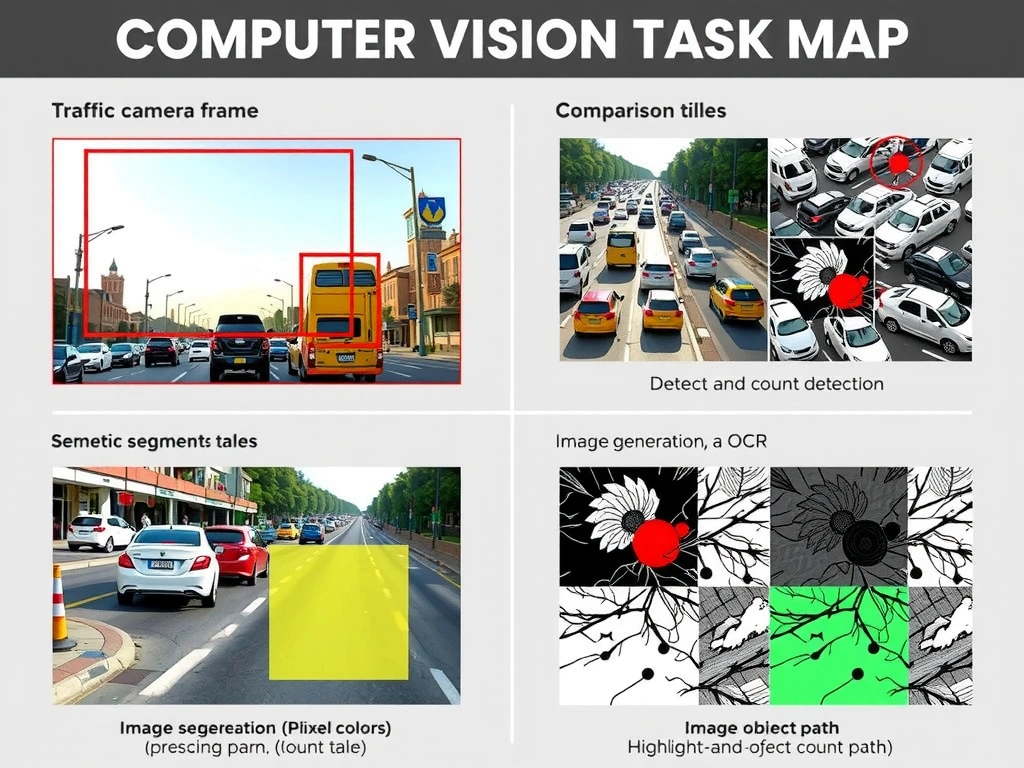
Imagine your boss walks in with a stack of traffic-cam stills: "Tell me where the cars are and how many." That's classic object detection territory—find each instance, usually with a box and a class, then count the boxes. Pretty cool workflow for smart cities and ops dashboards. Exam trap: classification only tags the whole photo ("busy street"), generation invents fake scenes, OCR reads text. None of those give you per-vehicle locations for counting. Think of detection like putting sticky notes on every car in the picture, then adding them up. Land it: find + count instances = object detection. Got it? Sweet.
Full explanation below image
Full Explanation
Object detection predicts both what objects are present and where they are in an image, typically as class labels plus bounding boxes, oriented boxes, or similar regions. Once instances are localized, counting becomes a natural aggregation: sum detections of the target class above a confidence threshold, optionally after non-maximum suppression and tracking across frames for video. Traffic monitoring, inventory on shelves, and wildlife camera surveys all use this pattern. Architectures range from two-stage detectors to single-stage and transformer-based detectors; evaluation often uses mean average precision together with operational metrics such as count error.
The correct choice is object detection because the business need is to detect a specific class (vehicles) and support counting those instances in camera images. Pure image classification assigns one or more labels to the entire image without instance locations, so it cannot reliably answer “how many cars and where.” Semantic segmentation labels pixels by class but does not by itself separate instances unless extended to instance or panoptic segmentation; even then, the exam-style match for detect-and-count is still detection. Image generation synthesizes pixels and does not analyze real frames. OCR targets text glyphs, which is orthogonal unless the goal is plate reading rather than vehicle presence.
Strong distractors exploit confusion among vision tasks. Generation may be used for data augmentation of rare scenes but does not fulfill the operational detect-and-count requirement. Whole-image classification is simpler and cheaper but insufficient for localization-based counting. OCR is a specialized recognition task for characters. Best-practice notes for production counting include camera calibration expectations, occlusion handling, confidence calibration, and human review loops for safety-critical traffic decisions. Memory aid: classification = whole-image tag; detection = boxes + classes; segmentation = pixel maps; generation = create pixels. For “find and count objects,” pick detection.