
An application lets users upload a photo and returns other photos from a catalog that look visually alike. Which computer vision capability does this product primarily use?
Select an answer to reveal the explanation.
Short Explanation and Infographic
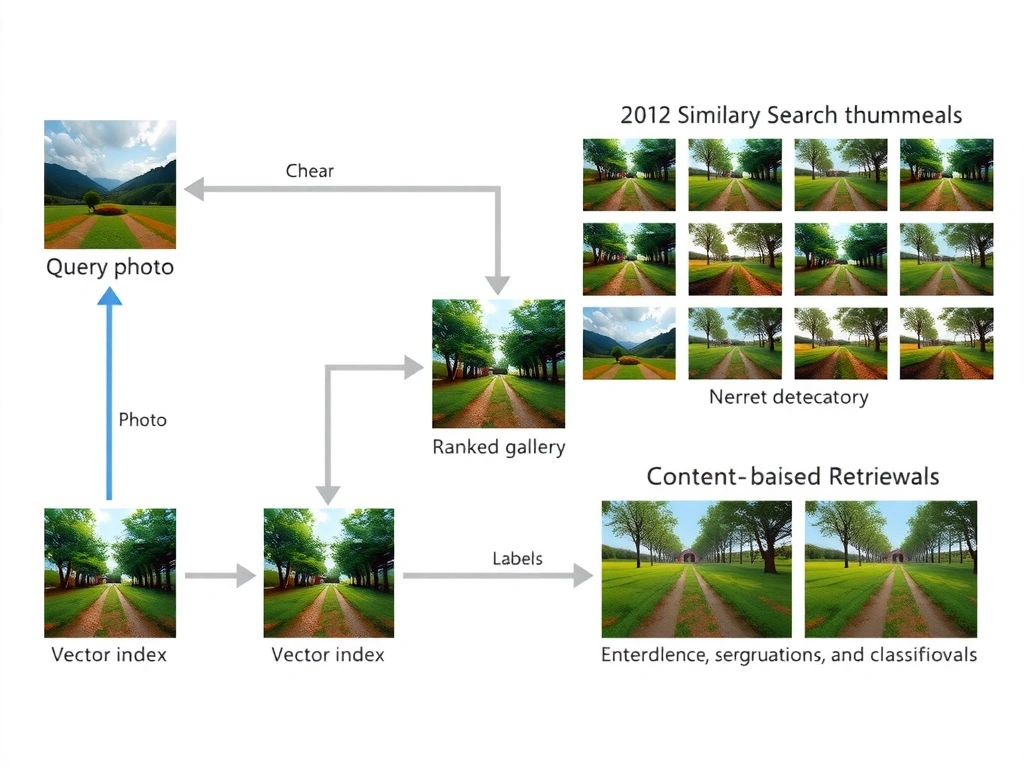
Here's where it gets interesting for you. User drops in a sneaker photo; the app should surface other sneaker photos that look close—color, shape, vibe. That's image similarity search: embed the query, embed the catalog, rank nearest neighbors. Think of it like a reverse image lookup, not a "what class is this?" quiz. Exam trap: detection, segmentation, and classification all operate on a single image’s structure or label, but they don't define gallery retrieval. Land it: upload → find lookalikes = similarity search / content-based image retrieval. Got it? Sweet—try sketching the embed-and-search pipeline once on paper.
Full explanation below image
Full Explanation
Image similarity search, also known as content-based image retrieval, ranks items in a gallery by visual likeness to a query image. Systems typically extract a fixed embedding from a convolutional or vision-transformer encoder, store vectors in an approximate nearest-neighbor index, and return the closest catalog entries under cosine or Euclidean distance. Optional stages include re-ranking, filtering by metadata, and multi-modal fusion when text queries are also supported. Success depends on representation quality, index recall, and evaluation with retrieval metrics such as precision@k and recall@k.
The product description—upload an image, retrieve similar images—matches this task directly. Object detection identifies and localizes instances within one image and may feed crops into a retrieval model, but detection alone does not return a ranked gallery of similar photos. Semantic segmentation labels each pixel with a class and is used for scene understanding, medical delineation, or autonomous driving perception, not neighbor search. Image classification maps an image to one or more category labels; that label might later filter a catalog, yet the core user experience of “show me images that look like this” is similarity search.
Exam questions often pile related vision tasks into distractors to test whether candidates separate per-image understanding from cross-image retrieval. Best practices for production similarity systems include curated hard negatives, domain-specific fine-tuning of the encoder, monitoring for near-duplicate spam, and privacy review of reverse-search capabilities. Memory aid: classification names it, detection boxes it, segmentation paints it, similarity search finds its cousins in the library. When the stem emphasizes finding similar images from a collection, choose image similarity search.